Unlocking the Power of LLMs
Introduction to Large Language Models
What Are Large Language Models?
At its core, a Large Language Model (LLM) is a type of artificial intelligence that's been trained on a massive amount of text data. Think of it as a system that has read a significant portion of the internet, including books, articles, and websites. This extensive training allows it to understand, generate, and interact with human language in a surprisingly sophisticated way.
A Large Language Model (LLM) is a type of artificial intelligence program designed to understand, generate, and work with human language.
Their significance in AI is huge. Before LLMs, getting a computer to understand the nuances of language—like sarcasm, context, and creative expression—was incredibly difficult. LLMs represent a major leap forward, making it possible to build applications that can write emails, translate languages, answer complex questions, and even generate computer code, all from simple text prompts.
A Brief History
The journey to today's LLMs began decades ago with simpler models. Early attempts at language modeling used statistical methods, like n-grams, which predicted the next word in a sequence based on the previous few words. While functional for basic tasks, they lacked a deeper understanding of grammar and context.
The real game-changer was the rise of neural networks and, specifically, the invention of the Transformer architecture in 2017. This new design allowed models to weigh the importance of different words in a sentence, no matter how far apart they were. This ability to handle long-range dependencies was the key that unlocked the potential for much larger, more powerful language models.
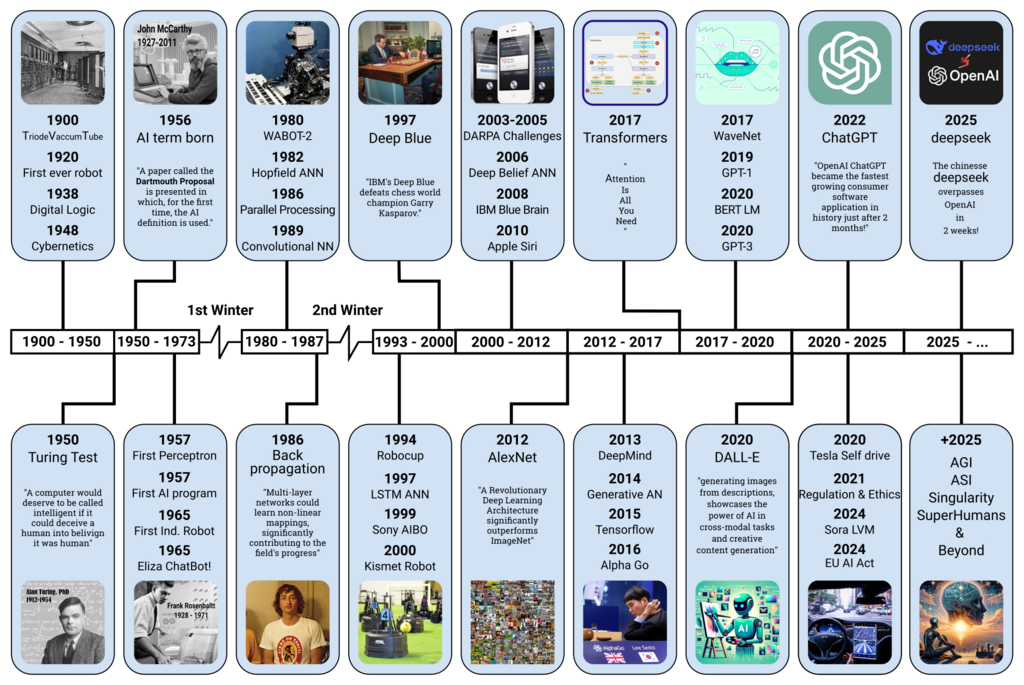
Researchers began scaling these Transformer models up, feeding them more data and increasing their size. This scaling led to an explosion in capability, resulting in the powerful LLMs we see today, like those that power chatbots and other generative AI tools.
The Core Concepts
So, how does an LLM actually work on a basic level? The fundamental task of most LLMs is to predict the next word in a sentence. It might sound simple, but it's a powerful concept.
When you give an LLM a prompt, like "The sun is shining and the birds are...", it doesn't know the answer. Instead, it calculates the probability of every word in its vocabulary being the next one. Words like "singing" or "chirping" would have a very high probability, while words like "swimming" or "driving" would have a very low one.
To do this, the model first breaks the input text into smaller pieces.
token
noun
A common sequence of characters found in text. A token can be a whole word, like "apple", or a part of a word, like "ing".
By analyzing the sequence of tokens, the LLM uses its training to find patterns and relationships. It learns that the token "birds" is often followed by tokens related to sound, like "singing". This pattern-matching ability, scaled across billions of parameters and trillions of tokens of training data, is what gives LLMs their remarkable ability to generate coherent, context-aware text.
The core function of an LLM is probabilistic. It's constantly calculating the most likely next token to generate text that seems human-like.
That's a quick look at what LLMs are and the basic ideas behind them. Let's test your understanding of these core concepts.
What is the fundamental task that most Large Language Models are trained to perform?
What key architectural innovation, introduced in 2017, was crucial for the development of today's powerful LLMs by allowing models to handle long-range dependencies in text?
Now that you've got the basics down, we're ready to dive deeper into the architecture that makes these models possible.