Unlocking Square Roots: A Conceptual Guide
Understanding Square Roots
From Area to Side Length
If you have a square with a side length of 5 units, finding its area is straightforward. You just multiply the side by itself: . The area is 25 square units. This operation is called squaring a number.
But what if you work backward? Suppose you know the area of a square is 25, and you need to find the length of its side. You're looking for a number that, when multiplied by itself, equals 25. That number is 5. This reverse operation is called finding the square root.
Visually, the square root can be obtained by finding the length of a side of a square with a given area.
The Radical Symbol
We use a special symbol for the square root called the radical sign. It looks like this: When you see this symbol, it's asking you to find the number that multiplies by itself to produce the value inside.
You can think of squaring and taking the square root as inverse operations, much like addition and subtraction. One undoes the other.
| Operation | Example | Inverse Operation | Example |
|---|---|---|---|
| Squaring | Square Root | ||
| Squaring | Square Root | ||
| Squaring | Square Root |
One Small Rule
There's a slight wrinkle. If we square -5, we also get 25, because . So, does equal 5 or -5? Both numbers work.
To avoid confusion, mathematicians decided that the radical symbol will always refer to the positive square root. This is called the principal square root. If you ever need to refer to the negative root, you would write it as .
When you see , it always means the positive number that, when squared, equals .
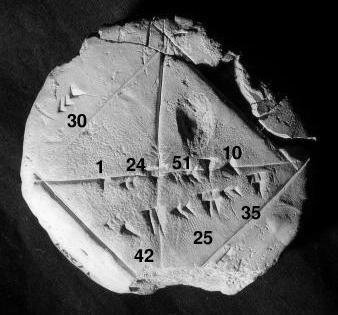
The concept of a square root is a fundamental building block in math, connecting simple geometry to more complex ideas you'll see later.