Unlocking RNA Interference
Introduction to RNA Interference
The Cell's Volume Control
Think of your DNA as a massive library of cookbooks. Each book, or gene, contains a recipe to build a specific protein. To make a protein, the cell doesn't take the original cookbook to the kitchen. Instead, it makes a temporary copy of the recipe, called messenger RNA (mRNA). This mRNA copy travels out of the nucleus to the cell's protein-making machinery.
But what if the cell needs to make less of a certain protein? Or stop making it altogether? It needs a way to control the volume. One of the most elegant ways it does this is through a process called RNA interference, or RNAi.
RNAi is a natural process that cells use to silence genes. It doesn't change the DNA itself, but instead intercepts and neutralizes the mRNA copy, preventing the protein from ever being made.
This powerful mechanism was first clearly understood in 1998 by scientists Andrew Fire and Craig Mello, who were studying the worm C. elegans. They discovered that introducing a specific type of double-stranded RNA into the worm could effectively shut down the corresponding gene. It was a groundbreaking discovery that opened a new window into how genes are regulated, earning them the Nobel Prize in 2006.
A Cellular Swiss Army Knife
RNAi isn't just a biological curiosity; it's a fundamental tool used by our cells for a variety of critical jobs. Its primary role is in gene regulation. Cells need to produce different proteins at different times to grow, develop, and respond to their environment. RNAi provides a precise way to fine-tune the output of genes, ensuring the right amount of protein is produced at the right time.
It also serves as a crucial part of the cell's immune system. Many viruses use RNA as their genetic material. When a virus injects its RNA into a cell, RNAi can recognize this foreign material and chop it up before it can be used to create more viruses. It's an ancient and effective defense against viral invaders. RNAi also helps to suppress transposons, sometimes called “jumping genes,” which are rogue DNA sequences that can move around the genome and cause mutations.
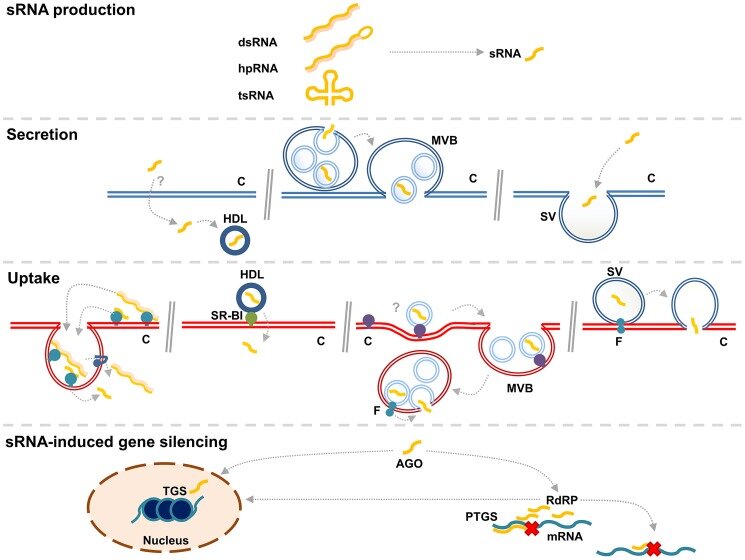
The Two Key Players
The work of RNAi is carried out by tiny pieces of RNA. While there are many types, the two main players are small interfering RNAs (siRNAs) and microRNAs (miRNAs). They have similar jobs, but different origins and slightly different ways of working.
Small interfering RNAs (siRNAs) typically come from outside the cell, like from a virus, or are introduced by scientists in a lab. They are a perfect match for their target mRNA. When an siRNA finds its matching mRNA sequence, it triggers a process that slices the mRNA in two, effectively destroying the message.
MicroRNAs (miRNAs) are encoded in our own DNA. They are part of the cell's built-in gene regulation toolkit. An miRNA is usually an imperfect match to its target mRNA. Instead of slicing the mRNA, it typically just latches on and blocks the protein-making machinery from reading the recipe. It's less like destroying the message and more like putting a giant clamp on it.
| Feature | siRNA (small interfering) | miRNA (microRNA) |
|---|---|---|
| Origin | External (e.g., viruses) or lab-made | Encoded in the cell's own DNA |
| Target Match | Perfect, 100% complementary | Imperfect, partial match |
| Action | Slices and degrades mRNA | Blocks translation of mRNA |
Understanding these two types of small RNAs is key to seeing how RNAi works as both a defense mechanism and a precise regulator of the cell's inner life. This natural process of gene silencing has not only revolutionized our understanding of biology but also opened the door to new therapies for a wide range of diseases.