Unlocking Pascal's Triangle
Introduction to Pascal's Triangle
A Triangle of Numbers
Some of the most beautiful ideas in math start with simple patterns. Let's explore one by building a triangle of numbers. It starts with a single '1' at the very top. Every number below it is found by adding the two numbers directly above it.
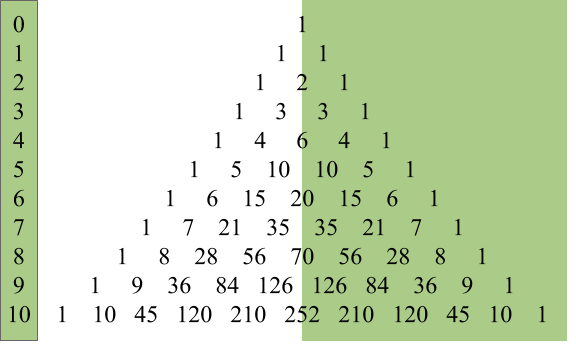
Let's build it step by step. The top is called Row 0, and it just has a '1'.
To get the next row (Row 1), we imagine zeros on either side of the '1' in Row 0. Adding the numbers above gives us a '1' on the left (0 + 1) and a '1' on the right (1 + 0). So, Row 1 is: 1 1.
For Row 2, we do the same thing. The outer numbers will always be '1'. The middle number is the sum of the two numbers from Row 1: 1 + 1 = 2. So, Row 2 is: 1 2 1.
For Row 3, the middle numbers are 1 + 2 = 3 and 2 + 1 = 3. This gives us: 1 3 3 1.
This simple process of addition creates an endlessly fascinating pattern known as Pascal's Triangle.
An Old Idea
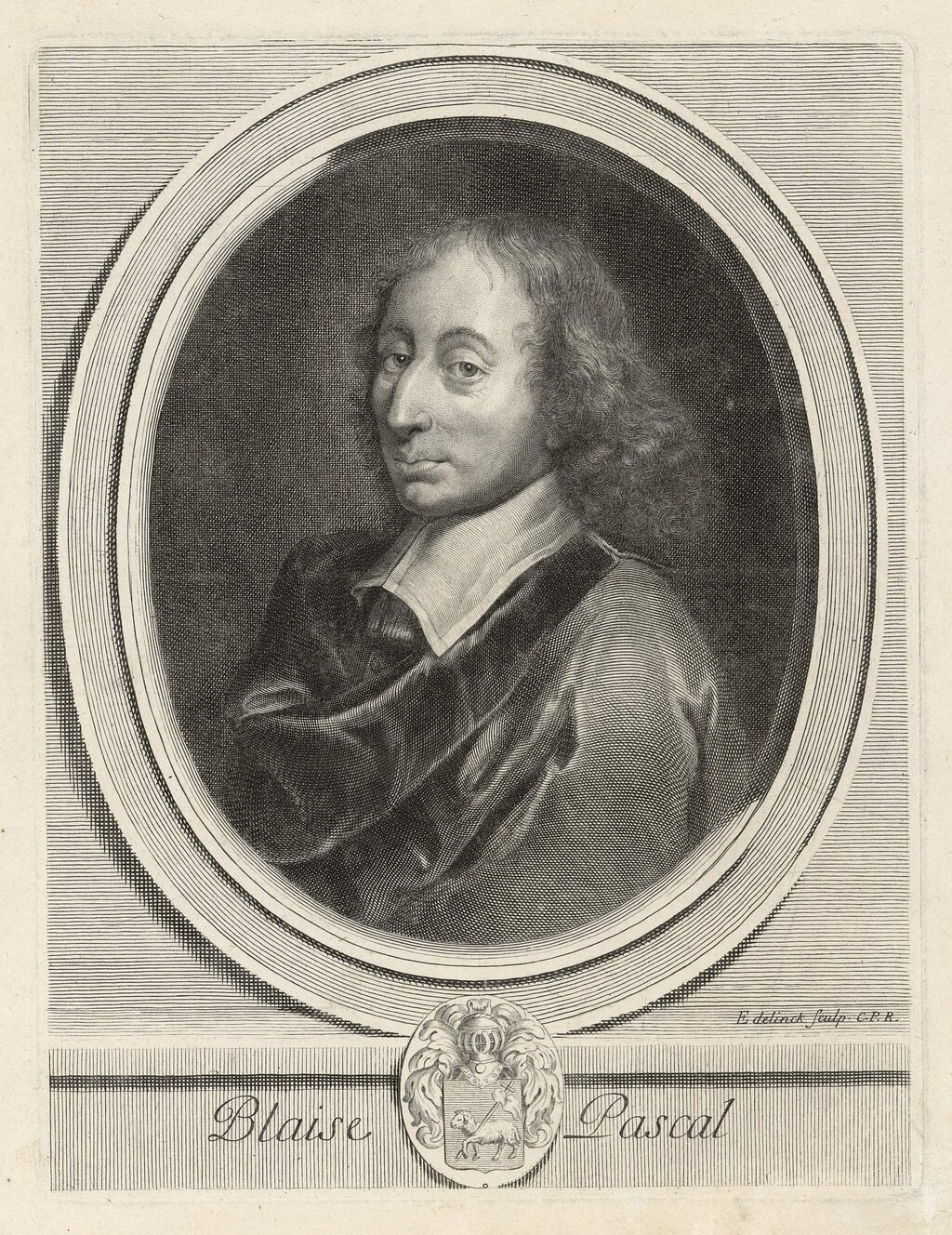
While the triangle is named after the 17th-century French mathematician Blaise Pascal, he wasn't the first to discover it. Pascal did extensive work on the triangle's properties and applications, but the pattern itself is much older.
Mathematicians in other parts of the world had studied this triangle centuries earlier. In China, it was known as Yang Hui's Triangle, appearing in a book from 1261. Even earlier, around the 11th century, it was being studied by mathematicians in Persia and India. Pascal's contribution was to organize and popularize many of its properties, linking it to probability theory.
Hidden Patterns
At first glance, the triangle is just a neat arrangement of sums. But look closer, and you'll find it's full of interesting properties.
First, notice the symmetry. The numbers on the left side of the triangle are a mirror image of the numbers on the right side. This makes sense, because the addition rule we use to build it is symmetrical.
More profoundly, the numbers in Pascal's Triangle represent something called binomial coefficients. That sounds complex, but the idea is straightforward. It's about counting the number of ways you can choose items from a group. This is often written as and read as "n choose k," where is the row number and is the position in that row (starting from 0).
For example, let's look at Row 4: 1 4 6 4 1.
Imagine you have 4 friends, and you want to choose some of them to go to the movies. How many ways can you choose them?
- Ways to choose 0 friends: 1 (you go alone)
- Ways to choose 1 friend: 4
- Ways to choose 2 friends: 6
- Ways to choose 3 friends: 4
- Ways to choose 4 friends: 1 (you take everyone)
The numbers match Row 4 exactly. Each number in the triangle tells you the number of ways you can combine things, a fundamental concept in a field of math called combinatorics.
Ready to check your understanding?
How is each number in Pascal's Triangle (below the top '1') determined?
What are the numbers in Row 4 of Pascal's Triangle, given that Row 0 is '1'?
This simple triangle, built from a single rule of addition, holds a universe of mathematical patterns. Its story, spanning centuries and cultures, shows how a simple idea can lead to deep and powerful insights.