Unlock Your Motivation and Abundance Mindset
Understanding Self-Motivation
The Engine Within
Self-motivation is the force that drives you to do things. It's not about waiting for a burst of inspiration or for someone else to tell you what to do. It's the ability to push yourself forward, to take action and see tasks through, simply because you've decided they're important.
Think of it as your internal engine. When it's running smoothly, you can navigate challenges, pursue goals, and learn new skills. A strong sense of self-motivation is a key ingredient for success in nearly every part of life, from hitting a deadline at work to learning a new language in your spare time. It's what turns a good idea into a finished project.
Two Flavors of Fuel
Motivation generally comes in two types: intrinsic and extrinsic. Understanding the difference is crucial because they affect our drive in very different ways.
Intrinsic motivation comes from within. You do something because it’s personally rewarding. The activity itself is the prize. Think of hobbies like painting, playing guitar, or solving puzzles just for the fun of it.
Extrinsic motivation comes from the outside. You do something to earn a reward or avoid a punishment. This could be studying to get a good grade, working extra hours for a bonus, or cleaning your apartment to avoid a complaint from your roommate.
Both types have their place, but relying solely on external rewards can sometimes undermine your natural interest in an activity. The most powerful and lasting motivation often comes from within.
Intrinsic motivation is a powerful driver of learning, as it makes the process more enjoyable and sustainable.
| Feature | Intrinsic Motivation | Extrinsic Motivation |
|---|---|---|
| Source | Internal satisfaction | External rewards/punishments |
| Example | Reading a book for enjoyment | Reading a book for a class grade |
| Sustainability | High (long-lasting) | Lower (can fade with reward) |
| Focus | The process and experience | The outcome or reward |
The Psychology of Drive
Why do we feel motivated in the first place? Psychologists Edward Deci and Richard Ryan developed a powerful idea called Self-Determination Theory. It suggests that we are all born with three basic psychological needs. When these needs are met, our intrinsic motivation thrives.
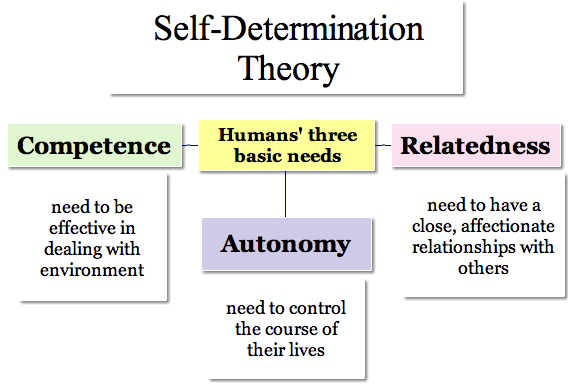
The three needs are:
- Autonomy: The need to feel in control of your own behaviors and goals. We like having a choice in what we do and how we do it.
- Competence: The need to feel capable and effective. We enjoy challenges that we can master and that allow us to grow our skills.
- Relatedness: The need to feel connected to others and belong to a group. We seek to interact and care for others.
When an activity supports these three needs, we're more likely to feel naturally engaged and self-motivated.
Common Motivation Killers
Sometimes, our internal engine stalls. This is completely normal. Recognizing what’s holding you back is the first step toward getting moving again. Here are a few common barriers.
Amotivation
noun
A state of lacking any motivation to engage in an activity, characterized by feelings of incompetence and a lack of control.
One major barrier is a lack of clarity. If you don't know what you're supposed to do or why it matters, it’s hard to get started. Vague goals like "get in shape" are much less motivating than specific ones like "walk for 30 minutes every Tuesday and Thursday."
Feeling overwhelmed is another classic motivation killer. When a task seems enormous, it's easy to feel paralyzed. The sheer size of the goal can make it seem impossible, so we don't even try.
Finally, the fear of failure can stop us in our tracks. We worry about not being good enough or making mistakes, so we procrastinate to avoid the possibility of failing. This is often tied to perfectionism, where we wait for the perfect moment or plan instead of simply beginning.
The key is not to avoid these feelings, but to have simple strategies to push past them. Breaking down a large goal into tiny, manageable steps is a great way to combat feeling overwhelmed. Connecting your task to a deeper personal value can provide the clarity and "why" you need. And as for the fear of failure, sometimes the best solution is to just start, giving yourself permission to be imperfect.
Let's review what we've covered about the fundamentals of motivation.
What is the core idea behind self-motivation?
A student studies hard to get a good grade on a test. This is primarily an example of: