Unleash Your Inner Artist
Observation Skills
Seeing Is Not Observing
We spend our lives seeing things. We see the street on our way to work, the food on our plate, the faces of our friends. But seeing is mostly passive. It’s an automatic process designed to help us navigate the world without bumping into things. It’s about recognition, not understanding.
Observing is different. It’s an active process. It’s the difference between hearing a song in the background and actively listening for the bassline, the harmony, and the rhythm. When you observe, you're not just identifying an object; you're exploring it. Drawing doesn’t start in your hand. It starts in your eyes.
Observational drawing is a fundamental practice that bridges the gap between the real world and your creative expression.
Let’s try a quick exercise. Stop reading for a moment and look around the room you're in. Find one object you see every day, like a lamp, a chair, or a coffee mug. Now, really look at it for a full minute. Your brain will want to just label it—“that’s a lamp”—and move on. Your job is to ignore that impulse.
Instead, ask questions. What exact shape is the base? Is the lampshade a perfect cylinder, or does it flare out? Where does the light catch its surface? Where are the darkest shadows? Notice the tiny imperfections: a small scratch on the wood, a bit of dust on the bulb. You’ve seen that lamp a thousand times, but you may have never truly observed it until now. This is the first step.
Describe What You See
Now that you're looking more closely, the next step is to put words to what you see. Describing visual elements helps solidify your observations. The most complex objects can be broken down into simpler components. Almost everything can be described using a few basic elements.
| Element | What to Look For |
|---|---|
| Lines | Are they straight, curved, jagged, or smooth? Thick or thin? |
| Shapes | Look for basic geometric shapes. Is that tabletop a rectangle? Is the plate a circle? |
| Space | How do objects relate to each other? Notice the negative space—the empty areas around and between objects. |
| Texture | Is a surface smooth, rough, bumpy, or soft? How does light interact with it? |
| Light & Shadow | Identify the light source. Find the brightest spot (the highlight) and the darkest spot (the core shadow). Notice the shadow the object casts on other surfaces. |
Practice this by 'narrating' what you see. Sit in a park and describe a tree as if you were explaining it to someone over the phone. You might say, 'The trunk is a thick, rough cylinder that splits into two main branches. The bark has deep, vertical grooves, and there's a patch of bright green moss growing on the side facing away from the sun.' This act of translation from sight to language forces you to pay attention to details you would otherwise miss.
Find the Patterns
Our world is full of patterns, both natural and man-made. Training your eye to spot them is a powerful observation tool because it helps you understand the underlying structure of what you're seeing. Repetition creates rhythm, and identifying it makes drawing complex subjects much less intimidating.
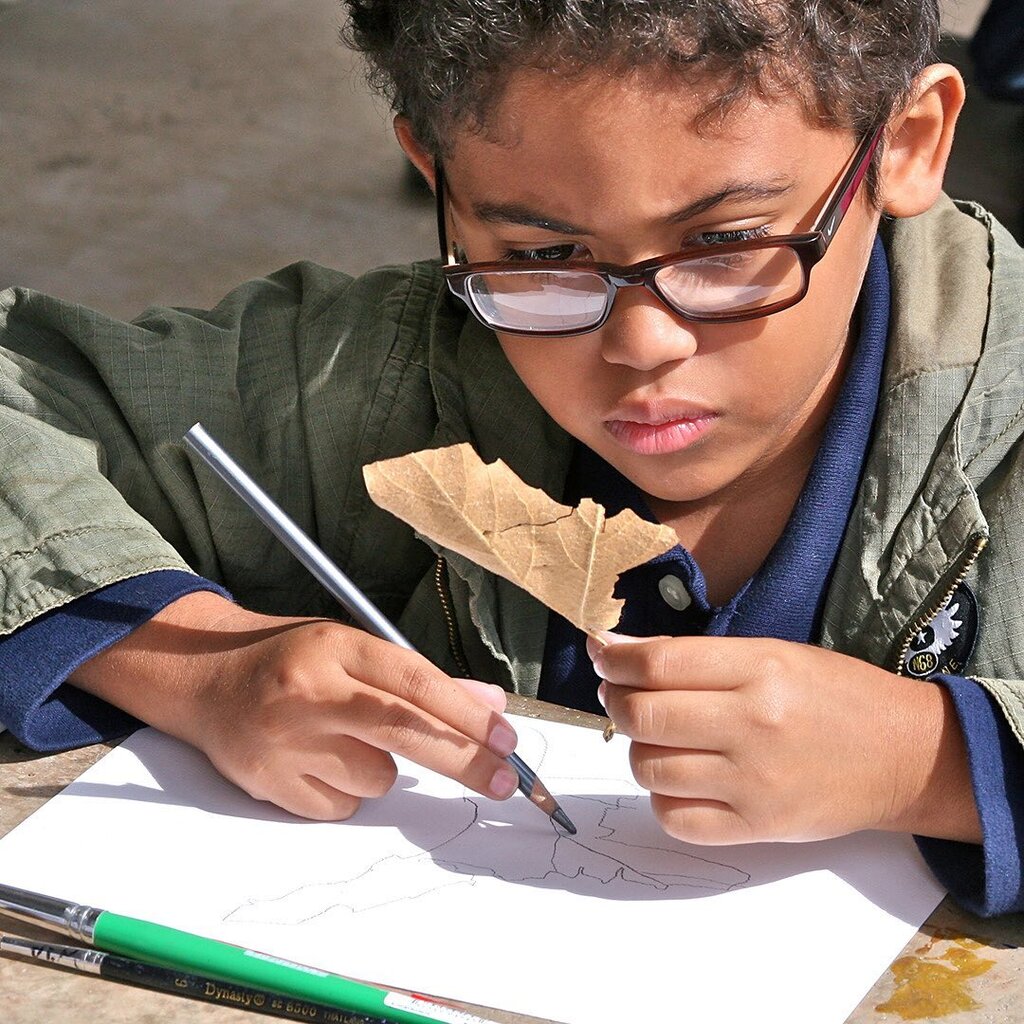
Look for patterns in the veins of a leaf, the bricks in a wall, the petals of a flower, or the tiles on a floor. Ask yourself how the pattern works. Are the elements arranged in a grid? Do they radiate from a central point? Are they random but similar, like the spots on a leopard?
Don't just look for obvious repetition. Patterns can also be found in how light and shadow fall across a textured surface, or in the way branches on a tree get progressively smaller as they extend outward. The more you look for these underlying rules, the more you'll see them everywhere.
When you draw a brick wall, you don't have to perfectly render every single brick. If you understand the pattern, you can suggest it, and the viewer's brain will fill in the rest. Observation teaches you what's important.
Ready to test your new observation skills?
What is the primary difference between seeing and observing, according to the text?
When you perform the exercise of observing a common object, what is the first impulse you are supposed to ignore?
Developing these skills takes practice. It’s about building a habit of curiosity and learning to look at the world with an artist's eye.