Unleash Your Inner AI Artist
Introduction to AI Art
Art and the Machine
Art has always evolved with technology. From the invention of the paint tube, which let artists work outdoors, to the camera, which changed our idea of portraiture, new tools have consistently opened new creative doors. Today, the latest tool is artificial intelligence.
AI-generated art is visual artwork created through a partnership between a human and an AI system. A person provides a prompt, usually in the form of text, and the AI generates an image based on that input. The AI isn’t “painting” in the traditional sense. Instead, it’s using patterns learned from a vast dataset of existing images to construct something new that matches the prompt's description.
From Simple Lines to Complex Worlds
The idea of a machine creating art isn't new. In the 1970s, artist and programmer Harold Cohen developed AARON, a computer program that could generate original black-and-white drawings. Cohen spent decades building the rules that AARON followed to create its art, acting as both artist and engineer.
For a long time, AI art remained a niche field. That changed dramatically in 2014 with the invention of Generative Adversarial Networks, or GANs. Think of a GAN as a pair of dueling AIs: one, the “generator,” creates images, while the other, the “discriminator,” tries to tell if the image is fake or real (from the training data). This back-and-forth pushed the generator to create increasingly realistic images. It was a breakthrough that laid the groundwork for the modern era of AI art.
The tools that brought AI art to the mainstream arrived in the early 2020s. Models like DALL-E, Midjourney, and Stable Diffusion made it possible for anyone to create complex, detailed, and often beautiful images just by typing a few words. The quality and complexity of AI-generated images have improved at an astonishing speed.
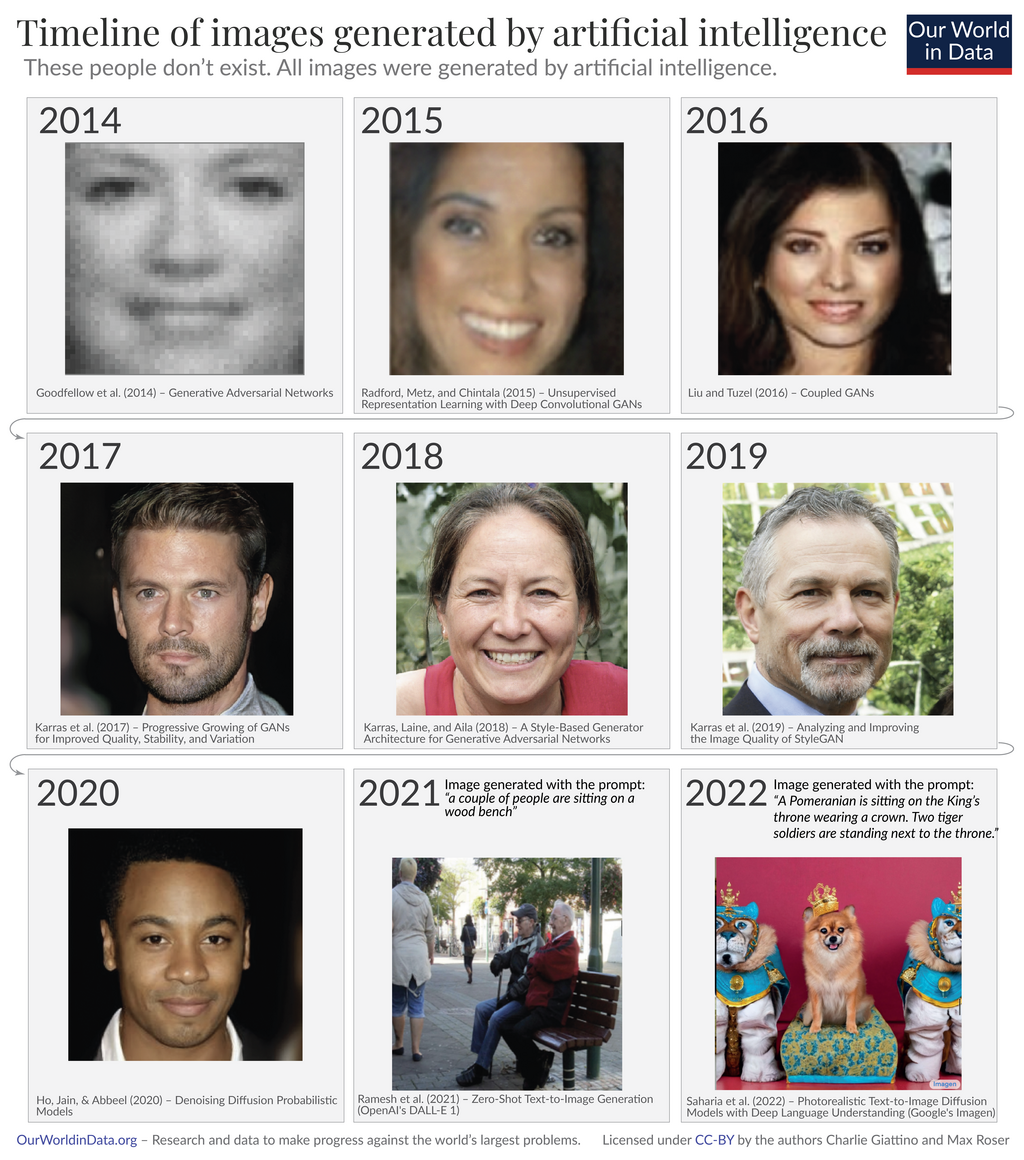
This accessibility has a profound impact on traditional art. It lowers the technical barrier for visual creation, allowing people without years of drawing or painting practice to bring their ideas to life. For professional artists, AI has become a powerful new tool for brainstorming, creating concept art, or generating textures and backgrounds, speeding up the creative process.
The Big Questions
The rise of AI art has also sparked intense debate. The new technology challenges our fundamental ideas about art, creativity, and ownership, raising several difficult ethical questions.
If a person writes a prompt and an AI creates the image, who is the artist?
Is it the person who had the creative vision and crafted the prompt? Is it the AI that generated the pixels? Or is it the team of developers who built and trained the AI model? The question of authorship is one of the most contentious issues, with legal systems and creative communities struggling to find a clear answer.
Another core issue is originality. AI models are trained on massive datasets containing millions, sometimes billions, of images scraped from the internet, many of which are copyrighted works by human artists. This has led to accusations that AI art is a form of high-tech plagiarism, simply remixing existing styles without true creativity. Artists have raised concerns that their work is being used to train their own competition without their consent or compensation.
Finally, this new technology forces us to ask what human creativity's role is in an age of AI. Does the ability to generate an image with a sentence devalue the skill, dedication, and years of practice that go into traditional art forms? Or is prompt-crafting a new artistic skill in its own right?
There are no easy answers. AI art is a new frontier, full of exciting potential and complex challenges. As the technology continues to evolve, so will the conversations around its place in the world of art.