University Level Logarithms
Introduction to Logarithms
The Inverse of Exponents
Exponents are all about multiplication. For example, is a shorthand way of writing . The answer is 1,000.
But what if you start with the answer and want to find the exponent? Imagine this question: "What power do you need to raise 10 to, in order to get 1,000?" The answer, of course, is 3. That's what a logarithm does. It finds the exponent.
A logarithm answers the question: How many times do we multiply one number (the base) by itself to get another number?
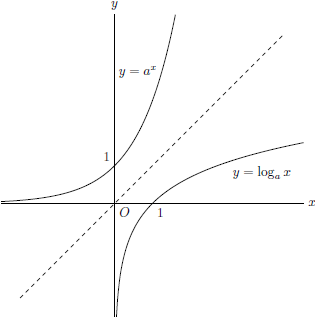
Logarithms are simply the inverse of exponential functions. They undo the work of an exponent, just like division undoes multiplication.
We write this relationship using special notation. The expression is the logarithmic way of writing the exponential equation . The small 'b' is the base.
Let's try it with our first example. The question "What power do you need to raise 10 to, in order to get 1,000?" is written as:
We know that , so the answer is 3.
Here's another one: . This asks, "What power do you raise 2 to, to get 8?" Since , or , the answer is 3.
Two Special Logarithms
While you can have a logarithm with any base, two bases are so common they get their own special names and notations.
Common Logarithm
noun
A logarithm with base 10.
The common logarithm is written as , without a base specified. If you see a 'log' with no little number next to it, the base is assumed to be 10.
is the same as , which equals 2 because .
Natural Logarithm
noun
A logarithm with base e.
The other special base is a number called , which is approximately 2.718. This number is incredibly important in math and science, especially when dealing with growth and change. The logarithm with base is called the natural logarithm, and it's written as .
So, is just a shorthand for .
A Quick History
Before calculators or computers, imagine you were an astronomer in the 1600s. You'd have to multiply or divide enormously large numbers by hand, a slow and error-prone process. Logarithms changed everything.
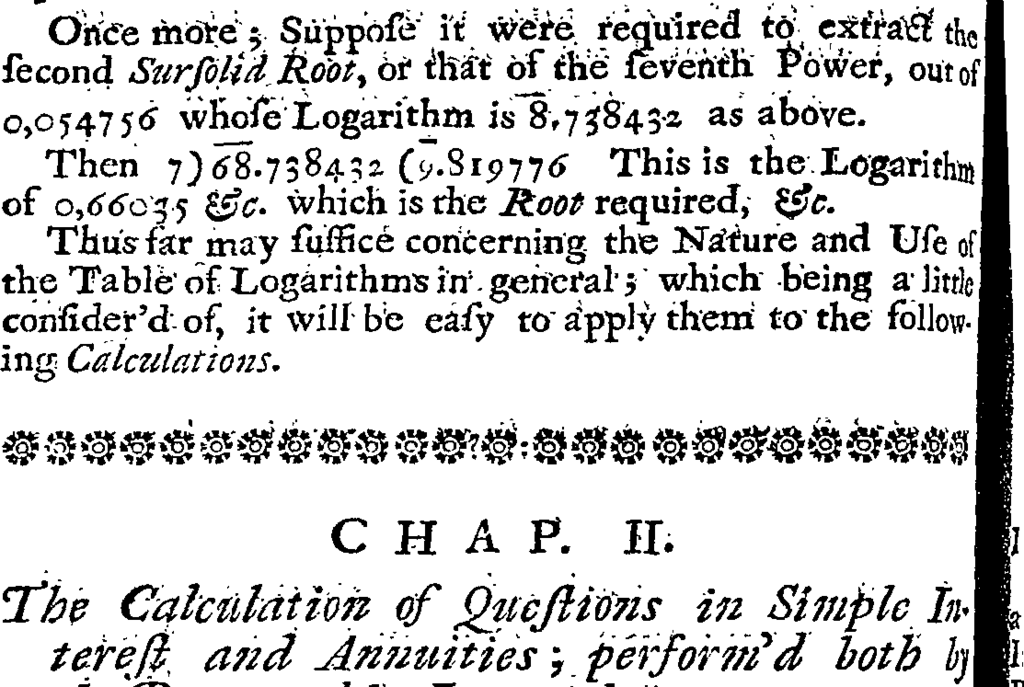
Invented by Scottish mathematician John Napier, logarithms turned complex multiplication problems into much simpler addition problems. Instead of multiplying two large numbers, you could find their logarithms, add those together, and then find the number corresponding to that sum. This saved huge amounts of time and dramatically increased accuracy in fields like astronomy, navigation, and engineering.
While we now have calculators to do the heavy lifting, logarithms are still fundamental. They're used in measuring the intensity of earthquakes (Richter scale), the acidity of solutions (pH scale), and the loudness of sound (decibels). They are a cornerstone of mathematics.
Let's test your understanding of these core concepts.
A logarithm fundamentally answers which of the following questions?
What is the value of ?
You now know what a logarithm is and how it relates to exponents. It's a powerful tool for finding the 'power' in an exponential relationship.