Universal Laws and Practical Physics
Two Dimensional Dynamics
Motion in Two Dimensions
The world isn't a one-lane road. Objects fly through the air, cars turn corners, and planets orbit stars. To understand this, we need to move beyond straight-line motion and explore movement in two dimensions. The key is breaking down complex paths into simpler, perpendicular components.
Any movement across a plane can be described by what's happening horizontally (along the x-axis) and what's happening vertically (along the y-axis). These two motions are surprisingly independent. What an object does horizontally doesn't affect what it does vertically, and vice-versa. This principle of vector decomposition is our starting point for analyzing everything from a thrown baseball to a satellite's orbit.
For any velocity vector at an angle above the horizontal, we can find its components:
This simple trigonometric split is the foundation for solving two-dimensional motion problems.
The Arc of a Projectile
Projectile motion describes an object flying through the air under the sole influence of gravity. Think of a cannonball, a kicked soccer ball, or a long jumper. Once launched, only gravity acts on it (we'll ignore air resistance for now).
Here's where vector decomposition shines. The horizontal motion is simple: no forces are acting in that direction, so the horizontal velocity, , is constant. The object just cruises sideways at the same speed. The vertical motion is a different story. Gravity pulls the object downward, causing a constant vertical acceleration, . The vertical velocity, , changes continuously—decreasing as the object rises, hitting zero at its peak, and increasing as it falls back down.
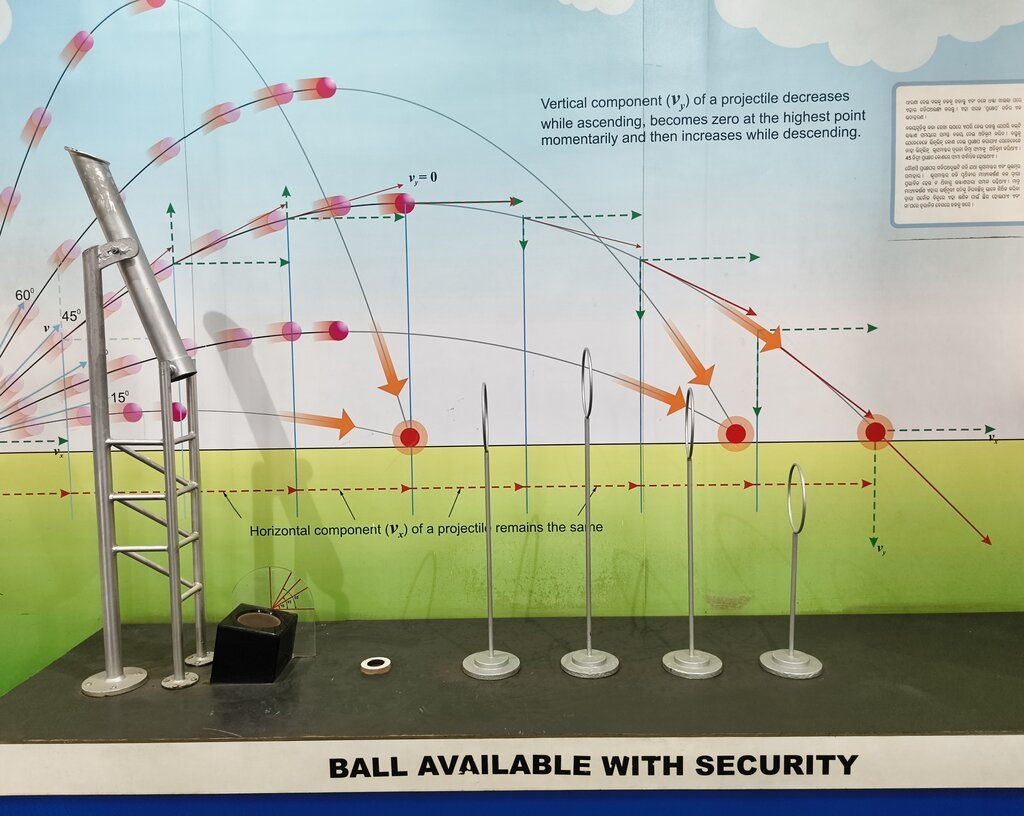
By treating the two components separately, we can use the familiar 1D kinematic equations we already know. For the horizontal position () and vertical position () at any time :
The common link between these two equations is time, . The time it takes for the projectile to complete its vertical journey is the same time it has to travel horizontally. This is the key to calculating a projectile's range or maximum height.
Swinging in a Circle
Now let's consider a different kind of 2D motion: an object moving in a circle at a constant speed, known as uniform circular motion. A car rounding a bend, a satellite in orbit, or a weight swung on a string are all examples.
Here's a seeming paradox: if the speed is constant, how can there be acceleration? Remember that velocity is a vector, possessing both magnitude (speed) and direction. In circular motion, the direction is always changing. And any change in velocity, even if it's just a change in direction, means there is an acceleration. This acceleration is called centripetal acceleration and it always points toward the center of the circle.
According to Newton's Second Law (), if there's an acceleration, there must be a net force causing it. This center-seeking force is called (). It's not a new, fundamental force of nature; it's the net result of other forces. For a car turning, it's the friction between the tires and the road. For a planet, it's the force of gravity. For the weight on a string, it's the tension in the string.
Without a centripetal force, an object in motion would simply continue in a straight line, tangent to the circle, according to Newton's First Law.
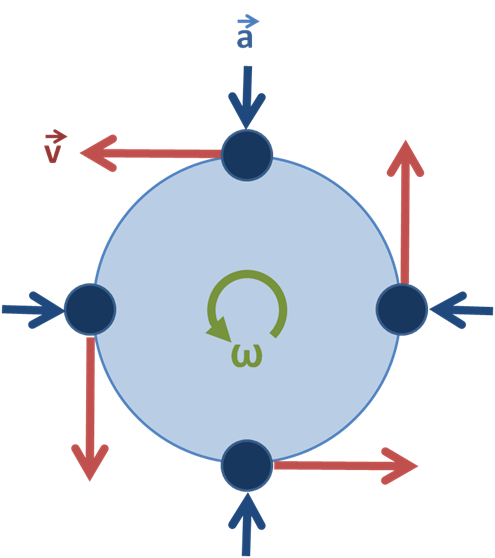
Let's apply this to a common scenario: a car making a turn. The force of static friction between the tires and the road provides the centripetal force needed to change the car's direction. The maximum speed a car can take a turn of radius without skidding depends on the coefficient of static friction, .
Notice that the mass cancels out. This means the maximum safe speed for a turn is the same for a small car and a large truck, assuming their tires have the same coefficient of friction. From here, you can solve for the maximum velocity, .
These principles of breaking down motion into components and understanding the forces behind curved paths allow us to analyze a vast range of dynamic situations in our world.
A cannonball is fired from a cannon at an angle of 30 degrees above the horizontal. Ignoring air resistance, which statement best describes the horizontal component of the cannonball's velocity during its flight?
An object is in uniform circular motion. If its speed is constant, how can it be accelerating?