Universal Language Systems and Architecture
Universal Grammar Frameworks
The Universal Blueprint
At first glance, Japanese, Swahili, and English seem wildly different. Their sounds, sentence structures, and vocabularies don't appear to have much in common. Yet, a child born anywhere in the world can learn any language they're exposed to with remarkable speed and without formal instruction. This simple observation suggests something profound: all human languages might be built on the same underlying chassis.
This is the core idea behind , a theory pioneered by linguist Noam Chomsky. It proposes that the human brain comes equipped with an innate, universal framework for language. We aren't born with blank slates; we're born with a blueprint. This explains why children learn language so efficiently and why they can create and understand sentences they've never heard before. It also explains the famous '' argument: the linguistic input children receive is often messy and incomplete, yet they acquire a rich and systematic grammar anyway. Their minds must be filling in the gaps with a pre-installed operating system for language.
Principles and Parameters
If we have a universal blueprint, how do we explain the differences between languages? The Principles and Parameters framework offers an elegant solution. Think of Universal Grammar as a pre-installed electrical switchboard in the brain.
Principles are the fixed, unchangeable wiring. They are the universal constants of language, like the fact that all sentences must have a subject (even if it's not spoken) or that phrases are structured hierarchically.
Parameters are the switches on that board. Each switch has a few possible settings (usually two), and the specific setting is determined by the language a child is exposed to. These parameters account for the variation we see across languages.
For example, the pro-drop (pronoun-dropping) parameter determines if a language allows sentences without an explicit subject. In Spanish, you can say "Llueve" ("Rains") to mean "It is raining." The subject is understood from the verb. The pro-drop switch is set to 'on'. In English, the switch is 'off'. You must say "It is raining"; the subject is obligatory. A child learning Spanish or English simply listens, and their brain sets the switch accordingly.
Building Blocks of Language
Universal Grammar also distinguishes between two fundamental types of categories in our mental dictionary (or lexicon). These are not just parts of speech, but deeper classifications of how words and morphemes function.
Lexical categories are the content words. They carry the core meaning of a sentence: nouns (like cat, idea), verbs (run, think), adjectives (red, fast), and adverbs (quickly).
Functional categories provide the grammatical scaffolding. They are words or parts of words that don't have rich semantic content on their own but specify grammatical information. This includes determiners (the, a), conjunctions (and, but), tense markers (-ed, will), and complementizers (that, if). While all languages have both types of categories (a Principle), how they are expressed varies widely (a Parameter). The brain's innate grammar system is often called the .
| Category | Role | Examples |
|---|---|---|
| Lexical | Carries primary semantic content | dog, build, happy, slowly |
| Functional | Provides grammatical structure | the, and, will, -s (plural) |
Infinite Sentences, Finite Rules
One of the most powerful features of this innate grammatical system is recursion. This is the ability to embed a structure inside a structure of the same type. It's what allows us to generate an infinite number of unique sentences from a finite set of words and rules.
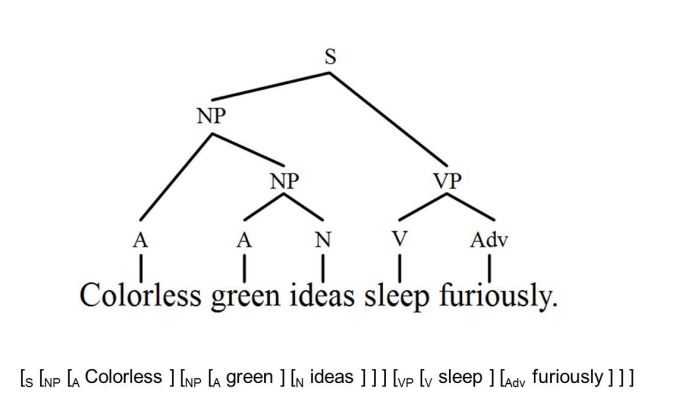
You can take a noun phrase like "the cat" and embed another phrase within it: "the cat on the mat." You can do it again: "the cat on the mat in the house." Or with sentences: "Mary thinks that John knows that Susan left." There is no theoretical limit to how many clauses you can embed. This hierarchical, recursive ability is considered by many linguists to be the hallmark of human language, a core Principle of our shared grammar.
Let's review the core ideas about the universal frameworks that underpin all human languages.
What is the fundamental proposal of Generative Grammar, as pioneered by Noam Chomsky?
The argument that children acquire a rich, systematic grammar despite receiving incomplete or messy linguistic input is known as the ______.
By understanding these universal frameworks, you can approach any new language not as a completely alien system, but as a different configuration of a familiar machine. The task is no longer about memorizing endless rules from scratch, but about discovering which settings have been toggled for that specific language.