Universal Gravitation Explained
Introduction to Gravity
The Pull We All Feel
Gravity is the invisible force that pulls objects toward each other. It’s what keeps your feet planted on the ground and what holds the Moon in a constant dance around the Earth. It’s a fundamental property of the universe, acting between any two objects that have mass.
Gravity is a force which tries to pull two objects toward each other.
For something so ever-present, our understanding of it has changed dramatically over time. Early thinkers had very different ideas about why things fall.
Aristotle's Common Sense
For nearly two thousand years, the ancient Greek philosopher Aristotle had the final word on gravity. His explanation was based on what seemed like common sense. He proposed that objects have a natural place in the universe. For earthy things like rocks and people, their natural place was the center of the Earth.
Aristotle also believed that heavier objects fall faster than lighter ones. A big rock, he reasoned, has more "earth" in it, so it desires to return to its natural place more strongly than a small pebble. If you drop a bowling ball and a feather, the bowling ball hits the ground first. To Aristotle, this was clear proof his theory was correct. It was an idea that went unchallenged for centuries.
Galileo Asks Questions
In the 16th century, the Italian scientist Galileo Galilei started to question these long-held beliefs. He wasn't satisfied with pure logic; he wanted to test ideas with experiments. A famous legend says he dropped two spheres of different masses from the Leaning Tower of Pisa. To everyone's surprise, they hit the ground at almost the exact same time.
While the Pisa story might be an exaggeration, Galileo did perform brilliant experiments. He realized that watching objects in freefall was too fast to measure accurately with the tools he had, like his own pulse or a water clock. To slow things down, he rolled balls down inclined planes. This allowed him to study the motion carefully.
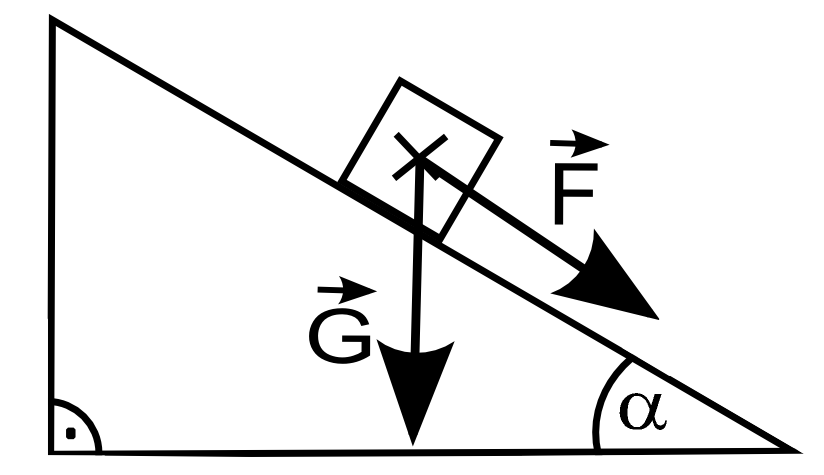
His results were revolutionary. Galileo discovered that, if you could ignore the effects of air resistance, all objects accelerate downward at the same rate, regardless of how heavy they are. The reason the feather falls slower than a bowling ball is because air resistance has a much greater effect on it. On the Moon, where there is no air, a hammer and a feather dropped together hit the ground at the same time, proving Galileo right.
One Force for All
Galileo's work laid the foundation for a new way of thinking. The next great leap, made by Isaac Newton, was to realize that gravity isn't just a phenomenon on Earth. It's universal.
Newton's insight was that the same force causing an apple to fall from a tree is the very same force that keeps the Moon locked in orbit around the Earth. It's also the force that keeps Earth and the other planets orbiting the Sun. Before this, people believed the heavens operated under a completely different set of rules than the Earth.
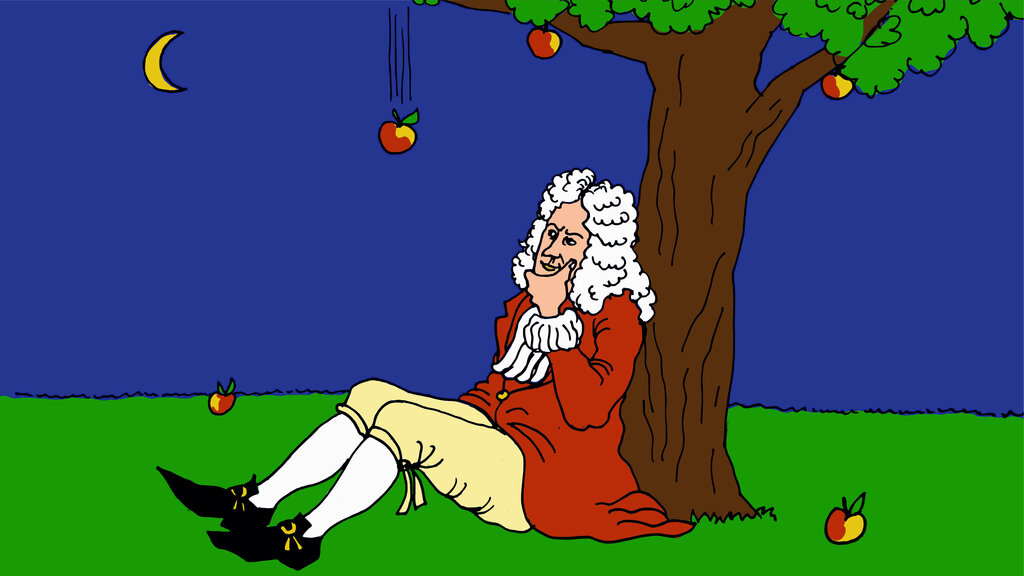
This was a profound shift. Gravity isn't special to our planet. It is an inherent property of mass. Any object with mass, whether it's an apple, a planet, or a star, exerts a gravitational pull on every other object with mass. This universal attraction governs the motion of everything from falling rain to swirling galaxies.
According to the ancient Greek philosopher Aristotle, why does a rock fall to the ground?
What was the primary reason Galileo Galilei used inclined planes (ramps) for his experiments on falling objects?