Universal Design for Learning in Mathematics
Mapping Math Barriers
Spotting the Hidden Hurdles
Universal Design for Learning isn't just a philosophy; it's a practical lens for inspecting your curriculum. The goal is to move from theory to a proactive audit of your math materials, identifying barriers before they trip up your students. Think of it like a building inspector checking for accessibility ramps and clear signage. We're doing the same, but for cognitive and linguistic pathways.
A traditional math curriculum often contains unintentional obstacles. A word problem might use complex sentence structures or culturally specific scenarios, creating a language barrier that has nothing to do with the underlying math. A multi-step task might require a student to hold several pieces of information in their working memory, posing a huge challenge for anyone with executive function difficulties. By spotting these hurdles in advance, we can redesign the path to learning.
The key is to separate the skill being taught from the way it's presented. Is the barrier part of the core mathematical concept, or is it an artifact of the instructional material?
Language, Cognition, and Anxiety
Word problems are a classic source of curriculum-induced barriers. They often tangle two distinct challenges into one: understanding the language and solving the math. The linguistic load can be immense. Consider a problem about calculating interest on a loan. A student might get stuck on financial jargon like 'principal' or 'amortization' before they even get to the numbers.
This isn't just about vocabulary. It's about cognitive load. When a student's brain is working overtime to decode a sentence, it has fewer resources left for mathematical reasoning. This is where math anxiety can spiral. A student feels stressed by the text, which impairs their working memory, making the math harder and reinforcing the belief that they are 'bad at math'. It becomes a vicious cycle, all sparked by a poorly designed prompt.
Multi-step problems are another major hurdle, especially for students who struggle with skills like planning, sequencing, and self-monitoring. A task that asks a student to 'Calculate the area, then find the volume, then determine the material cost at $2.50 per cubic foot' requires them to create and follow a mental roadmap. If the instructions aren't broken down or supported with a checklist, the barrier isn't the math itself, but the organizational skill required to tackle it.
| Barrier Type | Example in a Math Problem | UDL-Based Question to Ask |
|---|---|---|
| Linguistic | A word problem uses unfamiliar idioms or complex sentence structures. | Could I present this problem using simpler language, a diagram, or a video? |
| Conceptual | The problem assumes prior knowledge the student may not have (e.g., how a mortgage works). | Is there a way to use a more familiar context or provide a brief explanation of the concept? |
| Executive Function | A multi-step task is presented as a single block of text. | Can I break this down into a numbered list or provide a graphic organizer? |
| Anxiety/Affective | The problem is timed or framed in a high-stakes way. | How can I lower the stakes and encourage exploration and productive struggle? |
Physical and Sensory Barriers
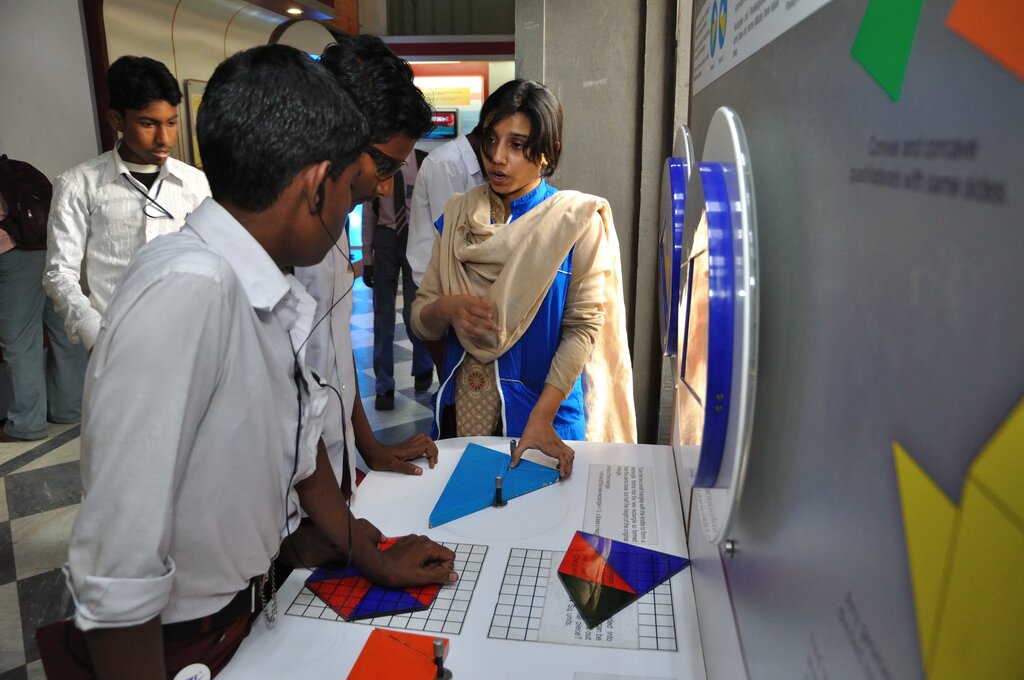
Barriers aren't just cognitive. They can also be physical or sensory. Consider the use of like base-ten blocks or fraction tiles. For a student with fine motor challenges, handling small blocks can be frustrating and distracting. The physical act of using the tool becomes a bigger challenge than the mathematical concept it's supposed to clarify.
Similarly, a reliance on visual models can be a barrier for students with visual impairments. If the only way to understand a geometric proof is through a complex diagram, we've excluded anyone who can't easily perceive it. The solution isn't to abandon manipulatives or diagrams, but to offer alternatives. Could a virtual manipulative work better for the student with motor challenges? Could the geometric proof be described auditorily or explored through a tactile model?
By auditing our materials for these hidden barriers—linguistic, cognitive, physical, and sensory—we shift our focus. Instead of asking 'Why can't this student learn this?', we start asking 'What is in the curriculum that is preventing this student from learning?'. This simple change in perspective is the first, most crucial step in building a truly accessible math classroom.
Now, let's test your ability to spot these barriers.
What is the primary goal of applying a Universal Design for Learning (UDL) lens to a math curriculum?
A word problem uses complex sentence structures and culturally specific scenarios to describe a mathematical situation. This is primarily an example of what kind of barrier?
Identifying these obstacles is a continuous process. By regularly examining materials through this lens, you can start to anticipate challenges and design more resilient, flexible learning experiences from the start.