Universal Assembly Language Foundations
Processor Architecture Fundamentals
The Heartbeat of the Machine
At its core, a Central Processing Unit (CPU) is a master of repetition. It does one thing, over and over, with incredible speed: it executes instructions. Every action your computer takes, from moving your mouse cursor to playing a video, is the result of the CPU processing a long list of simple commands. This fundamental process is known as the fetch-decode-execute cycle.
The CPU (Central Processing Unit) processes instructions using a repeated loop called the Instruction Cycle or Fetch–Decode–Execute (FDE) cycle.
Think of it as a chef following a recipe. The chef (CPU) reads one step (fetch), understands what it means (decode), and then performs the action, like chopping an onion (execute). This loop is the constant, rhythmic heartbeat of your computer.
Let's break that down.
1. Fetch: The CPU retrieves an instruction from memory (RAM). To do this, it uses a special register called the (PC). The PC always holds the memory address of the next instruction to be executed. Once fetched, the instruction is stored in another register, the Instruction Register (IR), while the PC updates to point to the next instruction in line.
2. Decode: Now that the instruction is in the IR, the CPU needs to figure out what to do. This is the job of the Control Unit (CU). The CU reads the instruction—a sequence of bits called an opcode—and decodes it, like a translator figuring out a foreign word. It then prepares the necessary circuits for the final step.
3. Execute: With the command understood, the Control Unit directs the appropriate component to perform the action. If the instruction is a mathematical or logical operation, it's sent to the (Arithmetic Logic Unit). This is the calculator of the CPU, handling everything from addition to comparing two numbers. The result of the execution is then stored in a register or written back to memory.
Organizing Instructions and Data
A computer's memory holds everything: the instructions the CPU needs to execute, the data those instructions operate on (like numbers in a spreadsheet), and the results of those operations. But how does the CPU distinguish between an instruction and a piece of data? They're all just ones and zeros in memory.
This question leads to a fundamental design choice in computer architecture. Most modern computers use a This design uses a single memory space and a single set of pathways (a bus) for both instructions and data. It's simple and flexible, as memory can be dynamically shared. A program can use more memory for data if it has few instructions, or vice-versa.
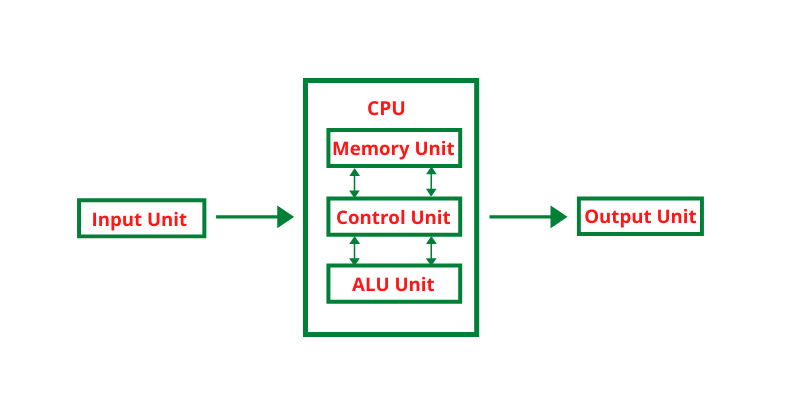
The alternative is the Harvard architecture, which has separate memory and separate buses for instructions and data. This allows the CPU to fetch the next instruction while simultaneously reading or writing data for the current instruction, which can improve performance. This design is common in specialized systems like microcontrollers and Digital Signal Processors (DSPs), where speed and predictability are critical.
From Human to Machine
The raw instructions that a CPU decodes are called machine code. They are nothing more than binary patterns, like 10110000 01100001. This is the only language a CPU truly understands. As you can imagine, writing a program directly in machine code is incredibly tedious and error-prone.
To make life easier, programmers created language. Assembly uses short, human-readable mnemonics to represent machine code instructions. For example, that binary string might correspond to the mnemonic MOV AL, 61h, which tells the processor to move the hexadecimal value 61 into a register named AL. An assembler program then translates these mnemonics into the binary machine code the CPU can execute.
| Concept | Description | Example |
|---|---|---|
| Machine Code | The raw binary instructions the CPU executes. | 10110000 01100001 |
| Assembly | Human-readable mnemonics for machine code. | MOV AL, 61h |
| High-Level Code | Abstract, expressive language for programmers. | x = 97; |
This creates a ladder of abstraction. High-level languages like Python or Java are compiled or interpreted into Assembly, which is then assembled into the machine code that brings your computer to life, one fetch-decode-execute cycle at a time.
What is the three-step process that a CPU continuously repeats to process instructions?
Which CPU component is responsible for interpreting the binary code of an instruction to determine what action to perform?