Unifying the Vector Concept
Abstract Vector Axioms
Beyond Arrows and Numbers
You’ve likely met vectors as arrows pointing in space or as lists of numbers in columns. These are useful pictures, but they are just two examples of a much bigger idea. The real power of linear algebra comes from abstracting away the specifics. It's not about what vectors are, but what they do.
Mathematicians noticed that many different kinds of objects—from arrows to polynomials to audio signals—behave in similar ways. They can be added together and scaled. This observation led to the formal definition of a vector space, a set of rules that defines a system where these operations work predictably. If a set of objects follows these rules, we can call them vectors and use the entire toolkit of linear algebra on them.
A vector space generalizes this notion of adding and scaling things that behave like Euclidean vectors.
A vector space consists of two main ingredients:
- A set of objects, which we call vectors (let's call the set ).
- A set of scalars from a field, which we can use to scale the vectors (let's call this set ).
For our purposes, the field of scalars is almost always the set of real numbers, . The system must also have two defined operations: vector addition (adding two vectors from to get another vector in ) and scalar multiplication (multiplying a vector from by a scalar from to get another vector in ).
For to officially be a vector space, these two operations must follow a list of eight fundamental rules, known as axioms. Think of them as the constitution for this abstract system.
The Rules of the Game
These eight axioms are divided into two groups, governing how vectors interact with each other (addition) and how they interact with scalars (multiplication). They ensure that the algebra works consistently, no matter what the 'vectors' actually represent.
| Axioms for Vector Addition | Description |
|---|---|
| 1. Closure under Addition | If and are in , then is also in . |
| 2. Commutativity | For any vectors and , . The order of addition doesn't matter. |
| 3. Associativity | For any vectors , , and , . The grouping of addition doesn't matter. |
| 4. Additive Identity | There is a zero vector in such that for any vector , . |
| 5. Additive Inverse | For every vector in , there is an inverse vector in such that . |
The commutativity axiom, for instance, is something we take for granted with numbers. With geometric vectors, it's visualized by the parallelogram rule: starting with vector and adding gets you to the same point as starting with and adding .
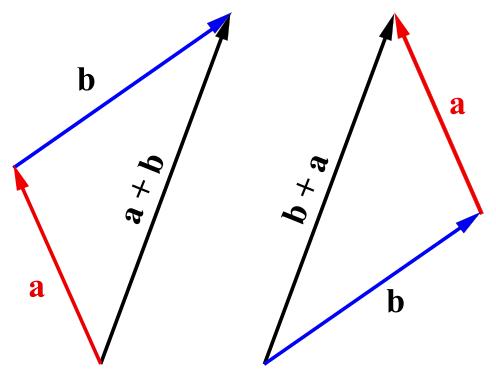
Next are the rules for how scalars and vectors play together.
| Axioms for Scalar Multiplication | Description |
|---|---|
| 6. Closure under Scalar Multiplication | If is in and is a scalar from , then is also in . |
| 7. Distributivity | and . Scalars distribute over vector addition, and vectors distribute over scalar addition. |
| 8. Multiplicative Identity | For any vector , , where is the multiplicative identity from the scalar field. |
You might notice there's also an associativity-like rule for scalar multiplication hidden in the full definition: . These rules together are what make a vector space a vector space. If any of these eight axioms fail, the set of objects is not a vector space, and we can't apply the tools of linear algebra.
Unexpected Vectors
The true payoff of this abstract approach is that it lets us treat surprising things as vectors. Consider the set of all continuous functions on the interval . We can define function addition and scalar multiplication .
Do these operations obey the eight axioms? Yes, they do. The 'zero vector' is just the function . The additive inverse of is simply . This means the set of all continuous functions on an interval forms a vector space. This insight is huge, paving the way for fields like where functions are treated as vectors with infinite components.
Similarly, the set of all matrices forms a vector space. We can add them and multiply them by scalars, and all eight rules hold. The 'vectors' in this space are matrices. Polynomials of a certain degree also form a vector space. This abstract perspective is the unifying theme of linear algebra. It shifts the focus from what an object looks like to how it behaves within a structured system.
What is the core idea that defines a set of objects as a vector space?
Which of the following is an example of an object that can be treated as a 'vector' in a vector space, according to the abstract definition?
By understanding these axioms, you've moved beyond the geometry of arrows and into the algebraic structure that underpins much of modern mathematics, physics, and engineering.