Understanding Your Pension Plan
Pension Plan Basics
Planning for Life After Work
A pension plan is a retirement account that an employer helps set up for their employees. Think of it as a long-term savings strategy. While you're working, you (and often your employer) contribute money to the plan. This money is invested and grows over time, creating a fund you can draw from once you retire.
The main goal is simple: to provide you with a steady income when you're no longer earning a regular paycheck.
Having a pension helps ensure you have financial security in your later years. It’s a key part of planning for a comfortable retirement, allowing you to cover living expenses and enjoy your life after your career ends.
The Two Main Flavors
Pension plans generally come in two types: Defined Benefit and Defined Contribution. The biggest difference between them comes down to who is responsible for the investment risk and how your final payout is determined.
Vesting
noun
The point at which you have a non-forfeitable right to the money your employer has contributed to your pension plan. If you leave your job before you are vested, you might lose some or all of the employer's contributions.
Defined Benefit (DB) Plans
Often called a "traditional pension," a Defined Benefit plan promises you a specific, pre-determined monthly income in retirement. The amount is usually calculated using a formula that considers your salary, age, and how many years you worked for the company.
With a DB plan, your employer manages the investment portfolio and bears all the risk. Their job is to make sure there's enough money to pay you the promised amount, regardless of how the market performs. These plans have become less common in the private sector.
Defined Contribution (DC) Plans
This is the more modern and common approach. In a Defined Contribution plan, you and/or your employer contribute money to an individual retirement account in your name. Common examples include 401(k) and 403(b) plans. The amount you have at retirement depends on how much was contributed and how well the investments you chose have performed.
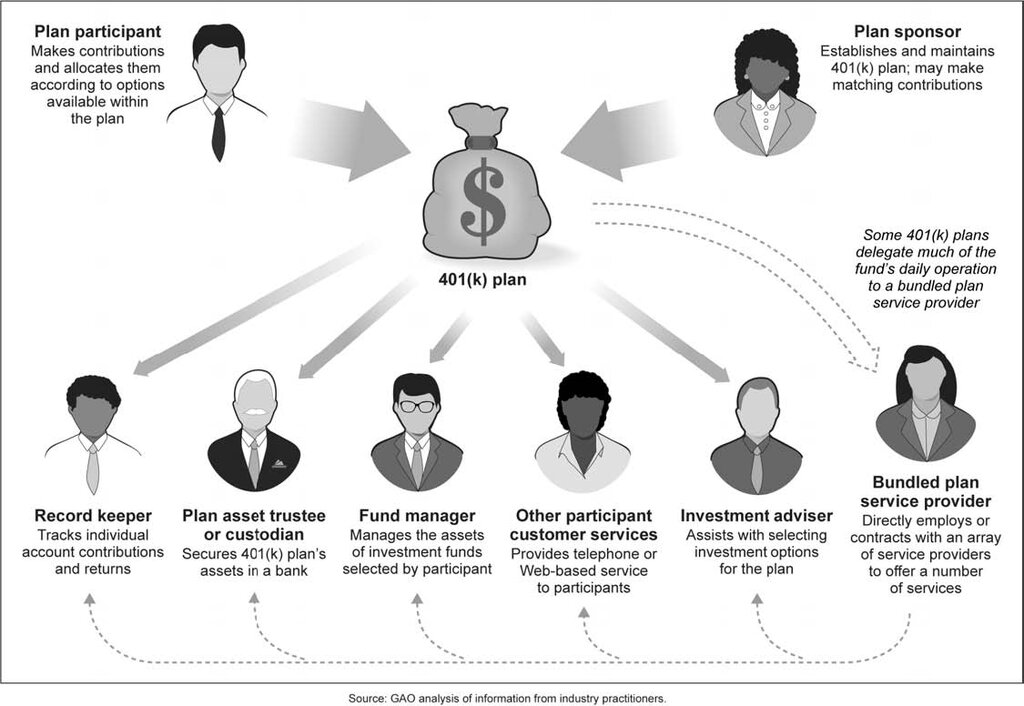
In this model, you, the employee, are responsible for managing the investments and assume the market risk. Your employer's role is typically to offer the plan, provide a menu of investment options, and often match a portion of your contributions.
| Feature | Defined Benefit (DB) | Defined Contribution (DC) |
|---|---|---|
| Payout | A guaranteed, specific monthly income. | The final account balance. |
| Investment Risk | Employer | Employee |
| Funding | Primarily employer-funded. | Funded by employee and/or employer. |
| Common Example | Traditional company pension | 401(k) plan |
Roles and Rules
In any pension plan, both the employer and employee have distinct responsibilities.
An employer's role is to establish and administer the plan. This includes choosing a record keeper, selecting investment options for DC plans, and ensuring the plan is managed according to the law. For DB plans, they are also responsible for funding the promised benefits.
An employee's role is to enroll in the plan and, for DC plans, decide how much to contribute and how to invest that money from the available options. It's up to you to understand the plan's rules, including vesting schedules.
Because workplace retirement plans should be designed to serve participants’ best interests, plan sponsors have a fiduciary responsibility to make prudent, well-informed decisions — particularly when evaluating complex asset classes like private markets.
To protect retirement savings, governments establish regulatory frameworks. In the United States, for instance, the Employee Retirement Income Security Act of 1974 (ERISA) sets minimum standards for most private industry pension plans. This law requires plan administrators to provide participants with information about plan features and funding, and it outlines fiduciary responsibilities for those who manage and control plan assets. These regulations ensure transparency and hold employers accountable for managing retirement funds responsibly.
Now, let's check your understanding of these core concepts.
What is the key difference between a Defined Benefit (DB) plan and a Defined Contribution (DC) plan?
An employee who is responsible for choosing their own investments from a menu of options and whose final retirement fund depends on the performance of those investments most likely has which type of plan?