Understanding Uniform Circular Motion
Introduction to Circular Motion
Going in Circles
Imagine you're on a Ferris wheel. You move in a big circle, always the same distance from the center, but your direction is constantly changing. This is circular motion. It's the movement of an object along the edge of a circle. From planets orbiting the sun to a car turning a corner, this type of motion is all around us.
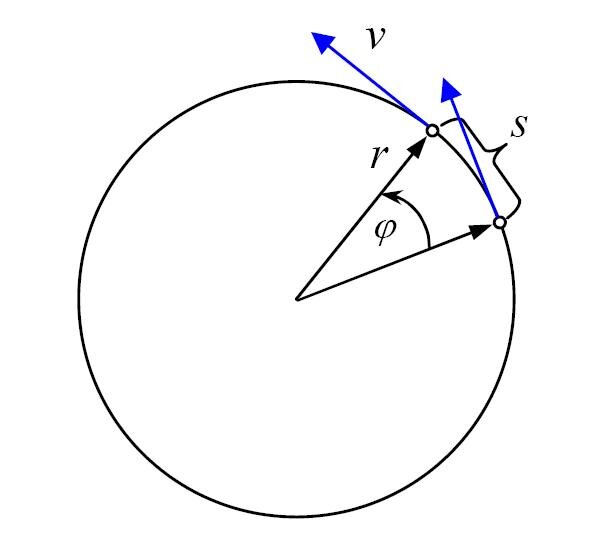
The simplest type is uniform circular motion, where the object moves at a constant speed. Think of the tip of a clock's second hand. It sweeps around the face at a steady pace. If the Ferris wheel you're on moves smoothly without speeding up or slowing down, that's uniform circular motion.
Of course, motion isn't always so neat. If the Ferris wheel starts slowly, picks up speed, and then slows to a stop, its motion is non-uniform. In this article, we'll focus on the simpler, steady case: uniform circular motion.
Distance and Direction
How do we describe an object's position on a circle? We can talk about the actual distance it has traveled along the curved path. This is called linear displacement, or arc length. If you walk halfway around a circular pond, your linear displacement is half the pond's circumference.
Linear displacement is the distance covered along the circular path.
But in circular motion, it's often more useful to talk about angles. As an object moves along the circle, the line connecting it to the center sweeps out an angle. This change in angle is called angular displacement.
Instead of degrees, physicists prefer to measure angles in radians. A radian is defined by wrapping a circle's radius around its circumference. One full circle is radians, which is the same as 360 degrees.
radian
noun
The angle made when the radius of a circle is wrapped along its circumference. One full circle contains radians.
Linear and angular displacement are directly related. The farther you are from the center (a larger radius), the greater the distance you travel for the same change in angle. Their relationship is captured by a simple formula, where is the linear displacement (arc length), is the radius, and is the angular displacement in radians.
Timing the Trip
To fully describe circular motion, we need to consider time. Three key parameters help us do this: radius, period, and frequency.
| Parameter | Symbol | Description |
|---|---|---|
| Radius | The fixed distance from the center of the circle to the object. | |
| Period | The time it takes to complete one full revolution or cycle. | |
| Frequency | The number of revolutions or cycles completed in a unit of time. |
Period and frequency are two sides of the same coin. If it takes a spinning top 2 seconds to make one full turn, its period is 2 seconds. In that same time, it completes half a turn every second, so its frequency is 0.5 revolutions per second. Frequency is often measured in Hertz (Hz), where 1 Hz equals one cycle per second.
They have an inverse relationship. A long period means a low frequency, and a short period means a high frequency.
Now that you understand these basic terms, you have a solid foundation for exploring the forces and acceleration involved in making things go in circles.