Understanding Turiya Consciousness
Introduction to Advaita Vedanta
The Wave and the Ocean
Imagine a wave in the ocean. It has a beginning and an end. It has a unique shape and size. From the shore, you can point to it and say, "There's a wave." But what is the wave really made of? It's made of water—the very same water that makes up the entire ocean. The wave is just a temporary form that the ocean takes.
This simple analogy is at the heart of Advaita Vedanta, one of the most influential schools of Hindu philosophy. The word "Advaita" itself means "not two" or "non-dual."
Advaita Vedanta is a non-dualistic philosophy that asserts the fundamental unity of all existence.
It proposes that beneath the surface of our individual identities and the diverse world we perceive, there is only one, ultimate, unchanging reality. This reality is called Brahman.
Brahman
noun
The ultimate, unchanging, infinite, and absolute reality in Hinduism. It is the single binding unity behind all that exists in the universe.
According to this philosophy, the individual soul or self, known as Atman, is not separate from Brahman. Your innermost consciousness, the sense of "I am," is identical to that ultimate reality. The wave is the ocean.
The core teaching is simple yet profound: Ātman is Brahman.
Waking from the Dream
If everything is one, why do we experience ourselves as separate individuals living in a world of countless different things? Advaita Vedanta answers this with the concept of Maya.
Maya
noun
A term for the powerful force that creates the cosmic illusion that the phenomenal world is real.
Maya is like a magical veil of illusion that makes the one reality (Brahman) appear as many. It's the filter through which our minds project a world of names, forms, and divisions. Think of it like a dream. While you're dreaming, the people, places, and events feel completely real. You feel joy, fear, and desire. But when you wake up, you realize it was all a projection of your own mind.
Advaita suggests that our everyday waking state is a similar, more persistent kind of dream. We are so caught up in the drama of our individual lives that we forget our true nature as the dreamer—the one, undivided consciousness. This mistaken identity is the root of suffering, as we attach ourselves to the temporary and limited aspects of our lives, fearing their loss.
The Philosophical Bedrock
While these ideas are ancient, they were most famously systematized by the philosopher Adi Shankara in the 8th century CE. He wasn't inventing a new philosophy but rather consolidating and clarifying the teachings found in Hinduism's most sacred texts.
The foundation of Advaita Vedanta rests on three primary sources, collectively known as the Prasthanatrayi, or the "three sources of knowledge."
| Source | Description |
|---|---|
| The Upanishads | Philosophical texts that form the core of Vedanta. They explore the nature of Brahman, Atman, and the path to liberation through knowledge. |
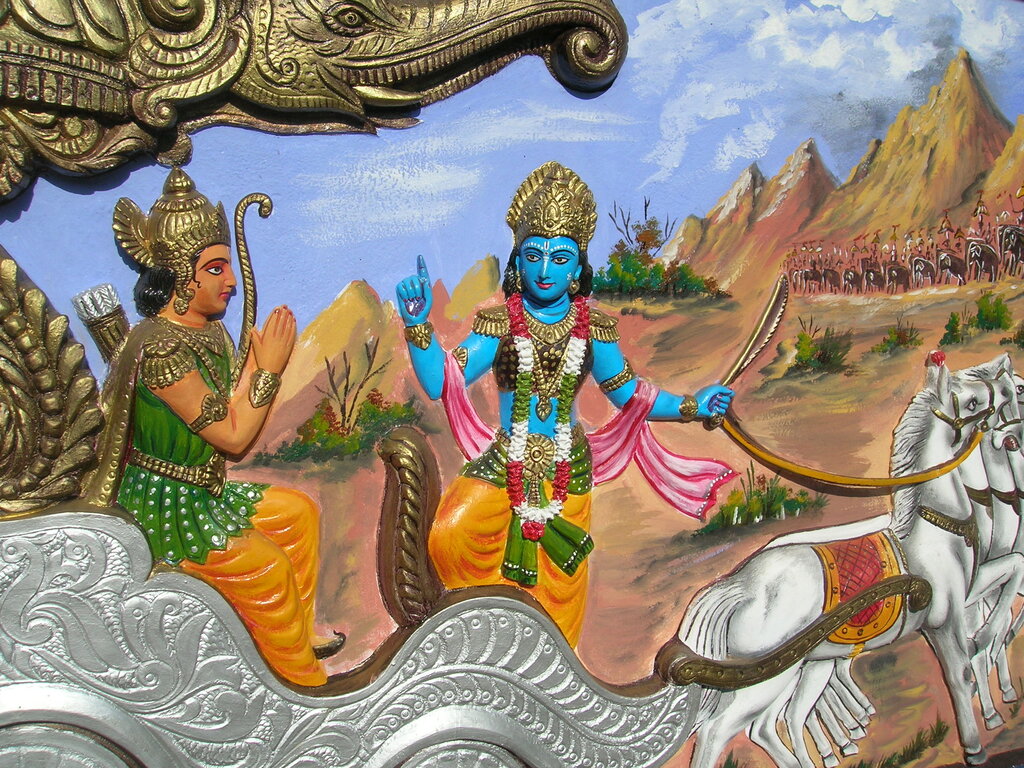
| The Bhagavad Gita | A dialogue between Lord Krishna and the warrior Arjuna. It synthesizes various philosophical paths, including the Advaitic idea of the eternal Self. |
| The Brahma Sutras | A collection of aphorisms that systematize and logically organize the teachings of the Upanishads. |
These texts serve as the scriptural authority for Advaita, providing the basis for its arguments and meditative practices. The Bhagavad Gita, in particular, illustrates the practical application of these profound truths in the midst of life's challenges.
The goal of studying these texts and engaging in spiritual practices like meditation is to pierce the veil of Maya. It is a journey of self-inquiry, constantly asking, "Who am I?" The path leads to the direct, experiential realization—not just the intellectual understanding—that your true self is, and always has been, the one, infinite, blissful reality of Brahman.
What is the central meaning of the term "Advaita"?
In the common analogy used to explain Advaita Vedanta, the individual wave represents the Atman (individual self). What does the ocean represent?
This understanding of non-duality provides a powerful framework for exploring the nature of consciousness itself.