Understanding the Photoelectric Effect
Classical Wave Theory Limitations
When Waves Fall Short
For a long time, the classical wave theory of light seemed unshakable. It perfectly explained why light bends around obstacles (diffraction) and creates interference patterns. According to this theory, light is an electromagnetic wave, and its energy is determined by its intensity, which is related to the wave's amplitude. A brighter light is a more intense, higher-energy wave. The colour, or frequency, of the light was thought to be irrelevant to its energy.
This model makes a few clear predictions. First, if you shine a dim light on a surface, it should take a while for the surface to absorb enough energy to cause any effect. The energy should build up gradually. Second, a very bright light, regardless of its colour, should carry a lot of energy. A faint light, regardless of its colour, should carry very little. These ideas seemed logical and were consistent with observations of waves in water and sound.
But at the end of the 19th century, a series of experiments began to reveal cracks in this beautiful theory. One experiment in particular, the photoelectric effect, produced results that the wave theory simply could not explain.
The Photoelectric Puzzle
The photoelectric effect is straightforward in principle. When you shine light onto a metal surface, electrons can be knocked loose from the atoms in the metal. These ejected electrons are called photoelectrons.
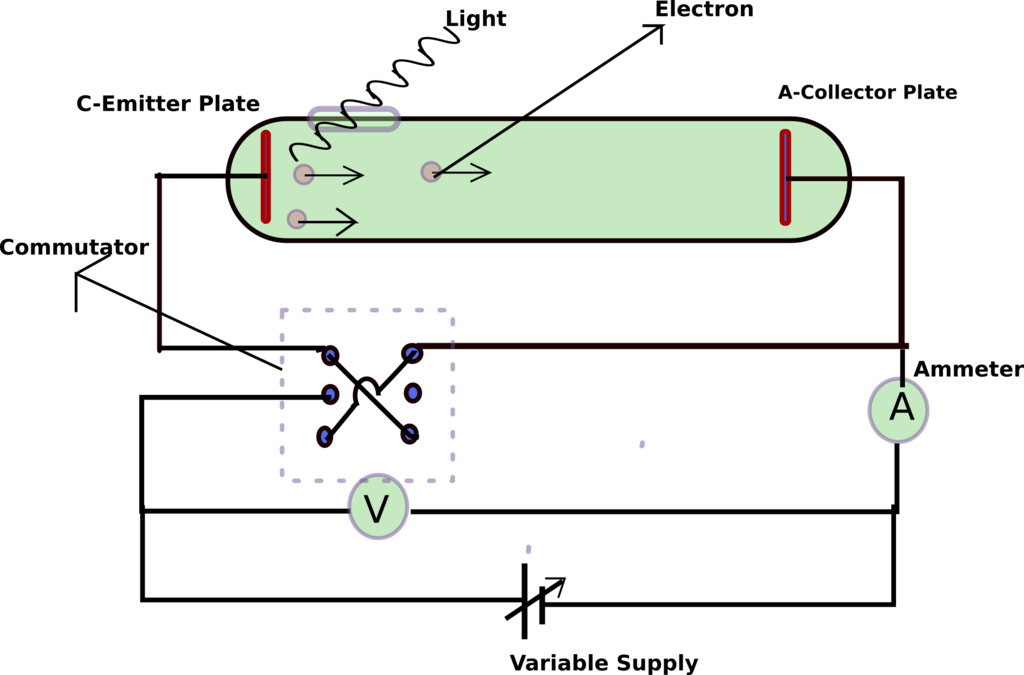
Scientists meticulously studied this phenomenon, and what they found was completely at odds with the predictions of classical wave theory. The results presented a three-part puzzle.
First, there's a threshold frequency. For any given metal, light below a certain frequency will not eject any electrons, no matter how bright the light is. If you shine an intensely bright red light on a particular metal and nothing happens, you can leave it on for a week and still nothing will happen. But a faint violet light, which has a higher frequency, might eject electrons instantly. Classical theory said intensity was all that mattered, but experiments showed frequency was the gatekeeper.
Second, the emission of electrons is instantaneous. As soon as light of a sufficient frequency hits the metal, electrons are ejected. There is no time delay for energy to build up, even if the light is incredibly dim. This contradicted the classical idea that a low-intensity wave would need time to transfer enough energy to an electron.
Third, the kinetic energy of the ejected electrons depends on the light's frequency, not its intensity. A higher-frequency light produces electrons with more kinetic energy—they move faster. Making the light brighter (increasing its intensity) only increases the number of electrons ejected per second, not their individual energies. This was the exact opposite of what the wave model predicted.
These experimental facts left physicists in a difficult position. The trusted wave theory of light, which worked so well for so many other phenomena, failed completely to explain the photoelectric effect. A new way of thinking about light was needed.
The wave picture is unable to explain the most basic features of photoelectric emission.
A Clear Contradiction
The gap between what classical theory predicted and what experiments showed was stark. The evidence pointed towards a fundamental misunderstanding of how light transfers energy to matter.
| Phenomenon | Classical Wave Prediction | Experimental Observation |
|---|---|---|
| Energy of Electrons | Depends on light intensity (brightness). | Depends on light frequency (colour). |
| Number of Electrons | Depends on light intensity. | Depends on light intensity. |
| Time Delay | A time lag should exist for dim light. | Emission is instantaneous. |
| Frequency Condition | Any frequency should work if intense enough. | A minimum (threshold) frequency is required. |
This wasn't just a minor discrepancy that could be fixed with a small adjustment to the wave theory. The results of the photoelectric effect demanded a radical new idea about the very nature of light itself.