Understanding the English 't' Sound
Introduction to English Phonetics
What is Phonetics?
Phonetics is the study of speech sounds. It's less about the letters you see on a page and more about the actual sounds you make and hear when you speak. Think of it as a behind-the-scenes look at language.
Why does this matter? English spelling can be tricky. The letter 'a' sounds different in 'cat', 'father', and 'late'. Phonetics gives us a precise way to talk about these sounds, helping us understand and improve pronunciation without the confusion of spelling.
phonetics
noun
The study and classification of speech sounds.
How We Make Sounds
Every sound you make starts with air from your lungs. This air travels up through your windpipe and passes through your voice box, also known as the larynx. Inside the larynx are your vocal cords.
If your vocal cords vibrate as the air passes through, you create a voiced sound, like /z/ or /v/. You can feel this vibration if you touch your throat while making these sounds. If they don't vibrate, you make a voiceless sound, like /s/ or /f/. Try it—you won't feel a buzz.
Finally, the air enters your mouth and nose. Here, your tongue, lips, and teeth—the articulators—shape the airflow to form specific sounds. The unique position of your articulators is what makes a /p/ sound different from a /k/ sound.
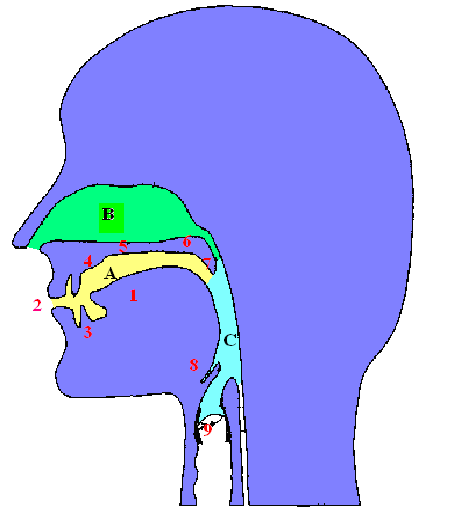
A Universal Alphabet for Sounds
Because English spelling is so inconsistent, linguists developed the International Phonetic Alphabet, or IPA. The goal of the IPA is simple: one symbol for every sound. No matter what the language, the symbol /p/ always represents the 'p' sound in 'pie'.
This system removes the guesswork. Consider the letters 'ough'. They're pronounced differently in 'through' (/θruː/), 'though' (/ðoʊ/), 'tough' (/tʌf/), and 'bough' (/baʊ/). The IPA makes these differences crystal clear.
The core principle of the IPA: one symbol equals one sound.
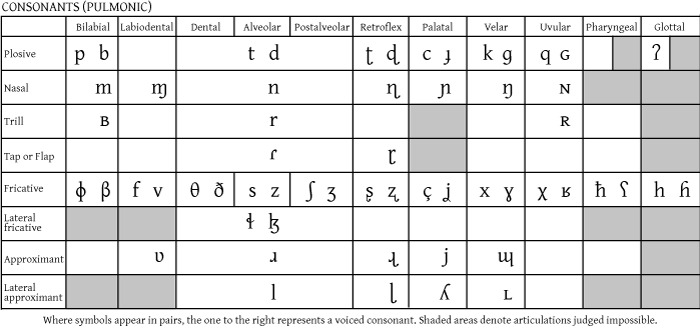
This chart might look complex, but it's just a map of all the consonant sounds humans can make using air from their lungs. Each column represents a place of articulation (where the sound is made), and each row represents a manner of articulation (how the sound is made).
Classifying Consonants
To understand a sound, phoneticians describe it in three ways:
- Voicing: Are the vocal cords vibrating? (Voiced or Voiceless)
- Place of Articulation: Where is the airflow obstructed in the vocal tract?
- Manner of Articulation: How is the airflow obstructed?
Let's look at the place and manner more closely.
The place of articulation is about where a sound is made. It's the location where your articulators get closest to each other.
| Place | Description | Example Sounds |
|---|---|---|
| Bilabial | Using both lips | /p/, /b/, /m/ |
| Labiodental | Lower lip against upper teeth | /f/, /v/ |
| Dental | Tongue tip against upper teeth | /θ/ (thigh), /ð/ (thy) |
| Alveolar | Tongue tip against the ridge behind your upper teeth | /t/, /d/, /n/, /s/, /z/ |
| Velar | Back of the tongue against the soft palate | /k/, /g/ |
The manner of articulation is about how the sound is made. It describes how the airflow is controlled.
| Manner | Description | Example Sounds |
|---|---|---|
| Stop (or Plosive) | Airflow is completely stopped, then released | /p/, /b/, /t/, /d/, /k/, /g/ |
| Fricative | Air is forced through a narrow channel, creating friction | /f/, /v/, /s/, /z/, /θ/, /ð/ |
| Nasal | Air escapes through the nose instead of the mouth | /m/, /n/, /ŋ/ (sing) |
| Approximant | Articulators are close but not enough to create friction | /w/, /j/ (yes), /l/, /r/ |
By combining these three labels, we can describe any consonant precisely. For example, the /p/ sound is a voiceless bilabial stop. The /z/ sound is a voiced alveolar fricative.
This framework is the foundation for understanding the subtle details of pronunciation, including the different ways we produce sounds like 't' in English.
What is the primary focus of phonetics?
A 'voiced' sound is produced when the vocal cords vibrate as air passes through them.