Understanding the Concept of D
Introduction to 'd'
Defining 'd'
You're likely familiar with delta, , which represents a finite change in a quantity. For example, could be a change of 5 units. The symbol 'd', as in , represents a similar idea but on an infinitely small scale. It's not a variable being multiplied by 'x'; rather, is a single entity that represents an infinitesimal change in the variable x. This is the fundamental building block of calculus.
Differential
noun
The principal part of the change in a function with respect to an infinitesimal change in the independent variable. It's an infinitely small change in a variable.
Think of zooming in on a smooth curve until it looks like a straight line. A tiny step along the x-axis is , and the corresponding tiny step along the y-axis is . The ratio of these two infinitesimally small steps gives us the slope of the curve at that exact point. This ratio is the derivative.
Why 'd' Matters
The concept of the differential unlocks the two major branches of calculus: differentiation and integration. It allows us to move from thinking about average change over an interval to instantaneous change at a single point. Without 'd', we couldn't precisely describe concepts like velocity at a specific moment or the slope of a tangent line to a curve.
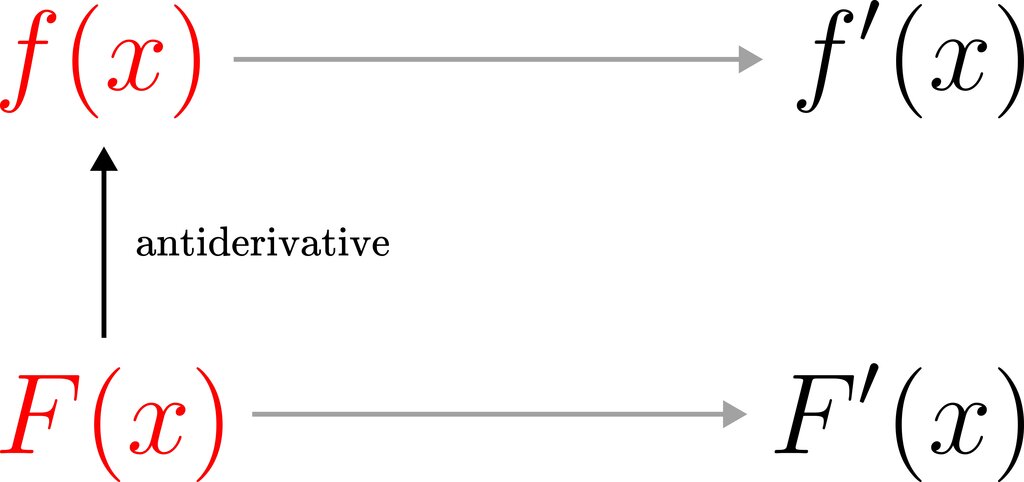
On the flip side, integration uses the differential to sum up an infinite number of these infinitesimally small pieces. To find the area under a curve, we can imagine slicing it into an infinite number of tiny rectangles. Each rectangle has a width of and a height of . The integral symbol, , represents the summation of the areas of all these tiny rectangles, giving us the total area.
Context is Key
The meaning of 'd' is consistent, but its application appears across many fields, often representing a tiny piece of a larger whole.
In physics, 'd' helps describe motion and forces. Velocity is the rate of change of position, and acceleration is the rate of change of velocity. Both are derivatives with respect to time, .
In geometry, differentials are used to calculate lengths of curves, areas of surfaces, and volumes of solids. For example, to find the length of a curve, we can approximate it as a series of tiny, straight line segments. The length of each segment, , can be found using the Pythagorean theorem with the differential changes in x and y.
This principle extends into other domains like economics, where 'd' is used for marginal analysis. The marginal cost, for example, is the derivative of the total cost function. It tells a company the cost of producing just one more unit, which is crucial for making production decisions.
What is the primary distinction between the symbol and the differential ?
In the context of finding the area under a curve, what does the in the integral represent?
Understanding the differential is a key step in mastering calculus and its applications. It bridges the gap between algebra and the study of continuous change.