Understanding Subnetting
Introduction to IP Addressing
What Is an IP Address?
Every device connected to a computer network, like the internet, needs a unique identifier. This identifier is its Internet Protocol (IP) address. Think of it like a mailing address for your house. It tells the network exactly where to send and receive information.
The most common version you'll see is IPv4 (IP version 4). An IPv4 address is a 32-bit number, which looks long and complicated in its raw binary form (a string of 32 ones and zeros). To make it easier for humans to read, we break it down into four 8-bit chunks called octets. Each octet is then converted into a decimal number from 0 to 255 and separated by a dot. This familiar format is called dot-decimal notation.
For example, the IP address
192.168.1.1is just a friendly way of writing the 32-bit binary number11000000.10101000.00000001.00000001.
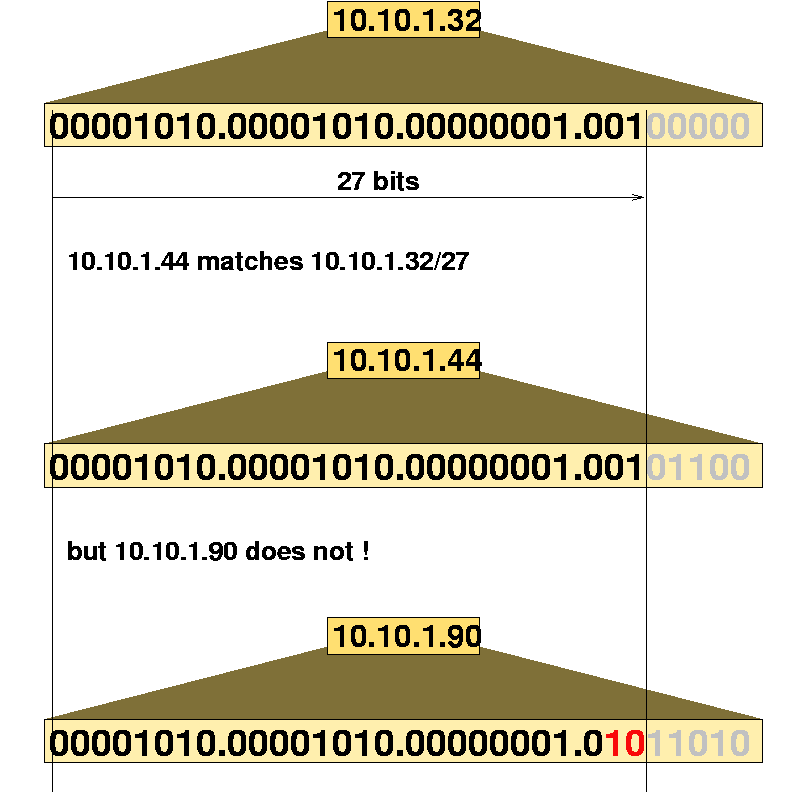
Network vs. Host
An IP address isn't just one single identifier; it's made of two parts: the network portion and the host portion.
- The network portion identifies the specific network the device is on. It's like the city and street name in your mailing address.
- The host portion identifies the specific device on that network. This is like your house number.
This division allows routers to efficiently send traffic to the correct network without needing to know the location of every single device on the internet. Once the data arrives at the right network, the local network hardware figures out which specific host gets the message.
Address Classes
Originally, IPv4 addresses were divided into different "classes" to accommodate networks of various sizes. The class of an address is determined by the value of its first octet. This system, known as classful addressing, helps define the default boundary between the network and host portions.
| Class | First Octet Range | Purpose | Default Network/Host Division |
|---|---|---|---|
| A | 1 - 126 | A few very large networks (e.g., for multinational corporations). | N.H.H.H (8 network bits, 24 host bits) |
| B | 128 - 191 | Medium-sized networks (e.g., for universities). | N.N.H.H (16 network bits, 16 host bits) |
| C | 192 - 223 | Many small networks (e.g., for small businesses). | N.N.N.H (24 network bits, 8 host bits) |
| D | 224 - 239 | Reserved for multicasting. | Not applicable |
| E | 240 - 255 | Reserved for experimental use. | Not applicable |
Notice that 127 is missing from the table. The entire 127.0.0.0 block is reserved for loopback addresses, which a device uses to send messages to itself, primarily for testing.
While this class system is now largely replaced by a more flexible method called Classless Inter-Domain Routing (CIDR), understanding classes is crucial for grasping the history and fundamentals of IP addressing.
multicast
noun
A communication method where a piece of information is sent from one or more points to a set of other points. A device can choose to join a multicast group to receive the data.
Ready to test your knowledge? Let's see what you've learned about the structure of IP addresses.
What is the primary function of an IP address?
An IPv4 address is a 32-bit number, but for human readability, it's typically written in dot-decimal notation. How is this format structured?
Understanding these core components of an IP address is the first step. It provides the foundation for how devices are located and how data is routed across the internet.