Understanding Static Electricity for Grade 7
Atomic Charge Transfer
The Electron Shuffle
You already know that atoms, the building blocks of everything, contain positively charged protons and negatively charged electrons. In a normal, stable atom, these charges balance out, making the atom electrically neutral. But things get interesting when this balance is disturbed.
Protons are locked tightly in the atom's nucleus and don't go anywhere. Electrons, however, are on the move. They orbit the nucleus and can sometimes be persuaded to jump from one atom to another. This movement is the key to understanding static electricity.
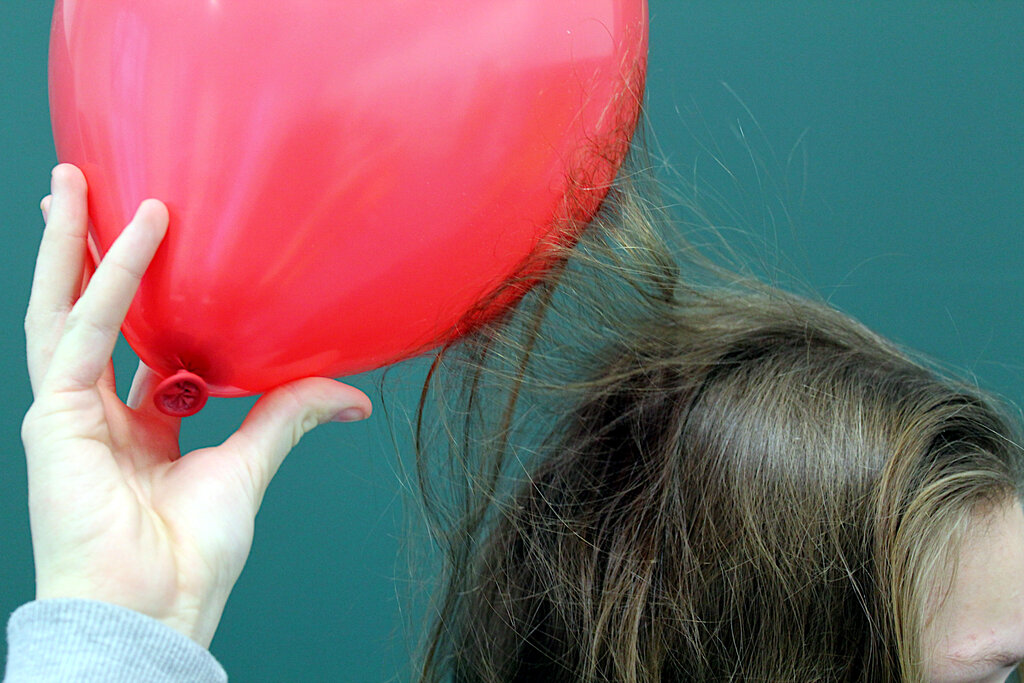
When you rub a balloon on your hair, you're creating friction. This isn't just generating heat; it's giving electrons enough energy to leap from your hair to the surface of the balloon. Your hair now has more protons than electrons, giving it a positive net charge. The balloon, with its extra supply of electrons, now has a negative net charge.
Opposite charges attract. This is why your positively charged hair lifts up to meet the negatively charged balloon. It's not magic, it's physics at the atomic level. Importantly, no new charges are created or destroyed in this process. They are simply moved around. This is the Conservation of Charge principle.
Net Charge
noun
The overall electric charge of an object, determined by the imbalance between its protons and electrons.
A Material's Preference
Why do electrons jump from hair to rubber, and not the other way around? It comes down to a property called electron affinity. Think of it as how much a material “likes” or “wants” electrons. Some materials, like the rubber of a balloon or plastic, have a high electron affinity. They are electron grabbers.
Other materials, like human hair or wool, have a low electron affinity. They hold onto their electrons more loosely and are more willing to give them up. When two materials are rubbed together, the one with the higher electron affinity will pull electrons from the one with lower affinity. This predictable exchange is the basis for something called the triboelectric series—a list that ranks materials by their tendency to gain or lose electrons.
An object becomes negatively charged by gaining electrons. It becomes positively charged by losing electrons.
| Material | Tendency | Example Charge after Rubbing |
|---|---|---|
| Glass | Easily loses electrons | Positive (+) |
| Human Hair | Tends to lose electrons | Positive (+) |
| Wool | Tends to lose electrons | Positive (+) |
| Cotton | Neutral (doesn't easily trade) | Neutral |
| Rubber | Tends to gain electrons | Negative (-) |
| PVC (Plastic) | Easily gains electrons | Negative (-) |
The table above is a simplified version of the triboelectric series. If you rub a material from the top of the list (like glass) with a material from the bottom (like rubber), you can confidently predict that electrons will move from the glass to the rubber. The glass will become positively charged, and the rubber will become negatively charged.
What is the net charge of a stable atom that has lost one or more electrons?
The principle of Conservation of Charge states that electric charge can be created by friction, but not destroyed.