Understanding Shakespeare
Shakespeare's Language
Speaking Shakespeare's Language
Reading Shakespeare can feel like learning a new dialect. It's not Old English or Middle English, but a form called Early Modern English. The grammar and vocabulary are different enough to trip us up, but familiar enough to understand with a little practice.
You'll notice pronouns like thee, thou, and thy instead of you and your. Verbs often end in -est or -th, like “thou goest” (you go) or “he goeth” (he goes). Shakespeare also loved to play with word order. He might write, “A sweeter flower did nature never pluck,” instead of the more modern, “Nature never plucked a sweeter flower.” This inversion isn't just for style; it helps fit the rhythm of the line.
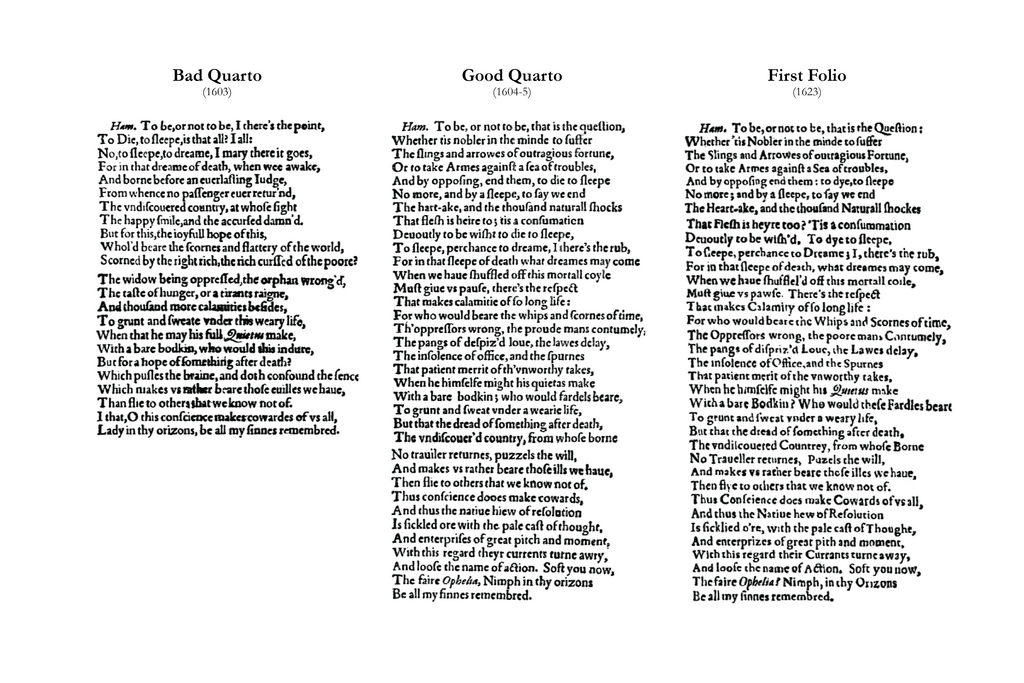
These variations in language, even between early editions of the same play, are part of what makes studying Shakespeare's work so fascinating.
The Rhythm of the Lines
Much of Shakespeare's drama is written in a specific poetic meter called iambic pentameter. It sounds complicated, but it's based on a simple, natural rhythm that mimics a heartbeat: da-DUM, da-DUM, da-DUM.
Each da-DUM is an “iamb,” a pair of syllables where the first is unstressed and the second is stressed. “Pentameter” just means there are five of these iambs in a line. So, a line of iambic pentameter has ten syllables in a repeating unstressed-stressed pattern.
But, soft! what light through yonder window breaks?
This line from Romeo and Juliet is a perfect example. Read it aloud, and you can feel the five beats. When iambic pentameter doesn't rhyme, it's called blank verse. This was Shakespeare's go-to form for most of the dialogue in his plays.
Prose vs. Verse
Shakespeare didn't write everything in iambic pentameter. He switched between verse (structured, rhythmic language) and prose (ordinary speech) to tell us about his characters. The way a character speaks is a clue to their social status, education, and emotional state.
High-status characters like kings, queens, and nobles usually speak in verse. It sounds formal, intelligent, and serious. In contrast, lower-status characters like servants, clowns, or common soldiers typically speak in prose. Their language is more direct and down-to-earth. Prose is also used for comedic scenes, letters, and moments when a noble character might be losing their mind or trying to be deceptive.
| Feature | Verse | Prose |
|---|---|---|
| Structure | Rhythmic, metered lines | Everyday speech patterns |
| Used by | Nobles, educated characters | Commoners, servants, clowns |
| Used for | Serious, emotional, or formal scenes | Comedic, informal, or chaotic scenes |
Think of Hamlet. In his famous soliloquies, he speaks in beautiful, philosophical verse. But when he pretends to be mad, he switches to wild, unpredictable prose.
Wordplay and Wit
Beyond rhythm and structure, Shakespeare's language is packed with rhetorical devices and wordplay. He was a master of puns, metaphors, and similes, using them to add layers of meaning and humor.
A pun is a play on words that sound alike but have different meanings. In Romeo and Juliet, a dying Mercutio says, “Ask for me tomorrow, and you shall find me a grave man.” “Grave” means both serious and a place for burial.
He also used metaphors (comparing two unlike things directly) and similes (comparing things using “like” or “as”). When Romeo first sees Juliet, he says, “It is the east, and Juliet is the sun,” a powerful metaphor suggesting she brings light and life to his world.
As much as plot and character, it's Shakespeare's language that enthrals.
The language also changes from play to play. The lyrical, romantic verse of A Midsummer Night's Dream is very different from the dark, violent, and fragmented language of King Lear. The style always serves the story, enhancing its themes and developing its characters in ways that continue to resonate with audiences today.
The English used in Shakespeare's plays is known as:
What is the primary reason Shakespeare often inverted the typical word order (e.g., “A sweeter flower did nature never pluck”)?
Understanding these linguistic building blocks unlocks a deeper appreciation for the artistry in Shakespeare's work.