Understanding Retrieval-Augmented Generation
Introduction to RAG
Giving AI an Open Book
Large Language Models, or LLMs, are powerful. They can write emails, summarize articles, and even generate code. They seem to know a little bit about everything. But they have a fundamental limitation: they only know what they were taught during their training. Their knowledge is frozen in time.
Ask an LLM about an event that happened yesterday, and it will likely draw a blank. Ask it about your company's internal policies, and it will have no idea. This is because a standard LLM works from memory alone, like a student taking a closed-book exam. It can't look things up.
This is where Retrieval-Augmented Generation, or RAG, comes in. RAG is a technique that gives an LLM an "open book" to consult before answering a question. It connects the model to external, up-to-date sources of information, allowing it to retrieve relevant facts first and then use those facts to generate a more accurate and timely response.
Retrieval-Augmented Generation (RAG)
noun
An AI framework that enhances Large Language Models by first retrieving relevant information from an external knowledge base and then using that information to generate a response.
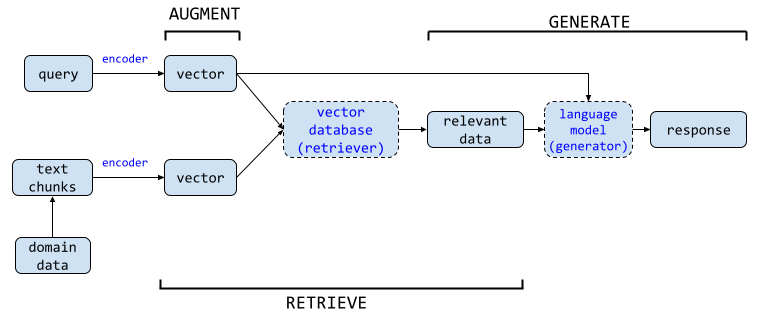
The process is straightforward. When a user submits a query, the RAG system doesn't immediately send it to the LLM. First, it searches a designated knowledge source—like a collection of company documents, a database, or a set of recent news articles—for information related to the query. It then takes the most relevant snippets it finds and combines them with the original question. This new, enriched prompt is then handed to the LLM to generate the final answer.
The Problem with Memory Alone
Without a system like RAG, LLMs face a few key challenges. Their static knowledge base is the most obvious one. Since training an LLM is incredibly expensive and time-consuming, it can't be done every day. This means a model trained in 2023 won't know the winner of the 2024 Super Bowl.
Another significant issue is "hallucination." When an LLM doesn't know the answer to a question, its programming might compel it to generate a plausible-sounding but incorrect response. It's not lying in the human sense; it's simply trying to be helpful by filling in the gaps with what it thinks should be there. This can be misleading or even dangerous in high-stakes situations.
Finally, standard LLMs lack specialized knowledge. They have a vast general understanding of the world, but they don't know the specific details of a particular organization's internal workings, the latest findings from a niche scientific field, or the personal context of an individual user.
A standard LLM is like a brilliant historian who has never read today's newspaper. RAG is the newspaper subscription that keeps it current.
RAG in the Real World
The benefits of RAG are clear: it makes AI responses more accurate, trustworthy, and relevant. By grounding the LLM's output in specific, verifiable documents, RAG reduces hallucinations and ensures the information is current. This has led to its adoption in many practical applications.
-
Customer Support: Chatbots powered by RAG can access a company's entire knowledge base of product manuals, FAQs, and troubleshooting guides. This allows them to provide accurate, up-to-date answers to customer questions instead of giving generic advice.
-
Enterprise Search: Employees can use a RAG-based system to ask natural language questions about internal company documents, such as HR policies, financial reports, or project histories. The system can find the exact information needed and summarize it instantly.
-
Research and Analysis: A financial analyst could ask a RAG system to summarize the key risks mentioned in the latest quarterly earnings reports for a dozen different companies. The system would retrieve the relevant sections from each report and generate a concise summary, saving hours of manual work.
By bridging the gap between an LLM's static knowledge and the dynamic, ever-changing world of information, RAG makes AI a more powerful and reliable tool.
Ready to check your understanding?
What is the primary limitation of a standard Large Language Model (LLM) that Retrieval-Augmented Generation (RAG) is designed to address?
Which of the following best describes the process a RAG system follows after receiving a user's query?
Now that you understand the what and why of RAG, we can move on to how it actually works under the hood.