Understanding Quantum Immortality
Introduction to Quantum Mechanics
The Weird World of Quantum Rules
In our everyday lives, things are straightforward. A cat is either asleep or awake. A light switch is either on or off. But when we zoom way down to the level of atoms and particles, the rules change completely. Welcome to quantum mechanics, where things can be in multiple states at once and behave in ways that seem to defy common sense.
Superposition
Imagine you flip a coin. While it's spinning in the air, what is it? Heads or tails? In a way, it's a mix of both possibilities. It's only when it lands and you look at it that it settles into a definite state. Quantum superposition is a bit like that spinning coin, but for fundamental particles like electrons.
A particle can exist in a combination of all its possible states simultaneously. It's not just 50% chance of being in state A and 50% chance of being in state B; it's actually in both states at the same time. This combination of states is described by a mathematical object called the wave function.
Superposition
noun
The principle that a quantum system can exist in multiple states or locations at the same time. The system's actual state is a combination of all possibilities.
This isn't just a theoretical trick. Superposition is a real, measurable property of the quantum world and is the foundation for technologies like quantum computing.
Wave-Particle Duality
Another strange quantum rule is that particles can also act like waves. Think of a particle like a grain of sand—a tiny, solid object. Now think of a wave, like a ripple in a pond, spreading out. In our world, something is one or the other. In the quantum realm, an electron can be both.
This was famously demonstrated in the double-slit experiment. If you shoot tiny particles, like electrons, at a screen with two slits in it, you might expect to see two bands on the detector behind it, right where the electrons passed through. But that’s not what happens.
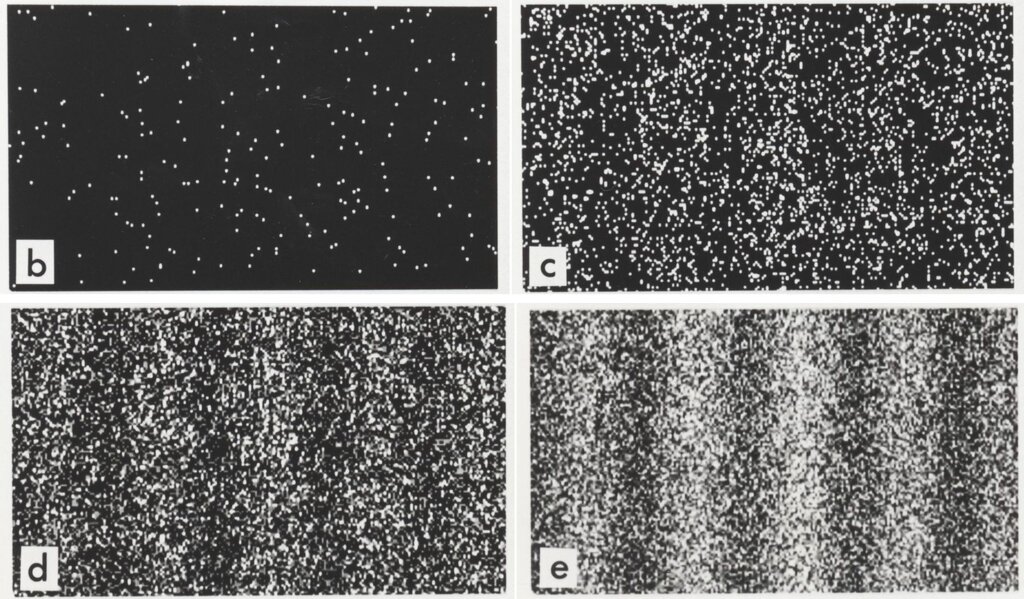
Instead, an interference pattern of many bands appears, as if waves were passing through both slits and interfering with each other. The strange part? Each electron is sent one at a time. It seems each electron somehow goes through both slits at once, like a wave, and interferes with itself.
But if you place a detector at the slits to see which one the electron goes through, the wave behavior vanishes. The interference pattern disappears, and you get just two bands, as you'd expect from particles. The very act of observing changes the outcome.
A quantum object acts like a wave when you're not looking, but like a particle when you are.
Wave Function Collapse
This brings us to our final concept, which ties everything together: wave function collapse.
The wave function describes all the possibilities of a quantum system in superposition. For the electron in the double-slit experiment, its wave function spreads out and passes through both slits. But when we measure it—when we “look” to see which slit it went through—the superposition is broken.
The wave function “collapses,” and the particle is forced to “choose” a single, definite state. It appears at one slit or the other, but not both. The probability of it appearing in any given state is determined by its wave function just before the measurement.
So, the spinning coin doesn't just decide to be heads or tails on its own. The act of it landing on the table—the measurement—is what forces the outcome. Similarly, the act of observing a particle forces it out of its cloudy, wave-like state of many possibilities into a single, concrete reality.
What does the principle of quantum superposition state?
In the double-slit experiment, firing electrons one at a time at two slits results in an interference pattern, as if they were waves. What does this suggest?
These three ideas—superposition, wave-particle duality, and wave function collapse—are the bedrock of quantum mechanics. They challenge our intuition, but they accurately describe the universe at its most fundamental level.