Understanding Planets
Introduction to Planets
What Makes a Planet?
A planet is a large celestial body that orbits a star. It's big enough to be rounded by its own gravity but not massive enough to start nuclear fusion like a star does. Think of it as a major player in its cosmic neighborhood.
A 'planet' is a celestial body that (a) is in orbit around the Sun, (b) has sufficient mass for its self-gravity to overcome rigid body forces so that it assumes a hydrostatic equilibrium (nearly round) shape, and (c) has cleared the neighbourhood around its orbit.
This official definition was set by the International Astronomical Union (IAU) in 2006. Let's break down those three rules.
First, it must orbit the Sun (or any star). This separates planets from moons, which orbit planets.
Second, it must be massive enough to be nearly round. The planet's own gravity pulls it into a spherical shape. Small objects like asteroids are often lumpy and irregular because their gravity isn't strong enough to do this.
Third, it must have “cleared the neighborhood” around its orbit. This is the trickiest rule. It means the planet has become the dominant gravitational force in its path, sweeping up or flinging away most other objects.
Orbit
noun
The curved path of a celestial object or spacecraft around a star, planet, or moon, especially a periodic elliptical revolution.
Planets vs. Other Objects
The third rule is what separates planets from dwarf planets. A dwarf planet, like Pluto, meets the first two criteria: it orbits the Sun and is round. However, it hasn't cleared its orbital path of other objects. Pluto's orbit is full of other icy bodies in a region called the Kuiper Belt. It’s more like one resident in a crowded cosmic cul-de-sac rather than the sole owner of a vast estate.
Moons, also known as natural satellites, are different. They orbit planets instead of orbiting the Sun directly. While some moons are larger than planets like Mercury, their primary orbit around a planet is what defines them.
Our Solar System's Lineup
Our solar system has eight official planets. Starting from the Sun and moving outward, the order is Mercury, Venus, Earth, Mars, Jupiter, Saturn, Uranus, and Neptune.
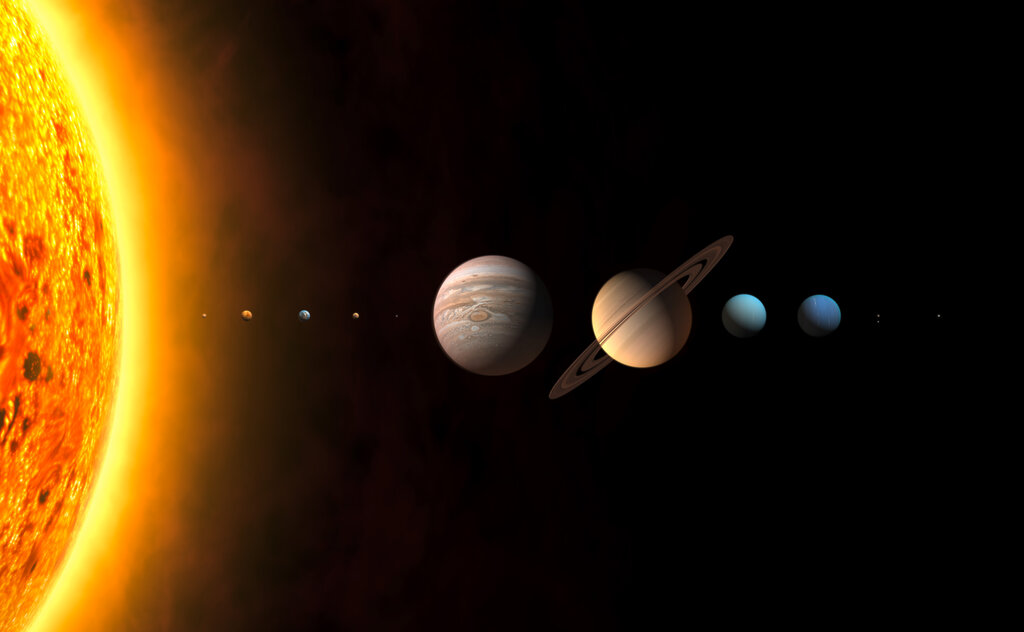
These planets are often split into two groups. The first four, Mercury through Mars, are the terrestrial planets. They are smaller, rocky, and have solid surfaces. The last four, Jupiter through Neptune, are the gas and ice giants. They are much larger and are composed mostly of gases and liquids, with a small rocky core.
| Planet | Type |
|---|---|
| Mercury | Terrestrial |
| Venus | Terrestrial |
| Earth | Terrestrial |
| Mars | Terrestrial |
| Jupiter | Gas Giant |
| Saturn | Gas Giant |
| Uranus | Ice Giant |
| Neptune | Ice Giant |
Ready to check your understanding? Let's see what you've learned about planets.
According to the International Astronomical Union (IAU), which of the following is NOT a required characteristic for a celestial body to be classified as a planet?
What is the primary reason Pluto is classified as a dwarf planet rather than a planet?
Understanding these basic definitions helps us categorize the countless objects we discover in space, both in our own solar system and beyond.