Understanding Newton's Laws of Motion
Introduction to Motion
What Is Motion?
Everything in the universe moves. From the planets orbiting the sun to the electrons buzzing inside atoms, motion is a fundamental part of existence. But what does it actually mean for something to be in motion?
Simply put, motion is a change in an object's position over time, relative to a reference point. If you walk from your sofa to the kitchen, your position has changed. You've moved. The sofa can be your reference point. This idea of a reference point is key. A passenger on a moving train might feel perfectly still, but relative to someone standing on the platform, they're moving very fast.
Motion
noun
The action or process of changing position or place.
Motion generally falls into two basic categories.
Linear motion is movement in a straight line. Think of a bowling ball rolling down an alley or a lift going from one floor to another.
Rotational motion is movement around a central point or axis. A spinning top, a turning Ferris wheel, and the Earth spinning on its axis are all examples of rotational motion. Many real-world movements are a combination of both.
Distance and Displacement
When we talk about how far something has moved, we need to be precise. There's a subtle but important difference between distance and displacement.
Distance is a measure of the total path covered during a motion. If you run a 400-metre lap around a track, the distance you've covered is 400 metres. It’s a scalar quantity, which means it only has a magnitude (a size or number).
Displacement, on the other hand, is the overall change in position from the starting point to the ending point. It’s a vector quantity, meaning it has both magnitude and direction. If you run a 400-metre lap and end up exactly where you started, your displacement is zero metres, even though you ran a long way.
Imagine walking 3 blocks east and then 4 blocks north. The total distance you walked is 7 blocks. However, your displacement is 5 blocks northeast from your starting point. It's the shortest straight-line path between start and finish.
Speed and Velocity
Just as distance and displacement are different, so are speed and velocity. They both describe how fast an object is moving, but they tell slightly different stories.
Speed is how fast an object is covering distance. It's a scalar quantity. If a car's speedometer reads 60 miles per hour, that's its speed. We can calculate the average speed of an object by dividing the total distance travelled by the time it took.
Velocity is the rate at which an object changes its position. In other words, it's the rate of displacement. Because displacement has a direction, velocity must have one too, making it a vector quantity. To state an object's velocity, you need to say how fast it's going and in what direction, for example, '60 miles per hour east'.
A race car driving around an oval track might have a constant high speed, but its velocity is constantly changing because its direction is always turning.
Getting Up to Speed: Acceleration
What happens when velocity itself changes? That's where acceleration comes in. Acceleration is the rate of change of velocity over time. Like velocity, it's a vector quantity.
Most people think acceleration just means 'speeding up'. That's partly true, but it's not the whole picture. Because velocity involves both speed and direction, you are accelerating if you:
- Speed up (positive acceleration)
- Slow down (negative acceleration, also called deceleration)
- Change direction
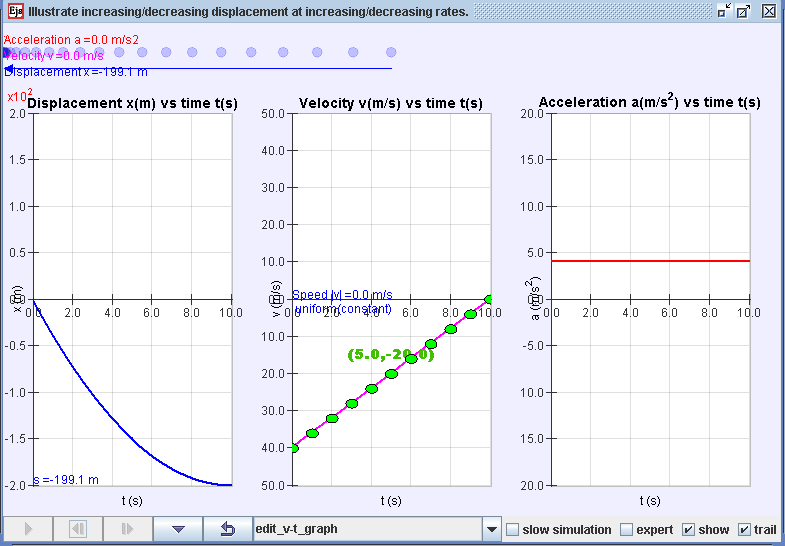
A car turning a corner at a constant speed is accelerating because its direction is changing. A ball thrown straight up into the air is also accelerating. Its speed decreases on the way up and increases on the way down, all while the acceleration due to gravity remains constant and directed downwards.
Now you have a grasp of the basic language used to describe motion. These concepts—displacement, velocity, and acceleration—are the building blocks for understanding the more complex reasons why things move the way they do.
An athlete runs exactly one full lap around a 400-metre track, ending precisely at the starting line. What is their total displacement?
Which of the following is a key difference between speed and velocity?