Understanding Navier-Stokes Equations
Introduction to Fluid Dynamics
What Makes a Fluid, a Fluid?
At its core, a fluid is any substance that can flow. This includes liquids like water and oil, but also gases like the air you're breathing. What truly separates a fluid from a solid is how it responds to a certain type of force.
Imagine you place a book on a table and push it lightly from the side. The book might move a tiny bit and then stop. It resists the force. That's a solid. Now, imagine putting your hand on the surface of water and pushing it sideways. Your hand moves continuously. The water doesn't stop it; it flows out of the way. This is the key characteristic of a fluid: it continuously deforms under a sideways force, known as shear stress.
fluid
noun
A substance that has no fixed shape and yields easily to external pressure; a gas or a liquid.
To describe how a fluid behaves, we focus on a few key properties. The two most important are density and viscosity.
Density () is how much mass is packed into a given volume. A cubic meter of water is much heavier than a cubic meter of air because water is denser.
Viscosity () is a measure of a fluid's resistance to flowing. Honey is highly viscous; it pours slowly. Water has a low viscosity; it flows easily.

A World Without Gaps
We know that air and water are made of countless tiny molecules buzzing around with empty space between them. If we wanted to describe fluid flow by tracking every single molecule, the task would be impossible. The numbers are just too big.
So, we make a simplifying assumption. We pretend the fluid is a continuous, unbroken substance, like a smooth jelly. This is called the continuum assumption. It allows us to ignore the individual molecules and instead talk about properties like density, pressure, and velocity at any given point within the fluid.
This assumption works remarkably well as long as the scale we're interested in is much larger than the distance between molecules. For nearly all real-world engineering and environmental problems, from designing airplanes to predicting weather, the continuum assumption is a valid and essential tool.
The Nature of Flow
When a fluid moves, it doesn't always move in the same way. The flow can be smooth and predictable, or chaotic and swirly. These two main types of flow are called laminar and turbulent.
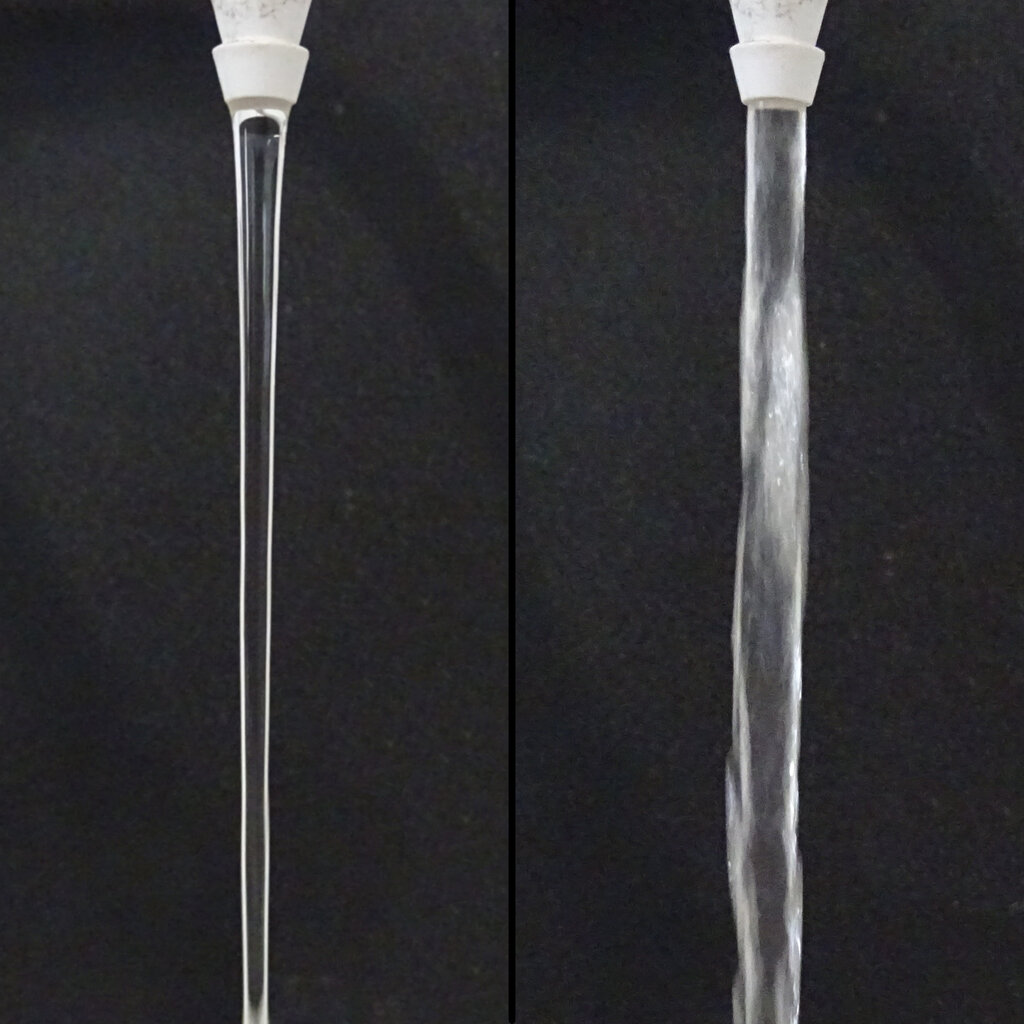
Laminar flow is characterized by smooth layers of fluid sliding past one another. Think of maple syrup slowly oozing off a pancake. The motion is orderly and predictable. This type of flow typically occurs at low speeds or in highly viscous fluids.
Turbulent flow, on the other hand, is chaotic and irregular. It's full of eddies and vortices that mix the fluid. A raging river, the smoke from a snuffed-out candle, or the air behind a speeding car are all examples of turbulent flow. It's much more common in nature and engineering than laminar flow.
The motion of a fluid, whether laminar or turbulent, is governed by a few basic principles. It's pushed around by pressure differences, pulled down by gravity, and its motion is resisted by its own internal friction, or viscosity. By understanding these properties and principles, we can begin to predict and control how fluids behave.
What is the defining characteristic of a fluid?
Why do engineers and scientists use the "continuum assumption" when analyzing fluids?