Understanding Motion
Introduction to Motion
Position and Change
Everything moves. A car driving down the street, a planet orbiting the sun, even the electrons buzzing inside the atoms of your chair. To study motion, physicists start with the basics: where an object is and how its position changes.
There are two ways to describe a change in position: distance and displacement. They sound similar, but the difference is critical.
Distance is a simple measure of how much ground an object has covered. If you run a 5-kilometer race, you've covered a distance of 5 kilometers. It doesn't matter if the race was in a straight line or a winding path. The distance is the total length of the path you took.
Distance is a scalar quantity. It only has a magnitude (a size or amount), like 10 meters or 25 miles per hour. It doesn't include a direction.
Displacement, on the other hand, is about the change from an object's starting point to its ending point. It's the shortest, straight-line path between those two points, and it includes a direction. Imagine you walk 4 meters east and then 3 meters north. The total distance you walked is 7 meters. Your displacement, however, is 5 meters to the northeast—the straight line from where you started to where you ended up.
In physics, we often care more about displacement than distance. Why? Because displacement is a vector. It has both magnitude and direction. This makes it much more useful for describing motion precisely.
displacement
noun
The change in an object's position, expressed as a distance and direction in a straight line from the starting point to the ending point.
How Fast
Just like we have distance and displacement, we have two ways to talk about how fast an object is moving: speed and velocity.
Speed is probably what you're most familiar with. It's the rate at which an object covers distance. When your car's speedometer reads 60 miles per hour, it's telling you your speed. Like distance, speed is a scalar—it only has a magnitude.
Velocity is the rate at which an object's position changes. In other words, it's the rate of displacement. Because displacement is a vector, velocity must be a vector, too. It has both magnitude (which is just the speed) and direction. Saying a storm is moving at 20 miles per hour isn't very helpful. Saying it's moving at 20 miles per hour to the east gives you the full picture. That's its velocity.
An object can have a high speed but zero velocity. If you run a full lap around a 400-meter track and end up exactly where you started, your displacement is zero. Even if you ran fast, your average velocity for the lap is zero because your position didn't change overall.
| Concept | Type | Description |
|---|---|---|
| Distance | Scalar | Total path length traveled. |
| Displacement | Vector | Change in position (straight line and direction). |
| Speed | Scalar | How fast distance is covered. |
| Velocity | Vector | How fast displacement occurs (speed and direction). |
Changing Velocity
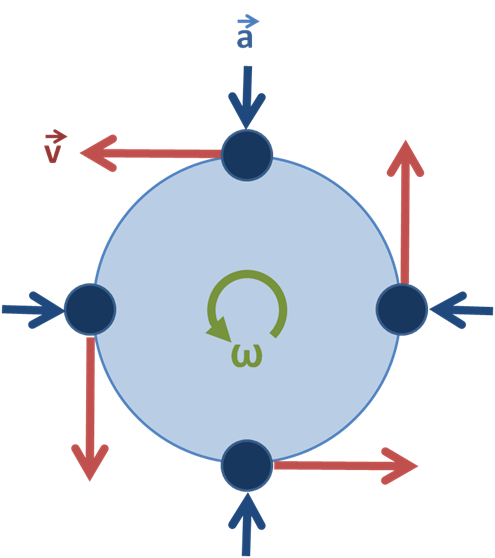
What happens when an object's velocity changes? We call this acceleration. Acceleration is the rate of change of velocity.
Most people think acceleration just means speeding up. That's part of it, but it's not the whole story. Since velocity is a vector (with speed and direction), you can accelerate in three ways:
- Speeding up: Stepping on the gas pedal in a car.
- Slowing down: Stepping on the brake. This is often called deceleration, but in physics, it's just a negative acceleration.
- Changing direction: A car turning a corner, even at a constant speed, is accelerating because its direction of motion is changing.
Like velocity, acceleration is a vector. It has both a magnitude and a direction.
acceleration
noun
The rate at which an object's velocity changes over time. An object is accelerating if its speed, direction, or both are changing.
The formula for average acceleration looks similar to the one for velocity. It's the change in velocity divided by the time it took for that change to happen.
Understanding these three concepts—displacement, velocity, and acceleration—is the first step to describing and predicting the motion of nearly everything in the universe.
Now, let's test your understanding of these fundamental concepts.
A runner completes one full lap around a 400-meter circular track. What is their total distance and total displacement?
A car is driving at a constant speed of 50 km/h around a bend in the road. Is the car accelerating?
These building blocks are essential. With a solid grasp of how to describe motion, you can begin to explore why things move the way they do.