Understanding Magnetic Fields and Their Properties
Magnetic Field Basics
The Invisible Field of Force
Every magnet, and every moving electric charge, is surrounded by an invisible area of influence. This region is called a magnetic field. It's a force field that can attract or repel other magnetic materials or moving charges without touching them.
While we can't see the field itself, we can see its effects. If you've ever sprinkled iron filings on a piece of paper with a magnet underneath, you've seen a map of this field. The filings arrange themselves into a distinct pattern of lines.
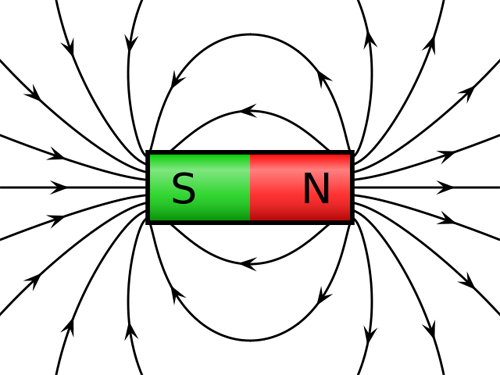
These patterns reveal what scientists call magnetic field lines. They aren't real lines, of course, but a tool to help us visualize the invisible. They tell us two important things about the magnetic field at any point: its direction and its strength.
The direction of the magnetic field line is the direction a compass would point. By convention, these lines always point away from a magnet's north pole and toward its south pole.
The strength of the field is shown by how close the lines are to each other. Where the lines are packed tightly together, the magnetic field is strong. Where they are spread far apart, the field is weak. You can see in the image above that the field is strongest near the magnet's poles.
An interesting property of magnetic field lines is that they always form closed loops. They don't start or end anywhere. They travel from the north pole to the south pole outside the magnet, and then continue through the magnet from south back to north, completing the loop.
Magnetic Flux
While field lines give us a good picture of the magnetic field, sometimes we need to quantify how much of the field is passing through a particular area. This measurement is called magnetic flux.
Imagine holding a hoop in a rainstorm. The total amount of rain passing through your hoop is like the magnetic flux. It depends on how hard it's raining (the field strength), the size of your hoop (the area), and how you angle the hoop relative to the rain (the orientation).
Magnetic flux, represented by the Greek letter phi ($ \Phi $), is a measure of the total number of magnetic field lines passing through a given surface.
A stronger magnetic field or a larger area will result in a greater magnetic flux. The angle is also key. If you hold the hoop parallel to the rain, no water passes through. Similarly, if a surface is parallel to the magnetic field lines, the magnetic flux through it is zero. Flux is maximized when the surface is perpendicular to the field lines, catching them all head-on.
The standard unit for magnetic flux is the weber, abbreviated as Wb.
weber
noun
The standard unit of magnetic flux, named after the German physicist Wilhelm Eduard Weber.
Understanding magnetic flux is crucial because, as we'll see later, a change in flux is what generates electric currents in a process called electromagnetic induction. This principle is the foundation for electric generators and transformers.
Ready to check your understanding?
What does the density of magnetic field lines in a particular region indicate?
Which statement accurately describes the path of magnetic field lines?
We've covered the fundamentals of what magnetic fields are and how we describe them. Next, we'll look at where these fields come from.