Understanding Lenses and Light
Properties of Light
A Dual Identity
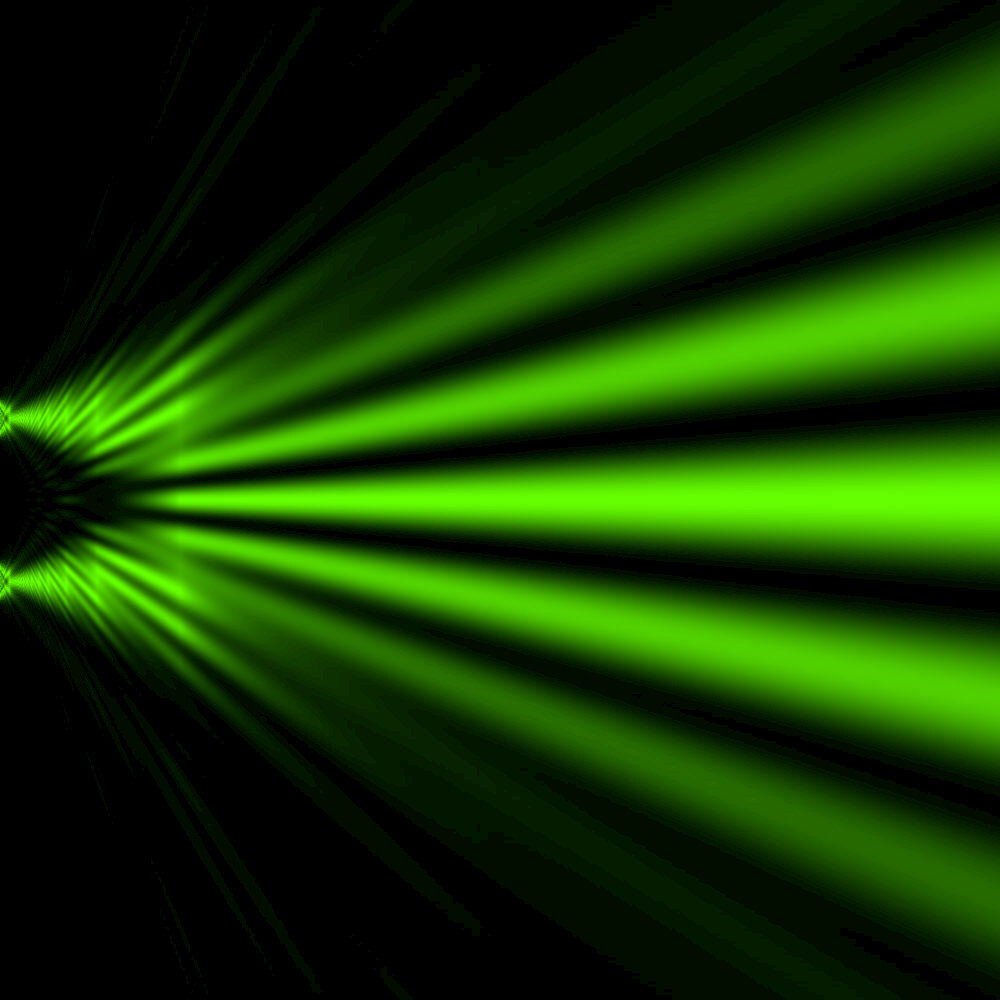
Light has a strange and fascinating nature. Sometimes it behaves like a wave, spreading out and creating interference patterns much like ripples on a pond. At other times, it acts like a stream of tiny, distinct packets of energy.
Photon
noun
A discrete packet of electromagnetic energy. It is the fundamental particle of light.
This concept is known as wave-particle duality. It's not that light is one or the other; it's somehow both at the same time. The behavior we observe depends on the experiment we perform. When we look for wave-like properties, such as how light bends around obstacles or interferes with itself, we find them. When we look for particle-like properties, like its ability to knock electrons off a metal plate, we find those too.
His observations of coloured fringes in these experiments demonstrated that light must travel from place to place in the form of a wave, and the different colours comprising white light could be characterized by different wavelengths.
Bending and Bouncing
When light hits a surface, two things can happen. It can bounce off, or it can pass through. Usually, a bit of both occurs.
Reflection is when light bounces off a surface. Think of a mirror. The light hits the silvered surface and reflects back, allowing you to see your image. Reflection follows a very simple and predictable rule.
The angle at which light hits a surface (the angle of incidence) is equal to the angle at which it reflects (the angle of reflection).
Refraction is the bending of light as it passes from one substance, or medium, into another. This happens because light travels at different speeds in different media. A classic example is a straw in a glass of water; it appears bent at the water's surface. This illusion is caused by the light from the straw refracting as it moves from water to air before reaching your eyes.
A Spectrum of Colors
What we perceive as white light is actually a mixture of all the colors of the rainbow. This can be demonstrated by passing light through a prism. The prism separates the white light into its constituent colors, a phenomenon called dispersion.
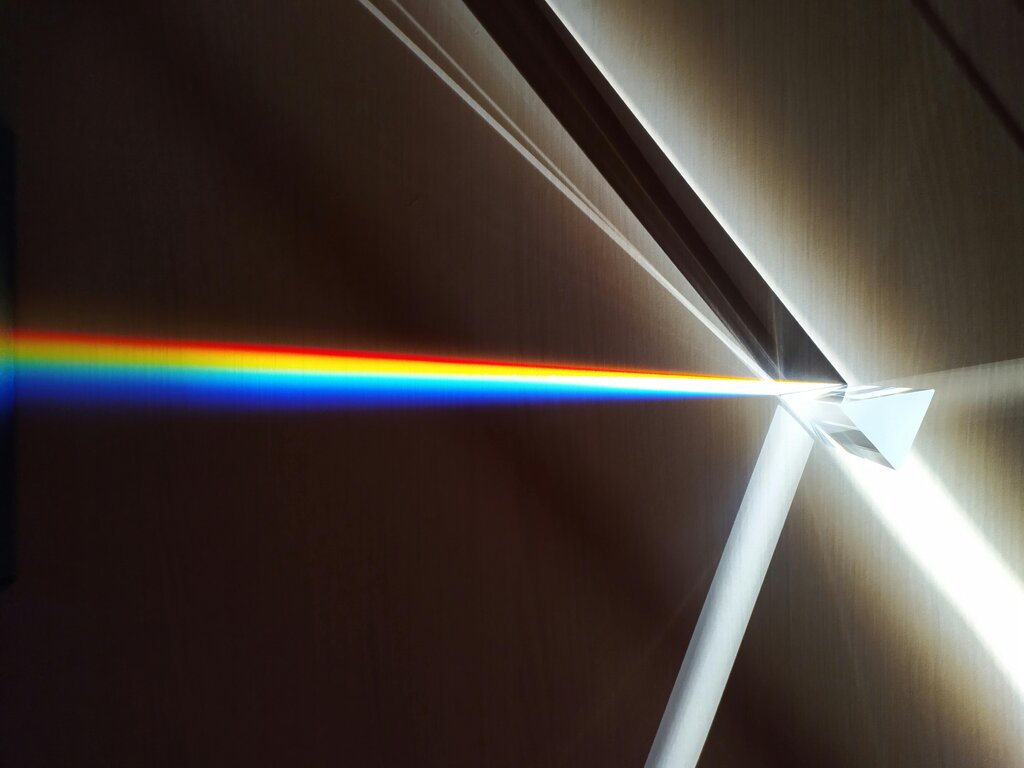
Dispersion occurs because the amount of refraction depends on the wavelength (or color) of the light. Violet light, with a shorter wavelength, bends more than red light, which has a longer wavelength. This slight difference in bending angle is enough to spread the colors out into a full spectrum.
The visible light we can see is just a tiny fraction of a much broader range of light called the electromagnetic spectrum. This spectrum includes everything from radio waves and microwaves to X-rays and gamma rays, all of which are forms of light with different wavelengths and energy levels.
The Cosmic Speed Limit
Light travels at its maximum speed in a vacuum, a speed so fundamental it's represented by its own constant, . This is approximately 299,792,458 meters per second, or about 186,282 miles per second. Nothing with mass can travel faster than this speed.
The speed of light in a vacuum () is the universe's ultimate speed limit.
However, when light passes through a transparent medium like air, water, or glass, it slows down. The amount it slows down is described by the medium's refractive index, denoted by the letter . A higher refractive index means light travels more slowly in that medium.
| Medium | Refractive Index (n) |
|---|---|
| Vacuum | 1.0 (exactly) |
| Air | ~1.0003 |
| Water | ~1.33 |
| Crown Glass | ~1.52 |
| Diamond | ~2.42 |
These fundamental properties—light's dual nature, its ability to reflect and refract, its colorful spectrum, and its changing speed—are the building blocks for understanding all of optics.
The concept that light can behave as both a wave and a stream of particles is known as:
A straw in a glass of water appears bent at the surface due to a phenomenon called: