Understanding Knowledge
Defining Knowledge
What is Knowledge?
Philosophers have been asking this question for centuries. On the surface, it seems simple. You know your name, you know the sky is blue, you know that 2 + 2 = 4. But what does it actually mean to know something? What separates knowledge from a lucky guess or a simple opinion?
For a very long time, the most common answer came from the ancient Greek philosopher Plato. He suggested that for something to count as knowledge, it must meet three specific criteria. This framework is often called the Justified True Belief, or JTB, model.
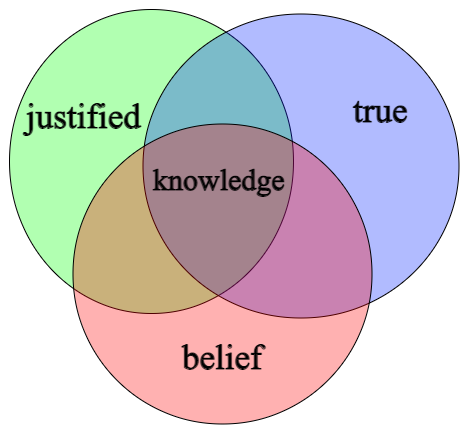
The classic definition of knowledge, dating back to Plato, is justified true belief.
Let's break down what each of those three conditions means.
The Three Ingredients of JTB
According to the JTB model, knowledge is the combination of belief, truth, and justification.
-
Belief: First, you must actually believe the statement to be true. You can't know that Paris is the capital of France if you don't believe it. Knowledge has to exist in someone's mind.
-
Truth: The belief must be objectively true. If you believe the capital of France is Lyon, you don't know it's Lyon, because that's false. Knowledge must align with reality.
-
Justification: You need a good reason for your belief. You can't just guess. If you randomly guess the winning lottery numbers, you can't claim you knew they would win. Your justification could be evidence, testimony from a reliable source, or logical reasoning. It's the answer to the question, "How do you know that?"
When these three conditions meet, you have knowledge. It's a belief that is anchored to reality (truth) by a solid reason (justification).
This definition was the standard in philosophy for over two thousand years. It's intuitive, elegant, and seems to cover all the bases. For a long time, it felt complete. Then, in 1963, a philosopher named Edmund Gettier published a very short paper that changed everything.
The Gettier Problem
Gettier's paper introduced a simple but powerful idea: you can have a justified true belief, but still not have knowledge. He presented scenarios, now called "Gettier problems," that meet all three JTB criteria but feel like they are based on luck.
Let's walk through a simplified example.
Imagine you're looking at a field. In the distance, you see a fluffy, four-legged animal that looks exactly like a sheep. You form a belief: "There is a sheep in that field."
Let's check the JTB conditions:
- Is it a belief? Yes, you believe there's a sheep in the field.
- Is it justified? Yes, you have visual evidence. You see what looks exactly like a sheep.
- Is it true? Yes. But here's the twist. The thing you are looking at is actually a very realistic statue of a sheep. However, hidden behind a hill and completely out of your sight, a real sheep is grazing in the same field.
So, your belief that "There is a sheep in that field" is a justified true belief. It meets all three criteria. But did you actually know there was a sheep in the field? Most people would say no. Your belief was true only by a coincidence.
The justification for your belief wasn't connected to what made the belief true. You were justified because of the statue, but your belief was true because of the real sheep you couldn't see. This disconnect is the core of the Gettier problem.
Gettier's work showed that the Justified True Belief model, while a good start, is incomplete. It's missing something. Philosophers have been trying to figure out what that missing fourth condition for knowledge might be ever since.
According to the Justified True Belief (JTB) model, what are the three essential conditions for knowledge?
What is the primary function of the 'justification' condition in the JTB model?