Understanding Integrated Air Defense Systems
Introduction to IADS
What is an Air Defense System?
An Integrated Air Defense System, or IADS, is a network of machines and people working together to protect a country's airspace. Think of it as a nationwide security system for the sky. Its job is to detect, track, and if necessary, neutralize any aerial threats. These threats could be enemy aircraft, drones, or incoming missiles.
The key word here is "integrated." An IADS isn't just one big radar dish or a single missile launcher. It's a web of many different components, all communicating with each other to create a complete picture of the airspace and respond effectively. This coordination allows a defender to see threats from hundreds of miles away, decide the best way to deal with them, and act before they become a danger.
A Quick History
Air defense is as old as military aviation itself. During World War I, the first anti-aircraft defenses were simple machine guns and artillery pointed skyward. Gunners relied on sight and sound to aim, which wasn't very effective against fast-moving planes.

World War II brought a revolutionary invention: radar. For the first time, defenders could "see" incoming aircraft from far away, day or night, and in any weather. This gave them precious time to scramble their own fighters and prepare anti-aircraft guns. Systems became more coordinated, but they were still largely analog and required a lot of manual effort.
The Cold War changed everything. With the arrival of jet aircraft and guided missiles, air defense had to get faster and smarter. This led to the development of the first truly integrated systems. Surface-to-air missiles (SAMs) were linked with powerful radars, and everything was connected to command centers through data links. Computers began to automate the process of tracking targets and guiding weapons, laying the foundation for the complex, highly-networked IADS of today.
The Core Components
Every IADS, no matter how simple or complex, is built from three fundamental types of components. They work in a sequence: the sensors detect a threat, the command and control centers make a decision, and the interceptors act on that decision.
First up are the sensors, the eyes and ears of the system. Their job is to constantly scan the sky for any and all activity. The most common sensor is radar, which sends out pulses of radio waves and listens for the echoes that bounce off objects. By analyzing these echoes, a radar system can determine an object's location, speed, and direction of travel.
But radar isn't the only tool. Modern systems also use passive sensors that don't emit any energy of their own. These can include infrared sensors that detect the heat from an aircraft's engines, or electronic support measures (ESM) that listen for radio or radar signals coming from a potential threat.
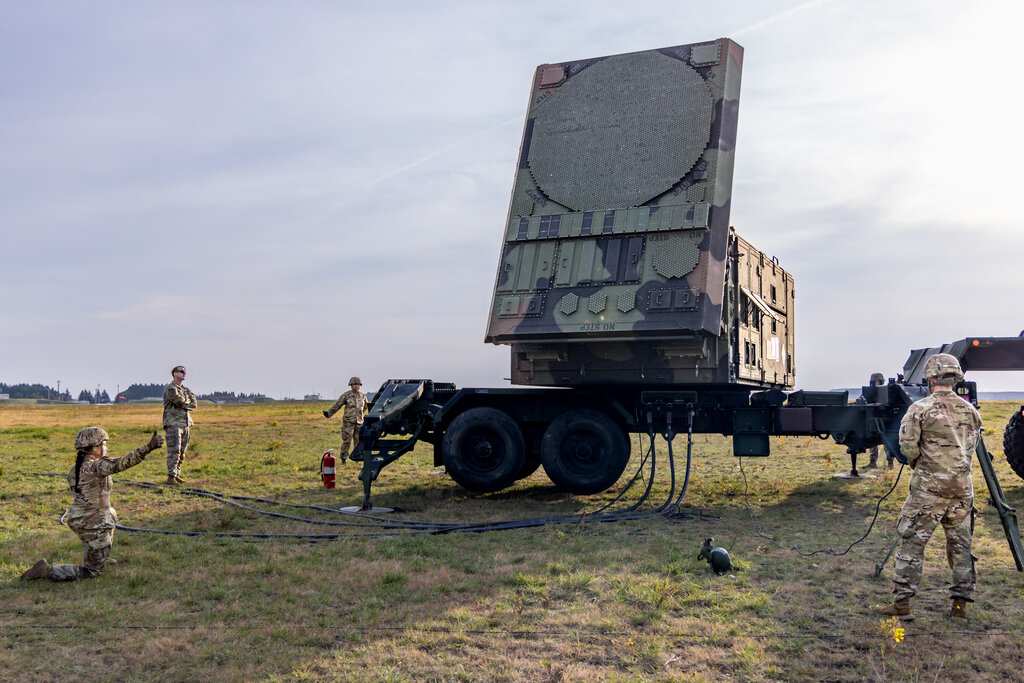
Next is Command and Control, or C2. This is the brain of the IADS. All the information gathered by the various sensors is fed into a C2 center. Here, human operators and powerful computers process the data to build a single, coherent picture of the airspace, often called a common operating picture.
The C2 center is where critical decisions are made. Is that dot on the screen a friendly airliner or a hostile bomber? If it's a threat, what's the best weapon to use against it? C2 links the sensors to the interceptors, ensuring the right weapon is assigned to the right target at the right time.
Finally, we have the interceptors. These are the weapons that neutralize threats. They come in many forms, from fighter jets armed with air-to-air missiles to ground-based surface-to-air missile (SAM) systems. Some systems even use high-powered anti-aircraft guns for short-range defense against smaller targets like drones.
Each component is vital. Without sensors, the system is blind. Without C2, it's clueless. And without interceptors, it's toothless.
Together, these three parts form a layered, resilient defense. By integrating them into a single network, an IADS can protect a vast area far more effectively than any standalone weapon system ever could.
What is the primary purpose of an Integrated Air Defense System (IADS)?
What are the three fundamental components that form every IADS?
This foundation gives us a clear picture of what an IADS is and how its basic parts fit together.