Understanding Hair Loss and Trichology
Hair Structure
The Anatomy of a Hair
What we call hair is primarily a protein called keratin. Each strand has two main parts: the hair follicle, which is the living part anchored beneath the skin, and the hair shaft, which is the visible part that grows out.
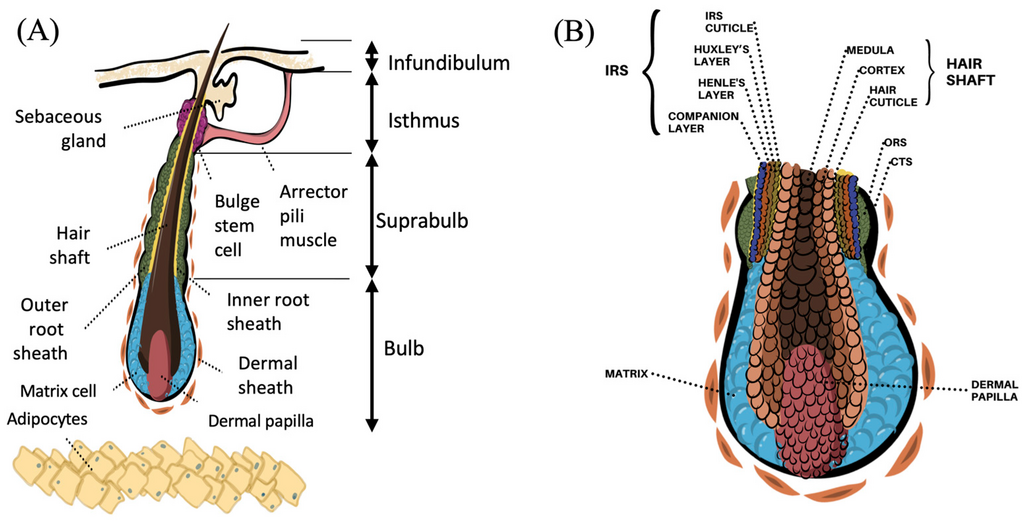
The follicle is a tube-like structure that houses the root of the hair. At its base is the hair bulb, which contains actively dividing cells that grow to build the hair shaft. Nourishment is delivered to these cells through the dermal papilla, a structure rich in blood vessels.
Attached to the follicle is the sebaceous gland. This small gland secretes an oily substance called sebum, which lubricates the hair and skin, keeping them waterproof and moisturized.
The hair shaft itself has three layers:
- The Medulla: The innermost core, which isn't always present, especially in fine hair.
- The Cortex: The middle layer, which provides the hair's strength, color, and texture. It's made of long keratin chains.
- The Cuticle: The outermost protective layer, composed of overlapping scales, like shingles on a roof. A smooth cuticle gives hair a shiny appearance.
The Hair Growth Cycle
Hair doesn't grow continuously. Each follicle goes through a repeating cycle with three distinct phases. Understanding this cycle is key to understanding hair growth and shedding.
1. Anagen (Growth Phase) This is the active phase. Cells in the root of the hair are dividing rapidly, forming a new hair and pushing it up the follicle. Hair grows about half an inch per month. This phase can last anywhere from 2 to 7 years. The length of the anagen phase determines the maximum length your hair can reach.
The length of one’s anagen phase is largely determined by genetics, but can also be affected by hormones, nutrition and environmental factors.
2. Catagen (Transitional Phase) This is a short, transitional stage that lasts about 2-3 weeks. Hair growth stops, and the outer root sheath shrinks and attaches to the root of the hair. This forms what is known as a club hair.
3. Telogen (Resting Phase) This is the resting phase, which lasts for around 3 months. While the old hair is resting, a new hair begins the anagen phase beneath it. Eventually, the old hair is shed, allowing the new hair to come through the follicle.
Factors Influencing Hair Growth
Several factors work together to influence the health and growth of your hair. While you can't change your genes, other elements are within your control.
Genetics is the primary driver of your hair's characteristics, including its thickness, texture, and the duration of your anagen phase.
Hormones play a significant role. For example, androgens (male hormones) can shorten the anagen cycle, leading to shorter, thinner hairs in individuals with a genetic predisposition.
Nutrition provides the essential building blocks. A diet lacking in protein, iron, zinc, and vitamins can impair cell division at the follicle, leading to weaker hair and slower growth.
Age naturally affects the hair cycle. As we get older, the anagen phase tends to become shorter, and the number of hair follicles can decrease, resulting in thinner hair.
What is the primary protein that makes up a hair strand?
Which layer of the hair shaft provides the hair's strength and contains the pigment that determines its color?
Understanding the basic structure and life cycle of hair provides a foundation for learning about hair health and the various conditions that can affect it.