Understanding Gravitation
Introduction to Gravity
The Pull We All Feel
Gravity is the invisible force that pulls objects toward each other. It’s what keeps your feet on the ground and what makes an apple fall from a tree. Anything that has mass, from the smallest dust particle to the largest star, exerts a gravitational pull on everything else.
Essentially, gravity is the universe's fundamental attraction service. The more massive an object is, the stronger its pull.
This force governs not just our daily lives but the entire structure of the cosmos. It holds planets in orbit around the sun, keeps stars clustered into galaxies, and pulls galaxies together into massive clusters. Without gravity, the universe as we know it would fly apart.
Early Ideas About Falling
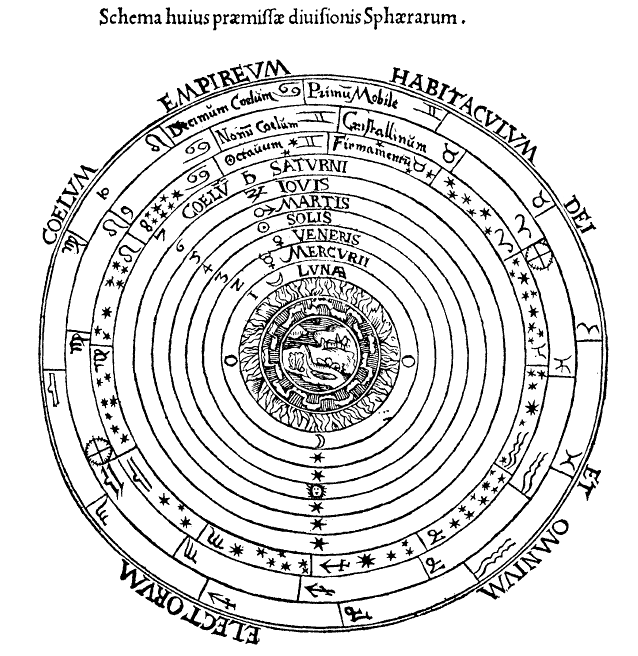
For thousands of years, people have wondered why things fall. One of the earliest influential thinkers to tackle the question was the ancient Greek philosopher Aristotle. He reasoned that objects fall because they are trying to reach their “natural place” at the center of the universe, which he believed was the Earth.
Aristotle also proposed an idea that seemed very intuitive: heavier objects fall faster than lighter ones. A rock, for instance, would plummet to the ground much more quickly than a feather. For nearly 2,000 years, this was the accepted explanation. It made sense based on everyday observation, and few thought to question it.
Challenging an Old Idea
In the late 16th century, the Italian scientist Galileo Galilei began to question Aristotle’s long-held beliefs. He performed careful experiments to test how objects fall. According to legend, he dropped two balls of different weights from the top of the Leaning Tower of Pisa.
To everyone's surprise, they hit the ground at the same time. Galileo demonstrated that the mass of an object doesn't affect the speed at which it falls. The only thing that makes a feather fall slower than a rock is air resistance. If you dropped both in a vacuum—a space with no air—they would fall at the exact same rate.
Galileo's discovery was monumental: Gravity accelerates all objects equally, regardless of their mass.
Newton's Universal Law
About 50 years after Galileo's death, an English scientist named Isaac Newton made an even more profound leap in understanding. The famous story is that Newton was sitting under an apple tree when an apple fell and hit him on the head. While this detail is likely an exaggeration, the falling apple did spark a revolutionary idea.
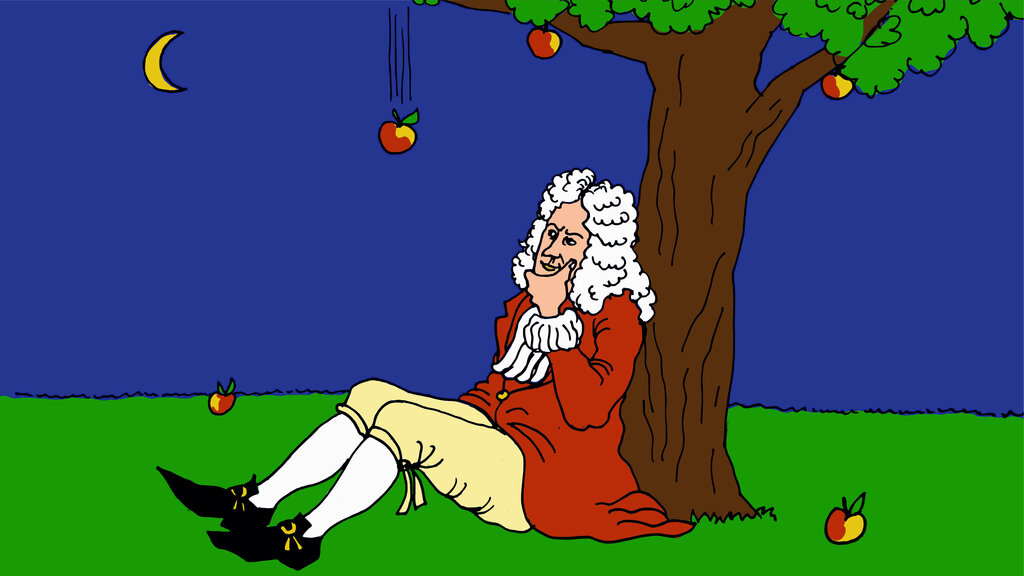
Newton wondered: if this force can pull an apple from a branch, could it also reach much higher? Could it be the same force that holds the Moon in its orbit around the Earth? He realized the answer was yes. The force of gravity wasn't just something that happened on Earth—it was universal.
This insight connected the motion of objects on Earth with the movements of the planets and stars. It was a single, elegant explanation for how the cosmos holds together. Newton's idea was that every object in the universe attracts every other object. The strength of that attraction depends on two things: how much mass the objects have and how far apart they are.
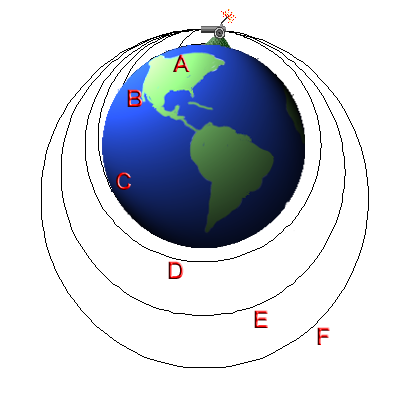
Newton's discovery transformed science. It explained why planets follow predictable paths and why we stay firmly planted on a spinning Earth. Gravity is not just about things falling down; it's the fundamental force that shapes our universe on the grandest scale.
According to the ancient Greek philosopher Aristotle, why do objects fall towards the Earth?
Which scientist demonstrated that, in the absence of air resistance, a heavy object and a light object will fall at the same rate?
From ancient ideas to groundbreaking experiments, our understanding of gravity has come a long way. This fundamental force is a constant, powerful presence in our lives and across the entire universe.