Understanding Funnels
Introduction to Funnels
What is a Funnel?
Think of a funnel in your kitchen. You pour a lot of liquid into the wide top, and a controlled stream comes out the narrow bottom. A conceptual funnel works the same way. It’s a model that helps us understand any process where a large number of inputs are narrowed down through a series of stages to produce a specific outcome.
Whether it’s potential customers, new ideas, or job applicants, a funnel visualizes their journey. Many start at the beginning, but only a fraction make it all the way to the end. This model gives us a clear map of that process, showing where things drop off and why.
A sales funnel is a visual representation of the customer journey, illustrating the stages a prospect goes through before making a purchase.
Where Did the Idea Come From?
The funnel concept isn't new. It traces its roots back to the 1890s with an American advertising pioneer named E. St. Elmo Lewis. He developed a model to describe the stages a customer goes through when interacting with a company. He called it AIDA.
- Awareness: The customer first becomes aware of a product or service.
- Interest: They develop an interest in its benefits.
- Desire: They form a desire for the product.
- Action: They finally take action to purchase it.
This simple, four-step framework was the original marketing funnel. It provided a powerful way to think about the customer journey. The idea was so useful that it was soon adapted to describe countless other processes, well beyond the world of advertising and sales.
Funnels Are Everywhere
Once you understand the basic concept, you start seeing funnels in many different fields. The core principle of filtering a large input into a smaller output is universal.
In marketing and sales, a funnel tracks how thousands of website visitors are converted into paying customers. Each step, from clicking an ad to making a purchase, narrows the group.
In product development, teams might start with dozens of ideas for a new feature. Through research, prototyping, and testing, they funnel those ideas down to the one they ultimately build and launch.
When hiring, a company might receive hundreds of applications for one open position. The recruiting process—from resume screens to multiple interview rounds—acts as a funnel to identify the single best candidate.
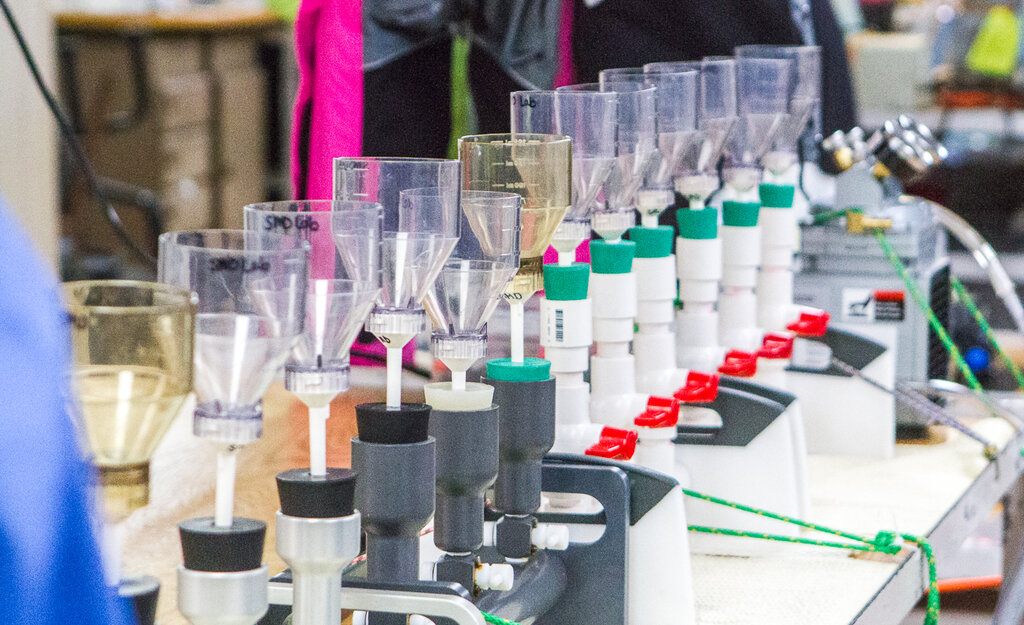
Even in science, physical funnels are essential tools. They're used in laboratories to guide liquids, filter particles from a solution, or channel materials for experiments. The function is identical: to manage a broad input and direct it toward a specific point.
In all these examples, the funnel provides a valuable framework. It helps us map out a process, measure how many entities move from one stage to the next, and identify areas for improvement. By understanding the structure of the funnel, we can make the journey through it more efficient.
What is the primary function of a conceptual funnel?
Who developed the AIDA model, which is considered the original marketing funnel?