Understanding Friction Force
Introduction to Friction
The Grip of Friction
Friction is one of the most common forces in our daily lives. It's the resistance you feel when you rub your hands together to warm them up, and it's what keeps your shoes from slipping on the pavement. Simply put, friction is a force that opposes motion between two surfaces that are touching.
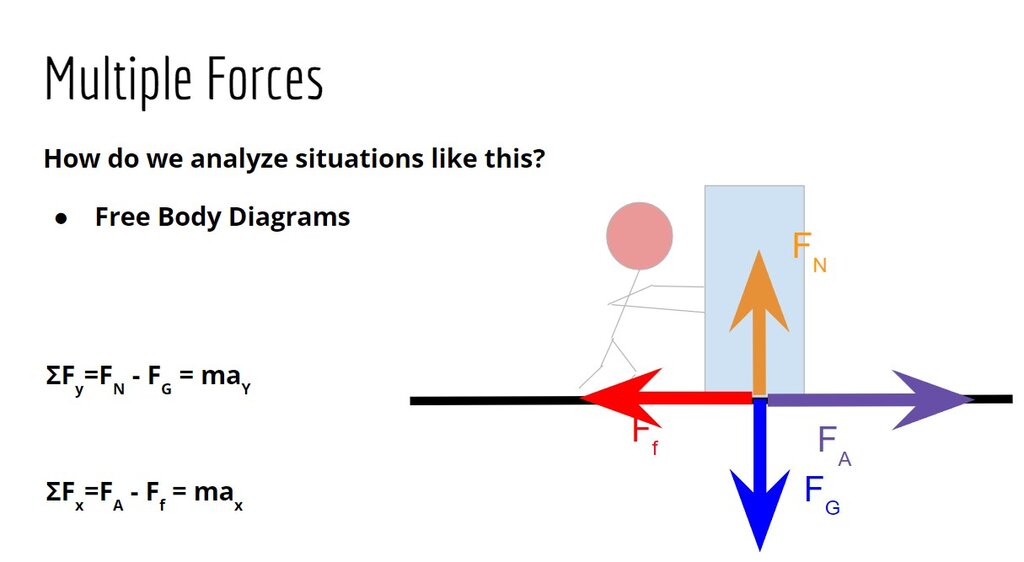
Imagine trying to slide a heavy box across the floor. You push, but it doesn't move. You push harder, and it still stays put. Push even harder, and it finally lurches forward. This experience demonstrates the two main types of friction: static and kinetic.
Starting vs. Sliding
When you first start pushing the box, you're working against static friction. This is the friction that acts on objects when they are resting on a surface. It's a responsive force—it increases as you push harder, matching your force exactly to keep the object from moving. But it has a limit. Once your push exceeds the maximum static friction, the box starts to move.
Static friction prevents motion between surfaces that are at rest relative to each other.
As soon as the box is sliding, a different type of friction takes over: kinetic friction. This is the force that resists the motion of a sliding object. You might notice that it's a bit easier to keep the box moving than it was to get it started. That's because the force of kinetic friction is typically less than the maximum force of static friction.
Kinetic friction acts between surfaces that are in motion relative to each other.
The transition from static to kinetic friction explains that little jolt you feel when an object finally starts to move. You've overcome the peak resistance, and now you're dealing with a smaller, more consistent opposing force.
A Measure of Roughness
Why is it easier to push a box across a polished wood floor than across a thick carpet? It comes down to the nature of the surfaces themselves. Some surfaces are simply "grippier" than others.
To quantify this, scientists use a value called the coefficient of friction. It’s a number that describes the ratio of the force of friction between two bodies to the force pressing them together. A higher coefficient means more friction, while a lower coefficient means less.
The coefficient of friction is a dimensionless value that indicates the roughness or stickiness of two surfaces in contact.
Every pair of surfaces has its own coefficients of friction. Since static friction and kinetic friction are different, there's a coefficient of static friction () and a coefficient of kinetic friction (). The coefficient for static friction is almost always higher than the one for kinetic friction.
For example, the coefficient of static friction for rubber on dry concrete is high, which is why tires can grip the road so well. For steel on ice, the coefficient is very low, which is why ice skating is possible.
What is the primary role of the force of friction?
You're pushing a heavy bookshelf. It's much harder to get it to start moving than it is to keep it sliding across the floor. Why?
Understanding these basic principles of friction is the first step in analyzing how and why objects move the way they do.