Understanding Free Speech
Origins of Free Speech
Speaking Truth to Power
The right to speak your mind feels like a modern idea, but its roots reach back over two millennia to ancient Athens. The Greeks had a specific concept for this: parrhesia.
to speak everything
Parrhesia wasn't about the freedom to say anything you wanted, whenever you wanted. It was a duty for citizens to speak frankly and truthfully in public debates for the good of the city. This often meant speaking uncomfortable truths to those in power. It was a risky act, requiring courage. The philosopher Socrates, famous for questioning Athenian leaders, practiced a form of parrhesia, a commitment that ultimately cost him his life.

This powerful idea of speaking truth for the common good didn't vanish with ancient Greece. It was rediscovered and championed by Enlightenment thinkers centuries later, eventually crossing the Atlantic to the American colonies.
The Colonial Press
In colonial America, freedom of speech was not guaranteed. English common law made it illegal to publish information that opposed the government, a crime called seditious libel. Under this law, it didn't matter if what you published was true. Simply criticizing a government official in print could land you in jail.
A landmark moment arrived in 1735 with the trial of John Peter Zenger, a New York printer. Zenger's newspaper had published articles criticizing the corrupt colonial governor, William Cosby. Zenger was arrested and charged with seditious libel.
Zenger's lawyer, Andrew Hamilton, made a revolutionary argument. He urged the jury to judge not just whether Zenger had printed the words, but whether the words were true. If they were true, he argued, they couldn't be libelous.
The jury agreed and found Zenger not guilty. While the verdict didn't officially change the law, it sent a powerful message across the colonies. The idea that truth is a defense against libel became a cornerstone of a free press in America.
A Constitutional Guarantee
When the time came to draft a new government, the American founders drew upon these historical lessons. They understood that a republic could not function if citizens were afraid to criticize their leaders or debate ideas openly. Thinkers like James Madison argued that a free exchange of ideas was essential for self-governance.
After the Constitution was ratified, many felt it didn't do enough to protect individual liberties. This led to the creation of the Bill of Rights, a set of ten amendments designed to safeguard fundamental freedoms.
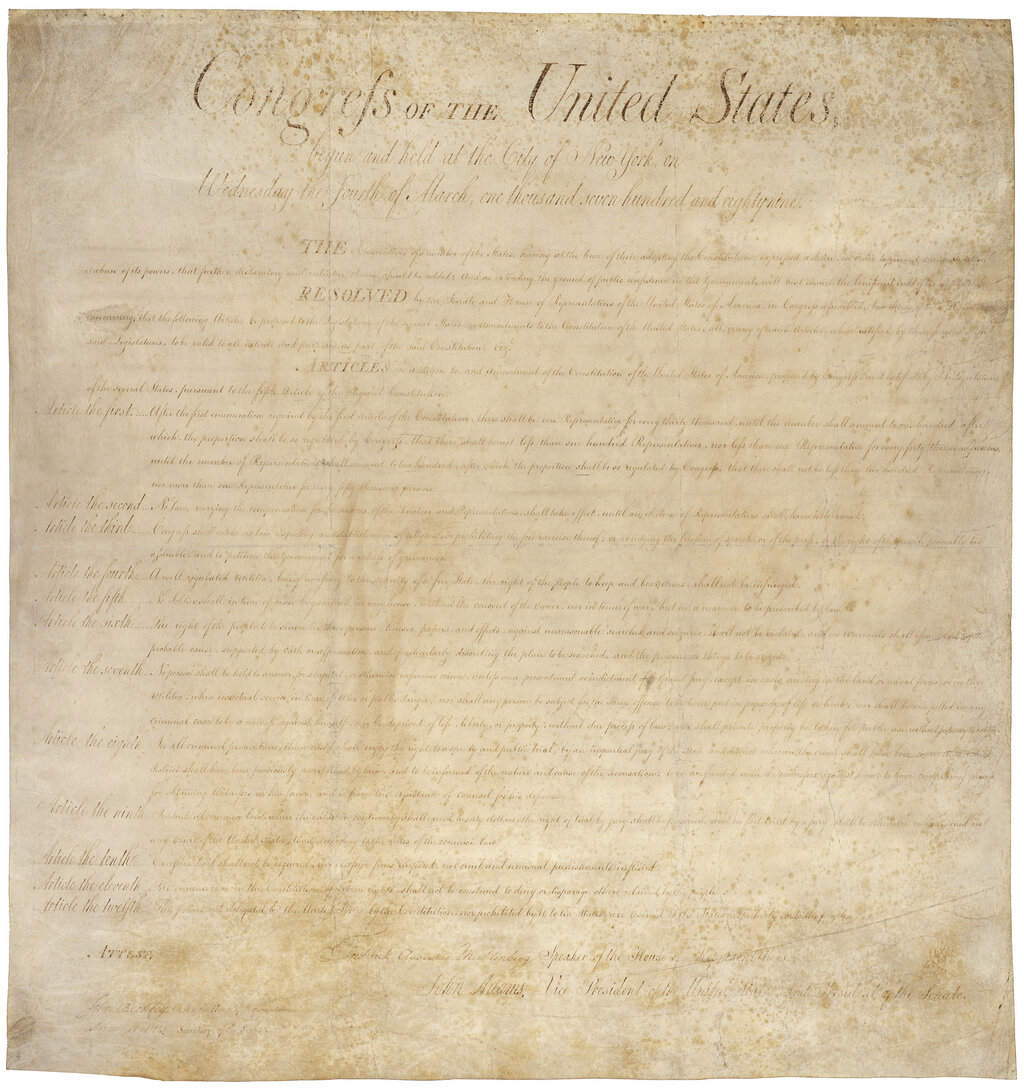
The very first of these amendments addresses speech directly.
By placing this protection in the First Amendment, the founders signaled the central importance of free expression to the new nation. It was a direct response to the censorship of the colonial era and a lasting tribute to the ancient idea that citizens in a free society must have the right to speak.