Understanding Felt
Introduction to Felt
What is Felt?
Most fabrics you encounter are either woven or knitted, with threads arranged in a neat, orderly pattern. Felt is different. It's a non-woven textile made by pressing and matting fibres together until they interlock into a single, dense sheet.
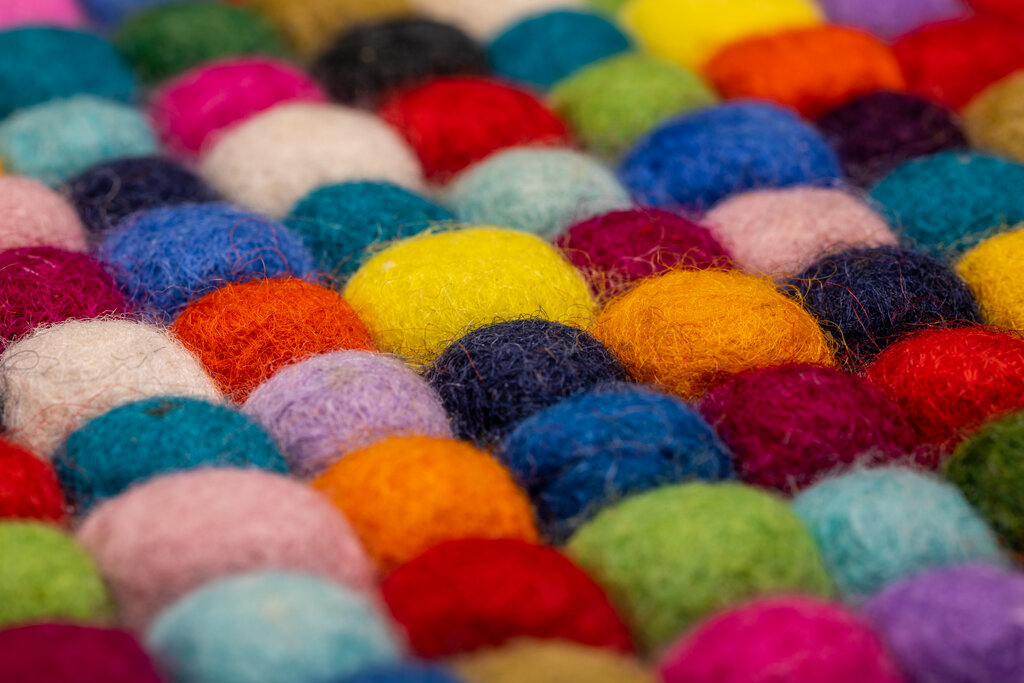
Imagine a pile of loose wool. If you add moisture, heat, and pressure, the tiny scales on the surface of the wool fibres open up and latch onto each other, tangling into an inseparable mass. This process, called felting, creates a fabric without a single thread or stitch.
Felt
noun
A type of cloth made by rolling and pressing wool or other animal fibres, or a mixture of these with synthetic fibres, under the influence of heat and moisture.
A Fabric Without a Weave
To understand what makes felt unique, it helps to compare it with other fabrics.
Woven fabrics are created on a loom by interlacing two sets of threads at right angles: the warp (running lengthwise) and the weft (running crosswise). This creates a stable, grid-like structure, much like a basket. Denim and linen are common examples.
Knitted fabrics are made from a single, continuous thread that is looped together. This structure gives knitted materials, like a woolly jumper or a t-shirt, their characteristic stretch.
Felt, however, has no organised structure. Its fibres are tangled together in a random, chaotic way. This fundamental difference is why felt behaves so differently.
Because it has no threads, felt does not fray. You can cut it at any angle, and the edge will remain clean and stable.
Felt's Special Qualities
Its unique structure gives felt several useful properties.
First, it's incredibly durable. The densely interlocked fibres resist tearing and wear. This is why it has long been used for hats and boot liners. It's also dense, which makes it a great insulator. The trapped air pockets within the matted fibres slow the transfer of heat, making it effective for both warmth and protection against heat.
This sound-dampening quality is also why you find felt used in modern architecture for acoustic wall panels and on the bottom of furniture legs to prevent scraping noises.
It’s a simple material with a surprisingly wide range of uses, all thanks to its lack of a weave.