Understanding Entropy Made Simple
Introduction to Entropy
What is Entropy?
Entropy is a way to measure disorder or randomness in a system. Think of it as a count of the number of ways things can be arranged. A system with high entropy is more disordered and has more possible arrangements. A system with low entropy is more ordered and has fewer arrangements.
entropy
noun
A measure of the amount of disorder, randomness, or uncertainty in a system.
Consider a bedroom. A perfectly clean room, with every book on its shelf and every shirt folded in a drawer, is a state of low entropy. There are only a few ways for the room to be perfectly neat. Now, imagine a messy room. Clothes are on the floor, books are scattered, and papers are everywhere. This is a state of high entropy. There are countless ways for a room to be messy.
Over time, without any effort, the room is more likely to become messy than to magically clean itself. This illustrates a fundamental principle: systems naturally tend to move from states of lower entropy to states of higher entropy. Order tends to become disorder.
Seeing Entropy in Action
This tendency towards disorder isn't just about messy rooms. It's a basic principle of the physical world. Let's look at another example.
Imagine a box separated by a divider. On one side, you have red marbles, and on the other, blue marbles. This is an ordered, low-entropy state. If you remove the divider and shake the box, what happens? The marbles will mix. It is extremely unlikely they will stay separated by color. They will almost certainly end up in a jumbled, disordered, high-entropy state.
There are very few ways for all the red marbles to be on one side and all the blue on the other. But there are a massive number of ways for them to be mixed together. The system moves toward the state with the most possible arrangements, which is the mixed-up state.
Perfume sprayed in a corner of a room doesn't stay in the corner. The molecules spread out until they are evenly distributed throughout the room. This is another example of entropy increasing, as the perfume molecules move from an ordered state (concentrated in one spot) to a disordered one (spread out everywhere).
Why It Matters
The concept of entropy helps explain why certain processes happen on their own, or
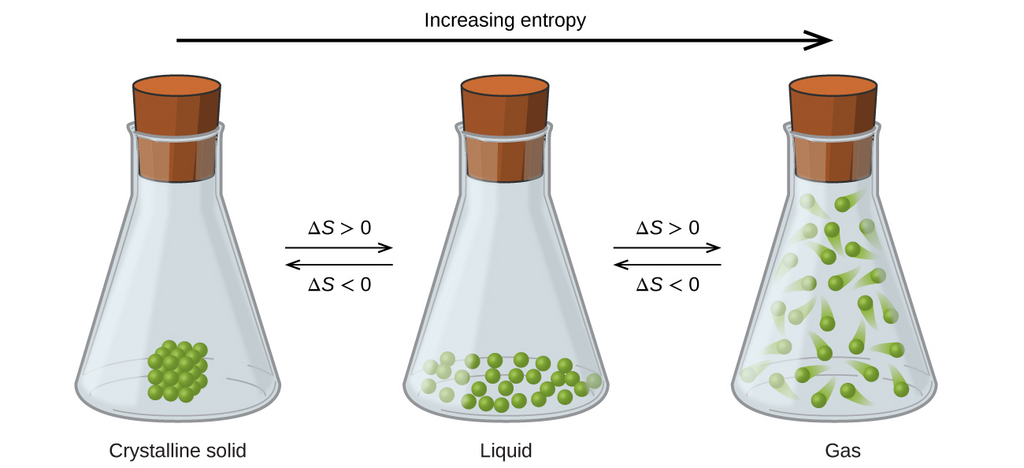
An ice cube (a highly ordered, low-entropy solid) sitting on a counter will melt into a puddle of water (a more disordered, higher-entropy liquid). It won't spontaneously refreeze into a perfect cube. A hot cup of coffee will cool down as its heat energy dissipates into the cooler air of the room, rather than the room's energy gathering to make the coffee hotter. In both cases, the total energy spreads out, and the overall disorder, or entropy, of the universe increases.
In very broad terms you can think of entropy as a measure of 'disorder' - the random motion of molecules in steam corresponds to more disorder, and hence more entropy, than the more orderly motion of molecules in ice.
This natural flow toward higher entropy is one of the most fundamental principles in science, known as the Second Law of Thermodynamics. It governs everything from chemical reactions to the ultimate fate of the universe.
Ready to check your understanding?
Which of the following best describes entropy?
Imagine a brand new, unopened deck of cards, with all cards arranged in order by suit and number. After you shuffle the deck thoroughly, what has happened to its entropy?
Understanding entropy is about recognizing the natural tendency of things to move from order to disorder. It's a simple idea with profound implications for the world around us.