Understanding Entropy
Introduction to Thermodynamics
Energy, Work, and Heat
Thermodynamics is the study of energy, how it moves, and how it transforms. To make sense of it, scientists talk about a system and its surroundings. A system is just the part of the universe we’re interested in, like a cup of coffee or a car engine. The surroundings are everything else.
Energy can cross the boundary between the system and its surroundings in two ways: as heat or as work.
Heat
noun
The transfer of energy between objects due to a temperature difference.
Heat () is the energy that flows from a hotter object to a colder one. Work (), on the other hand, is energy transferred when a force causes displacement. A classic example is a gas in a cylinder pushing a piston. As the gas expands, it does work on the piston.
The First Law
The first law of thermodynamics is a fundamental rule: energy cannot be created or destroyed, only converted from one form to another. It's the principle of energy conservation applied to thermodynamic systems.
When you add heat to a system, that energy has to go somewhere. It can either increase the system's internal energy () or be used by the system to do work on its surroundings, or both. Internal energy is the total energy of all the particles inside the system.
The relationship is expressed in a simple equation:
Here, is the change in the system's internal energy. is the net heat added to the system, and is the net work done by the system.
- If you add heat to a system, is positive.
- If the system does work (like a gas expanding), is positive.
- If the system's internal energy goes up (it gets hotter), is positive.
First law of thermodynamics is a restatement of the principle of consertion of energy.
State Functions
Imagine climbing a mountain. You start at the base (1,000 feet) and finish at the peak (10,000 feet). Your change in elevation is 9,000 feet. It doesn't matter if you took a long, winding trail or a short, steep one. The change in elevation depends only on your starting and ending points.
In thermodynamics, a property that depends only on the current state of a system—not the path taken to get there—is called a state function. Temperature, pressure, volume, and internal energy () are all state functions. If you know these values, you know the state of the system.
Heat () and work () are not state functions. They are path-dependent. The amount of work done or heat transferred depends on the specific process. Just like the miles you walked to climb the mountain depend on the trail you chose, the amount of and depend on the thermodynamic path.
| State Functions (Path-Independent) | Path Functions (Path-Dependent) |
|---|---|
| Internal Energy () | Heat () |
| Temperature () | Work () |
| Pressure () | |
| Volume () |
The Second Law
The first law tells us that energy is conserved, but it doesn't say anything about the direction of processes. A broken glass won't spontaneously reassemble, even though doing so wouldn't violate energy conservation. The second law of thermodynamics gives us this directionality.
One of the simplest statements of the second law is that heat naturally flows from a hotter object to a colder one, and never the other way around on its own. To move heat from a cold place to a hot place, you have to do work—that's how refrigerators and air conditioners operate.
Another key implication of the second law is that no heat engine can be 100% efficient. An engine works by taking heat from a hot source, converting some of it into work, and rejecting the rest to a cold sink. It's impossible to build an engine that converts all the heat it takes in into useful work. Some energy is always lost to the surroundings as waste heat.
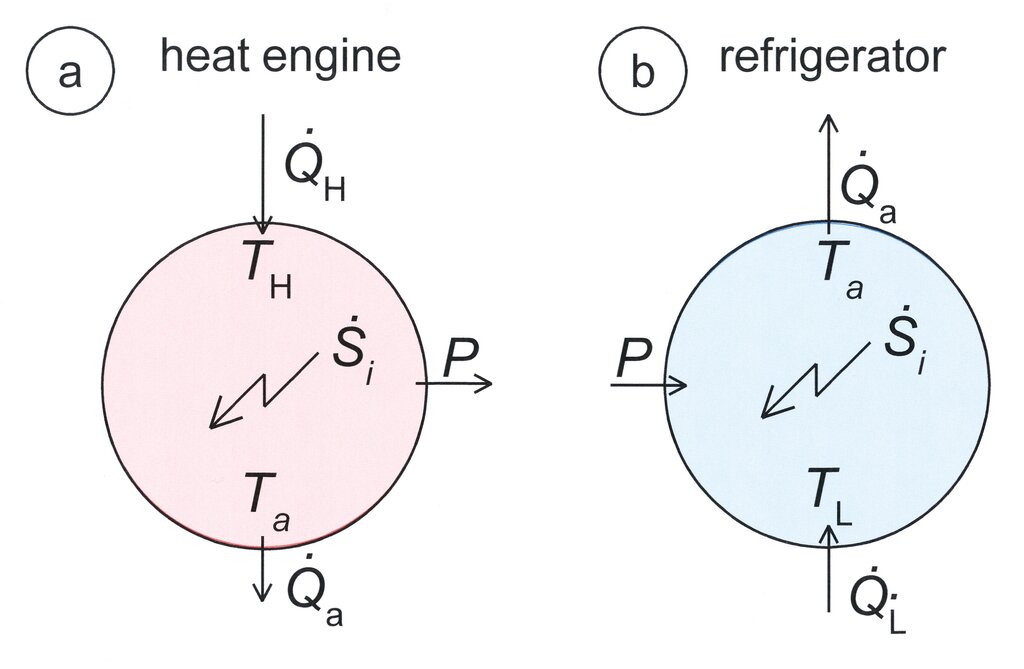
This law essentially says that natural processes tend to move toward a state of greater disorder. It places fundamental limits on the efficiency of energy conversion.
The second law explains why some processes happen and others don't, even if they don't violate the law of energy conservation.
Ideal vs. Real Processes
In an ideal world, we could imagine processes that are perfectly efficient and can be run forward or backward without any loss. These are called reversible processes. A reversible process happens so slowly that the system is always in equilibrium with its surroundings. Think of a piston in a cylinder expanding by infinitesimally small steps, with the pressure inside always perfectly balanced by the pressure outside.
Of course, in the real world, no process is truly reversible. All real processes are irreversible. They happen at a finite speed and involve factors like friction, turbulence, and heat transfer across a finite temperature difference. When you burn a log, you can't un-burn it. When you let gas expand quickly from a container, you can't get it back in without doing a lot of work on it. These are irreversible changes.
Reversible processes are a useful theoretical concept. They represent the absolute best-case scenario for efficiency, providing an upper limit that engineers strive to approach with real-world machines.
The First Law of Thermodynamics is a statement about:
A gas in a sealed container receives 200 Joules of heat from its surroundings. It expands, doing 80 Joules of work on a piston. What is the change in the internal energy () of the gas?
Thermodynamics gives us the fundamental rules governing energy. The first law confirms that energy is always conserved, while the second law defines the direction of natural processes and sets the limits of what's possible.