Understanding Earth's Rotation
Rotational Mechanics Basics
The Spin of a Planet
We're used to thinking about motion in straight lines, like a car driving down a road. But much of the universe moves in circles. Planets spin, moons orbit, and galaxies swirl. To describe this, we use the concept of angular velocity, which is simply the rate at which an object rotates or revolves around an axis.
For Earth, this rotation is remarkably consistent. It spins on its axis, completing a full circle (about 6.28 radians) every 24 hours. This gives it an angular velocity of about radians per second. While that number seems small, it's the foundation for a powerful stability that governs our planet's behavior. This stability isn't just about speed; it's about momentum.
A Cosmic Balancing Act
Think of an ice skater pulling their arms in to spin faster. They are conserving angular momentum, a fundamental principle in physics. Angular momentum is the rotational equivalent of linear momentum (mass times velocity). It's a measure of how much rotational motion an object has, and in a closed system, it always stays the same.
Earth has a tremendous amount of angular momentum, a leftover from the swirling cloud of gas and dust that formed our solar system. This is why it keeps spinning, day after day, with incredible reliability. This momentum depends not just on how fast Earth spins, but also on how its mass is distributed.
This property is described by rotational inertia, which measures an object's resistance to changes in its rotational motion. The more mass an object has, and the farther that mass is from the axis of rotation, the higher its rotational inertia.
For a spinning planet like Earth, a large acts like a massive flywheel, smoothing out its spin and resisting any forces that might try to alter it. The specific way Earth's mass is arranged from its dense iron core to its lighter crust is what determines this crucial value.
Shaped by Spin
Earth's rotation doesn't just stabilize its motion; it has physically shaped the planet. As Earth spins, the material at the equator is flung outward, similar to how you feel pushed to the side on a spinning merry-go-round. This persistent outward force, acting over billions of years, has caused our planet to bulge slightly at the equator and flatten at the poles.
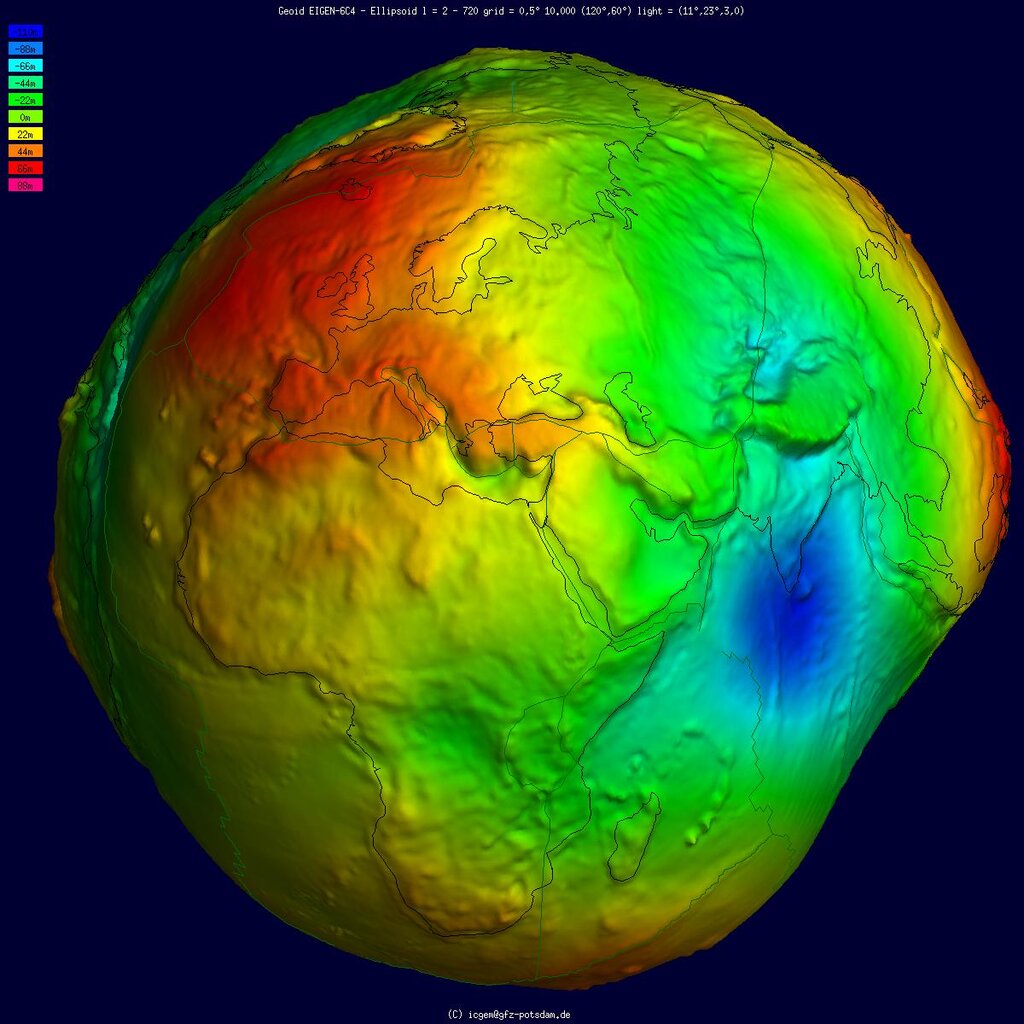
This makes Earth an , not a perfect sphere. The diameter from pole to pole is about 12,714 kilometers, while the diameter at the equator is about 12,756 kilometers. That's a difference of only 42 kilometers, or about 0.3%, but it's enough to have significant effects on the planet's dynamics.
This shape, in turn, influences Earth's gravitational field. Because the equator is farther from the center of mass, gravity is slightly weaker there than at the poles. This subtle variation affects everything from satellite orbits to the precise timing of global navigation systems. The bulge also provides a "handle" for the gravitational pulls of the Sun and Moon to tug on, which causes long-term wobbles in Earth's axis.
So, the basic mechanics of rotation tie everything together. The initial angular momentum from its formation caused the Earth to spin. This spin created an equatorial bulge. And the bulge affects how Earth interacts gravitationally with other bodies in the solar system. It's a chain reaction where physics dictates planetary form and function.
What is the primary reason Earth has maintained a consistent spin for billions of years?
The text describes Earth as an "oblate spheroid." What does this mean?
Understanding these core principles of rotation is the first step. They set the stage for all the more complex phenomena we see, from the daily cycle of light and dark to the slow, grand wobble of our planet's axis over millennia.