Understanding Dialects
Introduction to Dialects
Everyone Speaks a Dialect
It’s a common misconception that dialects are somehow “incorrect” versions of a language. The truth is, everyone who speaks a language speaks a dialect of that language. A dialect is simply a variety of a language that is characteristic of a particular group of speakers. These groups might be defined by their location, social class, ethnicity, or other shared factors.
Dialects differ from each other in three main ways:
- Pronunciation: This is what we often call an accent. Think of the difference between how a person from London says “water” versus someone from New York.
- Vocabulary: Different dialects might use different words for the same thing. Do you drink “soda,” “pop,” or “coke”? Do you carry things in a “bag,” a “sack,” or a “poke”?
- Grammar: This involves the rules of how sentences are put together. For example, some dialects of English use “y’all” or “you guys” for the second-person plural, while others just use “you.”
No single dialect is better or more correct than another. They are all valid systems of communication. The idea of a “standard” dialect is usually based on the version of the language used in government, media, and education, but it's just one dialect among many.
How Dialects Form
Languages are constantly changing, and they don't change uniformly for everyone. Dialects emerge when these changes aren't shared across all speakers. Several factors drive this process.
Geographic Isolation Imagine a group of people who speak the same language. Half of them sail to a remote island, while the other half stays on the mainland. For generations, the two groups have no contact. On the island, new words might be invented for new plants and animals. The pronunciation of certain vowels might slowly shift. The mainland group experiences its own set of changes. After a few hundred years, their ways of speaking will have diverged significantly.
This is a simplified version of what happens in the real world. Physical barriers like oceans, mountains, or vast deserts can separate groups of people, allowing their speech to evolve independently.
Social Stratification Dialects can also form along social lines. People tend to talk like the people they talk to most often. This means groups separated by social class, ethnicity, age, or occupation can develop distinct linguistic features. Teenagers, for instance, often use slang that is unique to their generation and social circles.
Historical Events Migration, colonization, and political change are powerful forces in shaping language. When groups of people move, they bring their language with them, which then interacts with the languages of the new region. The Norman Conquest of England in 1066, for example, brought a huge number of French words into English, permanently changing its vocabulary and influencing its development.
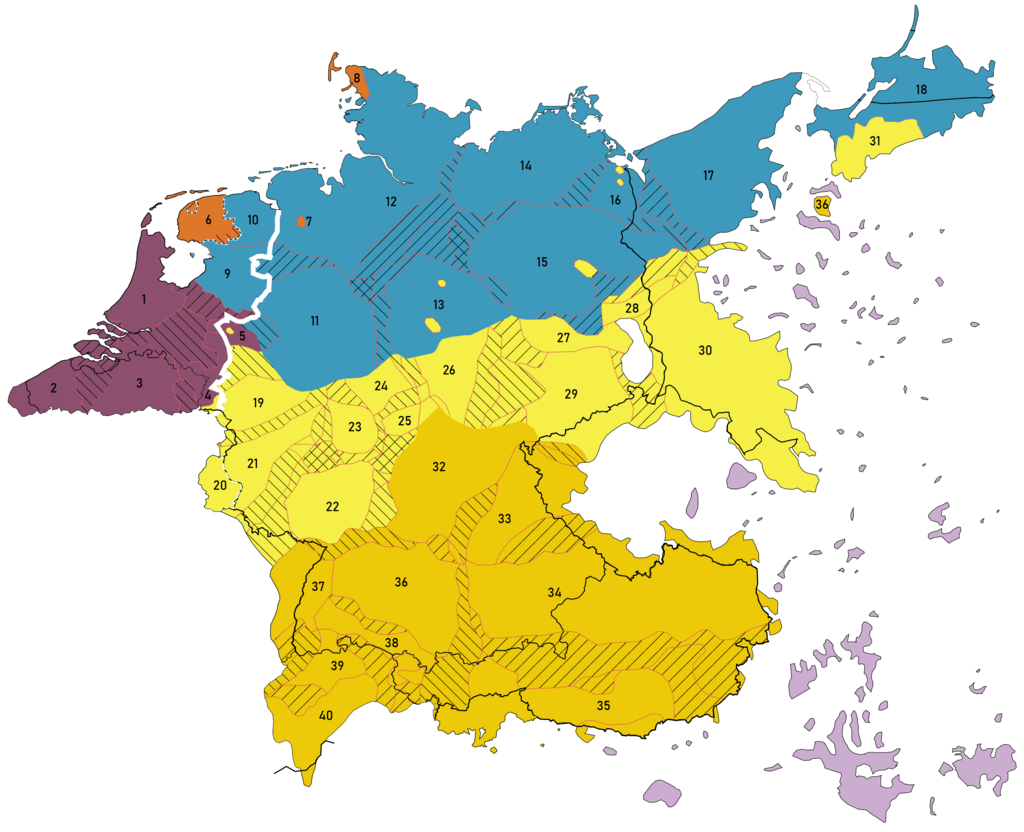
Language or Dialect?
So what's the difference between a dialect and a language? It seems like a simple question, but the answer is surprisingly complex. The most common linguistic yardstick is mutual intelligibility.
The idea is straightforward: If speakers of two varieties can understand each other, they are speaking dialects of the same language. If they can’t, they are speaking different languages. A farmer from rural Texas and a banker in London can have a conversation, despite their different accents and vocabulary. They both speak dialects of English. However, that same farmer from Texas would not be able to understand a farmer from rural Germany who only speaks German.
But this test isn't perfect. Sometimes, intelligibility is a one-way street. For example, speakers of Standard Dutch can often understand a good deal of Afrikaans (spoken in South Africa), but Afrikaans speakers may struggle to understand Dutch. Are they separate languages or dialects?
This is where the idea of a dialect continuum comes in. Imagine walking from Portugal, across Spain, and into France. At each point along the way, the local dialect is very similar to the one in the next village. There is no sharp linguistic border. Yet, a person from Lisbon (speaking Portuguese) and a person from Paris (speaking French) would not be able to understand each other at all.
Ultimately, the line between a language and a dialect is often drawn not by linguists, but by society. This brings us to a famous saying in linguistics:
“A language is a dialect with an army and a navy.”
This means that political power, national identity, and official status are often the deciding factors. For example, Serbian, Croatian, and Bosnian are almost completely mutually intelligible. Linguistically, they could be considered dialects of one language (Serbo-Croatian). However, due to the distinct national identities of the people who speak them, they are officially recognized as separate languages.
Conversely, the varieties of Chinese, such as Mandarin and Cantonese, are often not mutually intelligible when spoken. A Mandarin speaker and a Cantonese speaker would have great difficulty understanding each other. Yet, because they share a common writing system and are spoken within a single nation, they are often referred to as “dialects” of Chinese.
So, while linguistic criteria like mutual intelligibility provide a useful starting point, the story of what we call a “language” is deeply intertwined with history, culture, and politics.
According to linguists, what is a dialect?
The common linguistic test used to distinguish between a dialect and a separate language is known as: