Understanding Database Management Systems
DBMS Core Concepts
What is a DBMS?
A Database Management System, or DBMS, is the software that acts as an intermediary between the user and the database. Think of it as a skilled librarian for a massive, complex library. You don't need to know where every single book is physically located; you just tell the librarian what you need, and they handle the storage, retrieval, and organization for you.
DBMS stands for Database Management System. It is software that allows users to define, create, maintain, and control access to a database.
At its core, a DBMS manages the three key components of a database environment: the data itself, the database engine (the software that accesses and modifies the data), and the database schema, which is the blueprint defining the database's structure. This system ensures that data is not just stored, but stored in a way that is consistent, secure, and accessible to multiple users at once.
Core Functions
A DBMS performs several crucial functions to manage data effectively. These can be broken down into a few main categories. Understanding these functions is key to appreciating why a DBMS is so much more powerful than a simple collection of files.
| Function | Description |
|---|---|
| Data Definition | Provides tools to define the structure and organization of data. This is done using a Data Definition Language (DDL). |
| Data Manipulation | Allows users to insert, update, delete, and retrieve data from the database. This is typically done with a Data Manipulation Language (DML), like SQL. |
| Data Control | Manages user access and enforces security rules. It ensures that only authorized users can perform certain actions. |
| Data Recovery | Provides mechanisms for backup and recovery to protect the database from data loss due to hardware failure, software bugs, or human error. |
These functions work together to create a robust environment for data. For example, data definition sets the rules, data manipulation lets you interact with the data according to those rules, and data control makes sure you have permission to do so. If something goes wrong, data recovery is there to restore the system to a consistent state.
Why Use a DBMS?
Using a dedicated DBMS offers significant advantages over managing data in flat files or spreadsheets. These benefits are the reason they form the backbone of almost every modern application.
Key benefits include improved data integrity, better security, support for concurrent access, and data independence.
Data integrity means the data is reliable and accurate over its entire lifecycle. A DBMS enforces this through constraints, like ensuring an order_quantity field can only contain positive numbers.
Security is handled through granular access controls. You can specify that a sales representative can view customer data but cannot delete it, while a manager can do both. This is much harder to enforce with individual files.
is a huge benefit. It's the system's ability to allow multiple users to access and modify the database at the same time without interfering with each other. Imagine two airline agents trying to book the last seat on a plane simultaneously. A DBMS ensures that only one of them succeeds, preventing a double-booking.
Finally, a DBMS provides data independence. This means you can change the underlying hardware or the physical storage structure of the data without needing to rewrite the applications that use it. The DBMS handles the translation, decoupling the application logic from the physical storage details.
A Look at the Architecture
While specific architectures vary, most DBMSs can be understood through a layered model. At a high level, the system processes a user's request by passing it through several components, each with a specific job. This structure helps organize the complexity of data management.
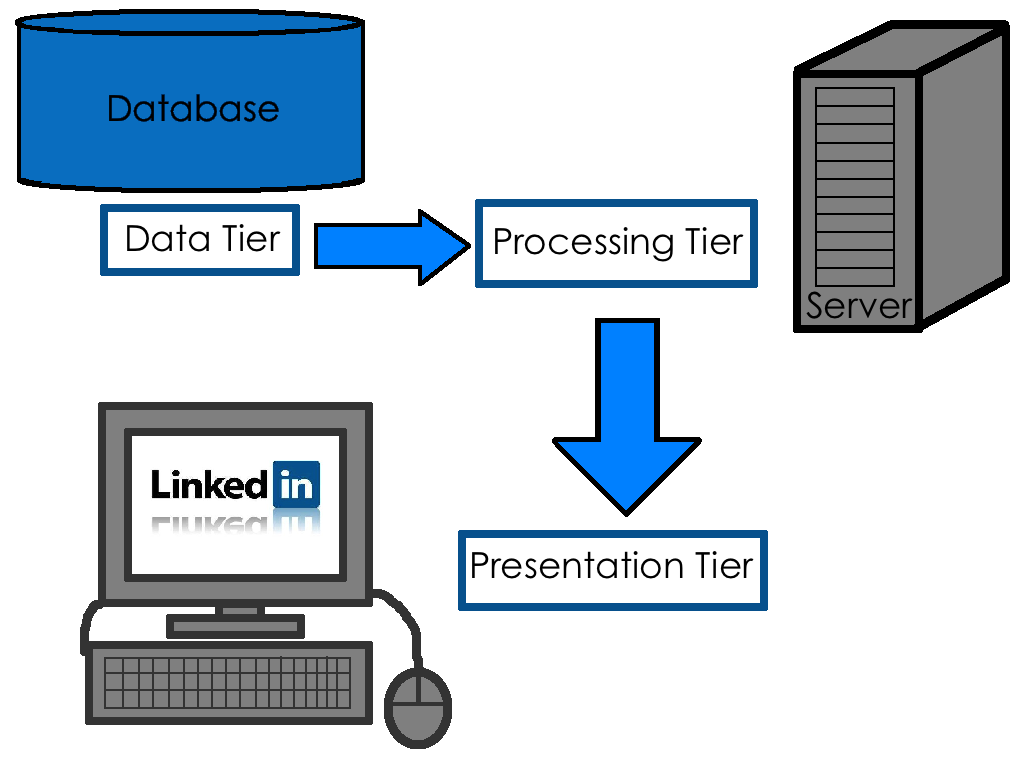
The typical flow starts when a user or application sends a query. The Query Processor is the first component to handle it. It parses, optimizes, and compiles the query into a series of low-level instructions that the can execute. The optimization step is critical, as it figures out the most efficient way to retrieve the requested data.
Next, the Storage Manager takes over. This component is the bridge between the logical data requested by the query and the physical files where that data lives. It manages file access, disk space, and the buffers in memory that hold frequently accessed data.
Finally, the Transaction Manager ensures that each operation, or transaction, is and consistent. It coordinates concurrent transactions and handles recovery if a transaction fails midway. This guarantees that the database is always in a valid state.
This modular architecture allows different DBMS products to innovate. Some might have a highly advanced query optimizer, while others focus on a fast and efficient storage manager for specific types of data.
Ready to check your understanding of these foundational concepts?
What is the primary role of a Database Management System (DBMS)?
The ability of a DBMS to allow multiple users to access and modify data simultaneously without interfering with each other is known as ______.
Understanding these core ideas provides the foundation for exploring different types of databases and learning how to interact with them effectively.