Understanding Complexity
Introduction to Complexity
More Than Just Complicated
We often use the words “complex” and “complicated” interchangeably, but they mean very different things. A jet engine is complicated. It has thousands of parts, but an expert can take it apart and put it back together. Its behavior is predictable.
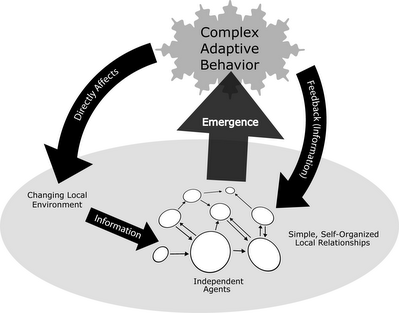
A complex system is different. It’s made of many individual components, or agents, that interact with one another. The crucial part is the interaction. From these simple, local interactions, a new, large-scale behavior emerges for the whole system. This emergent behavior can’t be predicted just by looking at the individual agents.
The behavior of a complex system is greater than the sum of its parts.
Think about a flock of starlings. There is no lead bird choreographing the flock's mesmerizing dance. Each bird follows a few simple rules, like staying close to its neighbors, avoiding collisions, and flying in the same general direction. From these basic, local rules, the beautiful, cohesive movement of the flock emerges. The flock acts like a single organism, but its intelligence is distributed among all its members.
Characteristics of Complexity
Complex systems show up everywhere, from the natural world to human society. While they look very different on the surface, they share a few core characteristics.
emergence
noun
The arising of novel, coherent structures, patterns, and properties during the process of self-organization in complex systems.
Emergence is the signature of a complex system. It’s the traffic jam that appears even when there's no accident, the stock market crash that no single investor intended, or the consciousness that arises from the interactions of billions of neurons.
These systems are also adaptive. They can change their behavior in response to a changing environment. A forest ecosystem adapts to a drought; a company adapts to new technology. This happens because the individual agents learn and adjust their simple rules over time.
Finally, there's no central control. Power is decentralized. The economy doesn't have a single CEO telling everyone what to do. The brain doesn't have a master neuron pulling all the strings. Order arises from the bottom up.
Complexity All Around Us
Once you start looking, you'll see complex systems everywhere.
-
Ecosystems: A rainforest is a web of interactions between millions of organisms and their environment. The health of the entire forest emerges from these countless connections. A change in one small species can have unpredictable, cascading effects.
-
Economies: Markets are driven by the buying and selling decisions of millions of individuals and firms. No one is in charge, yet these interactions produce global patterns of wealth, trade, and innovation.
-
Social Networks: How does an idea or a piece of news go viral? It spreads through a network of people, each making a simple decision to share or not share. The resulting trend is an emergent property of the network's structure and behavior.
Understanding complexity helps us see the world not as a collection of independent things, but as a deeply interconnected web. It shows how simple actions can lead to surprising, large-scale consequences.
Let's check your understanding of these foundational ideas.
Which of the following is the best example of a complicated system, as opposed to a complex one?
The signature property of a complex system, where large-scale patterns arise from simple, local interactions, is known as ______.