Understanding Cognitive Biases
Introduction to Cognitive Biases
Your Brain's Shortcuts
Your brain is incredibly powerful, but it's also lazy. It processes a staggering amount of information every second. To cope, it relies on mental shortcuts to make quick judgments and decisions. Think of them as rules of thumb that help you navigate the world without having to analyze every single detail from scratch. These shortcuts are called heuristics.
Most of the time, these mental shortcuts work well. They allow you to drive a car, recognize a friend's face, or catch a ball without conscious effort. But sometimes, these shortcuts lead to predictable errors in thinking. These systematic patterns of deviation from logic and rationality are known as cognitive biases.
Cognitive Bias
noun
A systematic error in thinking that occurs when people are processing and interpreting information in the world around them, affecting the decisions and judgments that they make.
A cognitive bias isn't just a random mistake. It's a predictable pattern. It's your brain consistently leaning in one direction, often without you even realizing it. These biases are a natural part of being human, hardwired into our cognitive machinery.
Two Modes of Thinking
Psychologists often describe our thinking process as a dual-system model. This model helps explain how these mental shortcuts and biases emerge.
System 1 is your brain's automatic, intuitive, and unconscious mode. It's fast and requires little to no effort. When you hear a loud noise and immediately turn your head, that's System 1 at work. It's the source of your gut feelings, quick impressions, and, importantly, your cognitive biases.
System 2 is the slower, more deliberate, and conscious part of your mind. It handles complex calculations, logical reasoning, and focused attention. When you solve a math problem or carefully weigh the pros and cons of a major life decision, you're using System 2. It's effortful and gets tired easily.
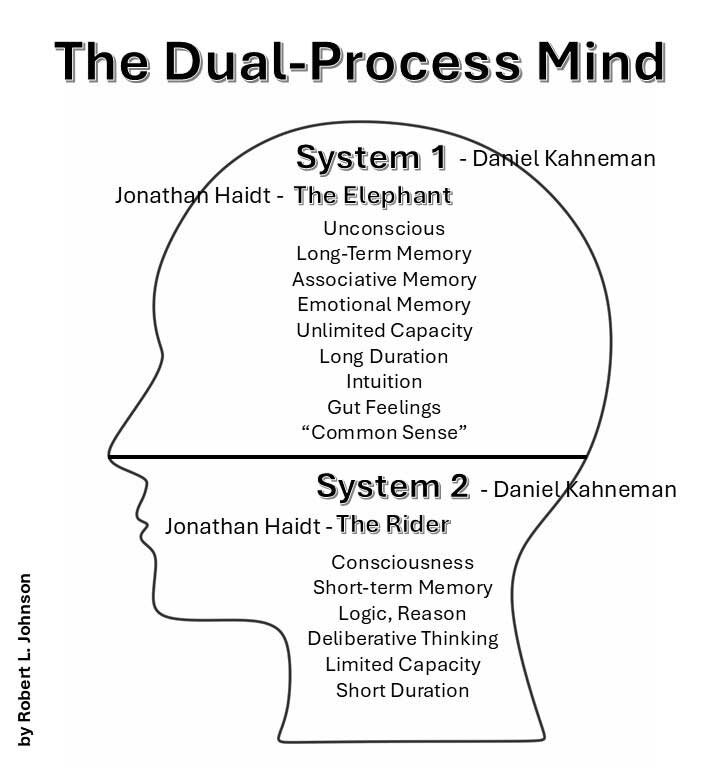
Because System 2 requires so much energy, our brains prefer to use System 1 whenever possible. We default to the quick, easy path. Cognitive biases are essentially the result of System 1 making a judgment call when the more analytical System 2 should have been engaged but wasn't. It's the mental equivalent of taking a well-worn path through the woods instead of charting a new, more accurate course.
Cognitive biases are predictable, systematic errors that arise from our brain's tendency to simplify information processing.
An Evolutionary Hangover
Why would our brains be wired to make these errors? The answer lies in our evolutionary past. For our ancestors living in a world full of immediate threats, making a fast decision was often more important than making a perfectly accurate one.
Imagine an early human hearing a rustle in the bushes. It could be a predator, or it could be the wind. Taking the time to slowly analyze the situation (using System 2) could be fatal. The person who instinctively assumes it's a threat and runs away (a System 1 reaction) is more likely to survive and pass on their genes. A bias toward assuming the worst in ambiguous situations was a valuable survival trait.
In the modern world, we face fewer life-or-death threats, but our brains still operate with the same ancient software. The mental shortcuts that kept our ancestors alive now influence our decisions about everything from financial investments to social interactions. What was once a life-saving adaptation can now be a hindrance to clear, rational thought.
Understanding this foundation is the first step. By recognizing that these biases are a fundamental part of how our minds work, we can begin to see their subtle but powerful influence on our daily lives.