Understanding Circular Motion
Introduction to Circular Motion
Moving in Circles
An object in circular motion follows a path shaped like a circle. Think of a satellite orbiting the Earth, a car navigating a roundabout, or the tip of a clock's second hand. In each case, the object is constantly turning, tracing a circular route.
Circular motion is the movement of an object along the circumference of a circle or rotation along a circular path.
This type of motion can be broken down into two main categories: uniform and non-uniform. The difference comes down to one thing: speed.
| Type | Speed | Velocity |
|---|---|---|
| Uniform Circular Motion | Constant | Changing |
| Non-Uniform Circular Motion | Changing | Changing |
In uniform circular motion, the object moves at a constant speed. Imagine a car driving on a circular track with its speedometer locked at 30 miles per hour. In non-uniform circular motion, the object's speed changes. This would be like our car on the track speeding up or slowing down.
Constant Speed, Changing Velocity
Here’s a tricky but important point. Even when an object moves at a constant speed in a circle, its velocity is always changing. How can that be? Remember that velocity is a vector, meaning it has both speed (magnitude) and direction. In circular motion, the direction of travel is constantly changing.
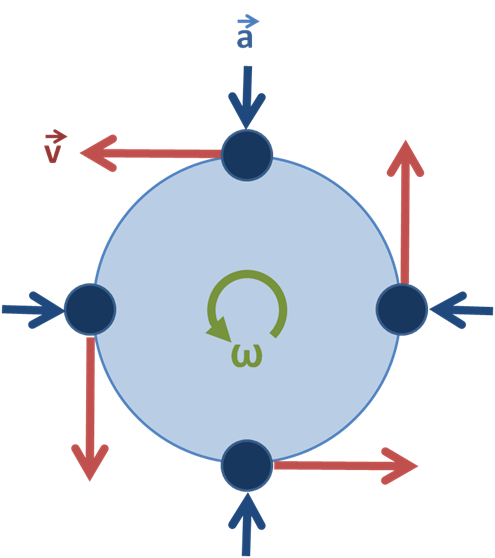
At any point on the circle, the object's velocity is tangent to the path. One moment it's heading north, the next it's heading northwest, then west, and so on. Because the direction is continuously changing, the velocity is too.
Acceleration Toward the Center
Whenever an object's velocity changes, it is accelerating. Since an object in circular motion is always changing its direction, it is always accelerating, even if its speed is constant.
This change in direction leads to centripetal acceleration, which always points toward the center of the circle.
This inward-facing acceleration is called centripetal acceleration. The word "centripetal" means "center-seeking." Its job is to continuously pull the object's velocity vector inward, forcing it to follow the curved path instead of flying off in a straight line.
centripetal acceleration
noun
The acceleration of an object moving in a circular path, directed toward the center of the circle, which is responsible for changing the direction of the velocity.
What causes this acceleration? A force, of course. For an object to maintain circular motion, there must be a net force acting on it that is directed toward the center of the circle. This is known as centripetal force.
Centripetal force keeps an object in circular motion.
It's important to understand that centripetal force isn't a new, fundamental force of nature. It's simply the label we give to the net force that causes circular motion. This force could be gravity holding a planet in orbit, tension in a string swinging a ball, or friction between tires and a road as a car makes a turn. Without this center-directed force, the object would obey its inertia and travel in a straight line.
What is the key difference between uniform and non-uniform circular motion?
A race car is driving around a circular track at a constant 100 mph. Which of the following statements is true?