Understanding Artificial Intelligence
Introduction to Artificial Intelligence
What Is Artificial Intelligence?
Artificial intelligence, or AI, is the science of making machines that can think and learn like humans. It's a broad field in computer science that aims to create systems capable of tasks that typically require human intelligence. This includes things like recognizing speech, making decisions, and translating languages.
Think of it this way: AI gives a computer the ability to interpret data, learn from it, and use that knowledge to achieve specific goals through flexible adaptation.
The scope of AI is vast. It's not just about futuristic robots. It powers many things we use daily, from the recommendation engine that suggests your next movie to the navigation app that finds the quickest route home. At its core, AI is about creating intelligence in a machine.
A Brief History of AI
The dream of creating intelligent machines isn't new; it has roots in ancient myths. But the scientific journey of AI began in the mid-20th century. The term "artificial intelligence" was first coined in 1956 at a workshop at Dartmouth College. Early researchers were optimistic, believing that a machine as intelligent as a human being was just a few decades away.
Early AI, often called Symbolic AI or "Good Old-Fashioned AI," was based on rules. Programmers would painstakingly write complex sets of if-then rules for the machine to follow. For example, to build a chess-playing AI, they would code rules based on the strategies of grandmasters. This approach worked well for well-defined, logical problems but struggled with the messiness of the real world, like understanding an image or a spoken sentence.
Symbolic AI was like giving a computer a detailed instruction manual for every possible situation. It was powerful but brittle; if it encountered something not in the manual, it failed.
By the 1980s and 90s, a new approach gained momentum: machine learning. Instead of feeding the computer rules, developers fed it data. The system would then learn the patterns and rules on its own. This was a major shift. Now, an AI could learn to recognize cats by analyzing thousands of cat photos, rather than by being fed explicit rules about what makes a cat a cat.
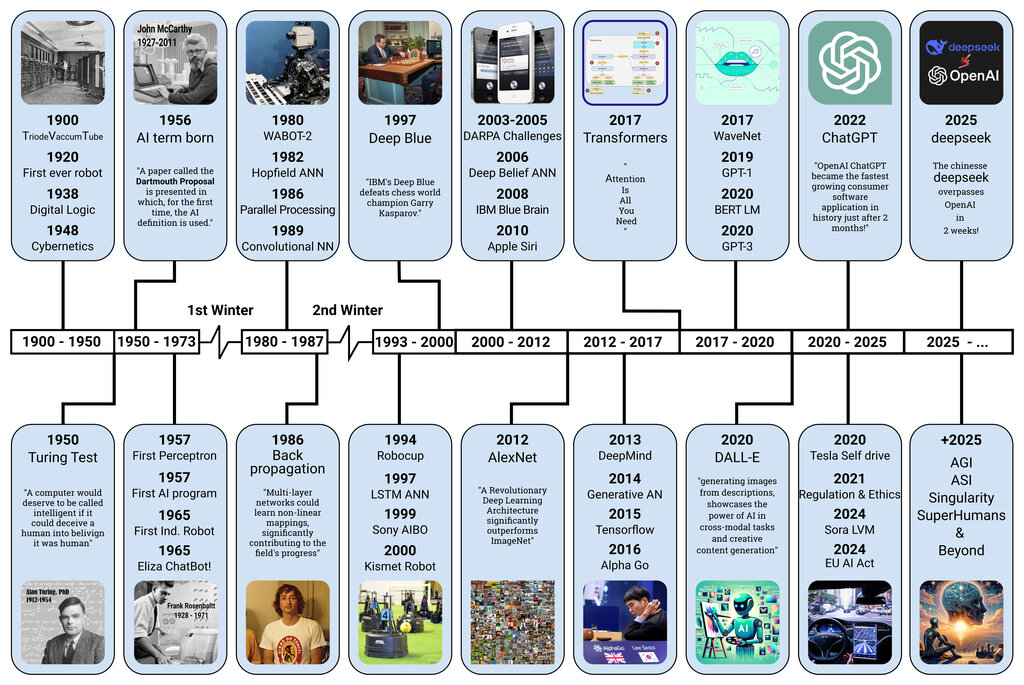
This transition from rule-based systems to data-driven learning is what unlocked the massive progress we see in AI today. Deep learning, a subfield of machine learning, took this even further by using complex structures called neural networks, leading to breakthroughs in vision, speech, and more.
A Field of Many Disciplines
AI isn't just one subject. It's an interdisciplinary field that sits at the crossroads of several major areas of study. Building intelligent machines requires more than just programming.
Here are the key players:
- Computer Science provides the foundational tools: algorithms, data structures, and the computational power to make AI possible.
- Cognitive Psychology helps us understand how the human mind works. By studying human intelligence, perception, and learning, we can get ideas for how to build artificial intelligence.
- Data Science is the practice of extracting knowledge and insights from data. Modern AI is heavily reliant on data, and data science provides the statistical methods and techniques to handle and interpret it.
Other fields like linguistics, philosophy, and neuroscience also play important roles, contributing ideas about language, logic, and the physical structure of the brain. This rich mix of disciplines is what makes AI such a dynamic and fast-evolving area.
Ready to check your understanding?
What is the primary goal of artificial intelligence?
How did early 'Symbolic AI', also known as 'Good Old-Fashioned AI,' primarily operate?
This introduction sets the stage for exploring the core principles and powerful applications of artificial intelligence.