Understanding Artificial Intelligence
Introduction to AI
Defining Intelligence, Artificially
Artificial Intelligence is the theory and development of computer systems able to perform tasks that normally require human intelligence. This includes things like visual perception, speech recognition, decision-making, and translation between languages. At its core, AI is about creating machines that can think, learn, and adapt.
Artificial Intelligence
noun
A branch of computer science dealing with the simulation of intelligent behavior in computers.
Think of it as a spectrum. On one end, we have Artificial Narrow Intelligence (ANI), which is designed for a specific task. Your spam filter, a chess-playing program, or a language translation app are all examples of ANI. They excel at their single purpose but can't operate outside it.
On the other end is Artificial General Intelligence (AGI), a type of AI that possesses the ability to understand, learn, and apply its intelligence to solve any problem, much like a human being. AGI is still the stuff of science fiction, but it represents the ultimate goal for many researchers in the field.
A Brief History of AI
The dream of creating intelligent machines is ancient, but the formal field of AI research began in the summer of 1956 at a workshop at Dartmouth College. It was there that the term "Artificial Intelligence" was coined. Early work was filled with optimism, focusing on problem-solving and symbolic methods.
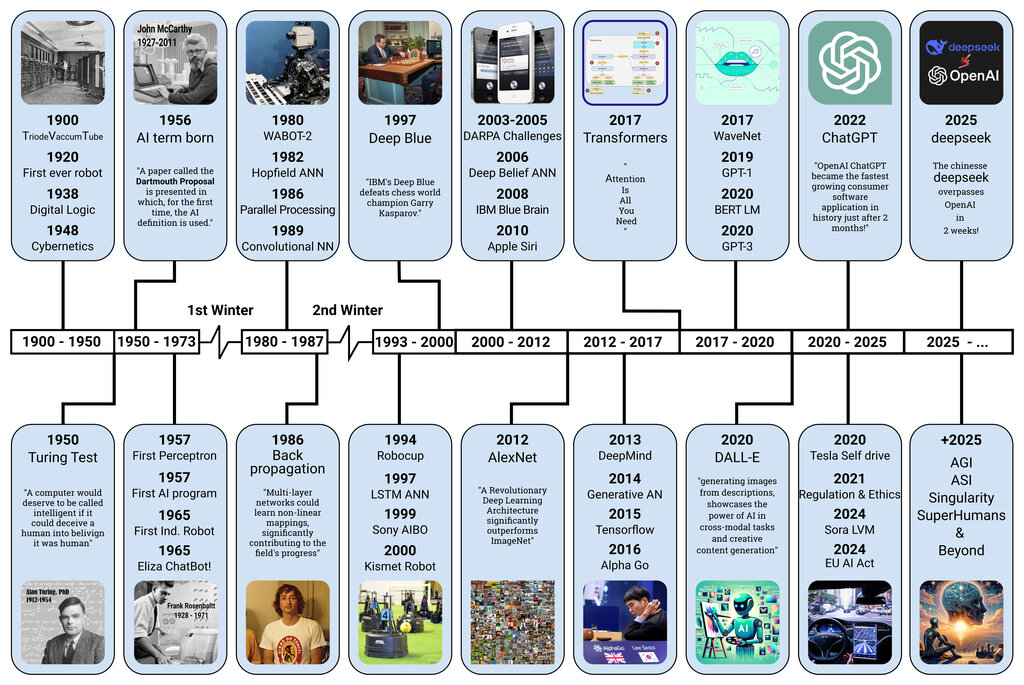
The path wasn't always smooth. The field experienced several "AI winters" in the 1970s and 80s, periods when funding dried up and interest waned due to the failure to meet overly ambitious promises. However, the 1990s and 2000s saw a resurgence. The explosion of big data and significant increases in computing power fueled the rise of a new approach: machine learning.
AI, Machine Learning, and Deep Learning
The terms AI, Machine Learning (ML), and Deep Learning (DL) are often used interchangeably, but they represent distinct concepts with a clear hierarchy. Think of them like Russian nesting dolls: AI is the largest doll, ML is a smaller doll inside it, and DL is the smallest doll inside ML.
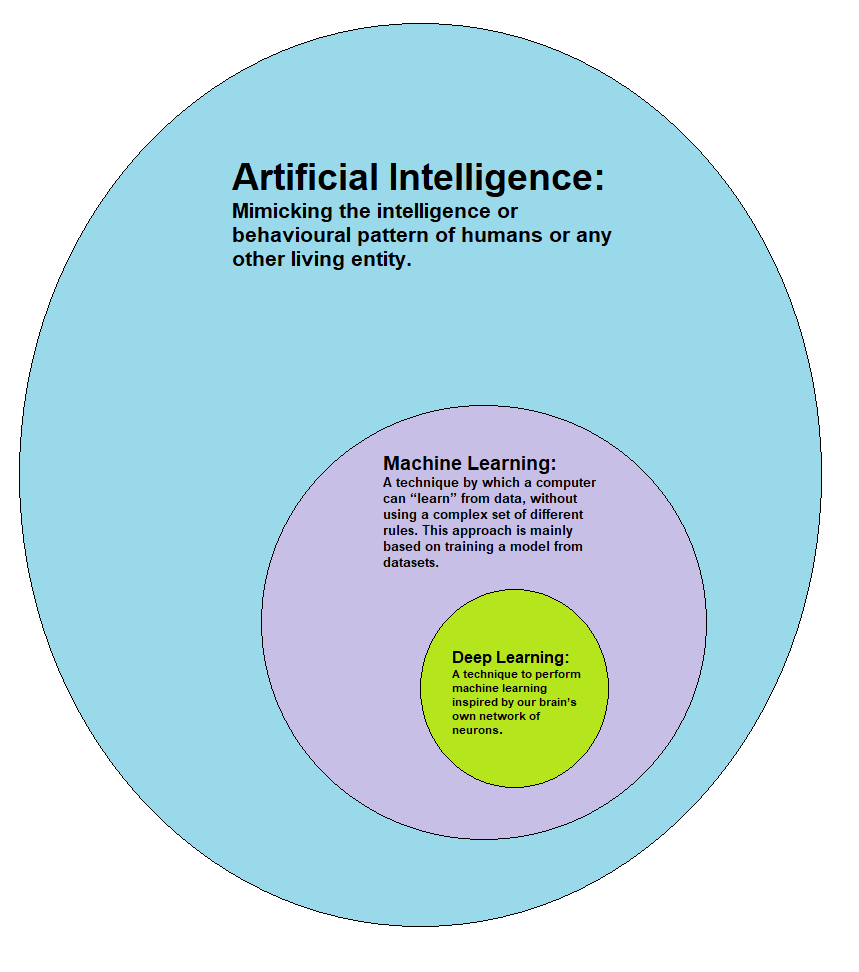
Artificial Intelligence is the all-encompassing concept of building smart machines.
Machine Learning is a specific approach to achieving AI. Instead of being explicitly programmed with rules, an ML system is trained on large amounts of data, learning to identify patterns and make decisions on its own. It's the engine that powers many of the AI applications we use today, from recommendation algorithms to fraud detection.
Deep Learning is a specialized type of machine learning that uses complex, multi-layered neural networks—structures inspired by the human brain. This depth allows it to learn from vast amounts of data and recognize intricate patterns, making it ideal for tasks like image recognition and natural language processing. The systems behind self-driving cars and advanced voice assistants are powered by deep learning.
| Feature | Artificial Intelligence (AI) | Machine Learning (ML) | Deep Learning (DL) |
|---|---|---|---|
| Scope | The broad concept of intelligent machines. | A subset of AI that learns from data. | A subset of ML using deep neural networks. |
| Core Idea | Simulating human cognitive functions. | Algorithms that parse data and learn. | Multi-layered networks for complex patterns. |
| Example | A robot that navigates a new environment. | A spam filter that adapts to new threats. | A system that identifies objects in a photo. |
Understanding these distinctions is key to navigating the world of AI. While AI is the goal, machine learning is the primary path we're currently taking to get there, and deep learning is one of the most powerful tools in our toolkit for the journey.
Which of the following best describes the relationship between Artificial Intelligence (AI), Machine Learning (ML), and Deep Learning (DL)?
A smartphone app that identifies a specific species of plant from a photo is an example of what type of AI?
With these foundational concepts in place, you're ready to explore the specific ways AI is changing our world.