Understanding Artificial Intelligence
Introduction to Artificial Intelligence
What Is Artificial Intelligence?
At its core, Artificial Intelligence is a field of computer science dedicated to creating machines that can perform tasks that typically require human intelligence. This includes abilities like learning from experience, solving problems, understanding language, and recognizing objects.
Think of it this way: traditional software follows explicit instructions written by a programmer. AI systems, on the other hand, can often figure out the instructions for themselves by analyzing massive amounts of data.
Artificial Intelligence
noun
The theory and development of computer systems able to perform tasks that normally require human intelligence.
AI isn't a single technology. It's a broad umbrella that covers many different approaches and subfields. You've likely heard terms like Machine Learning and Deep Learning. These are specific ways to achieve artificial intelligence. Machine Learning is a subset of AI, and Deep Learning is a further subset of Machine Learning.
A Quick Trip Through Time
The dream of intelligent machines is ancient, but the formal field of AI research began in the mid-20th century. The term "artificial intelligence" was officially coined in 1956 at a workshop at Dartmouth College. This event brought together the founding fathers of the field and kicked off decades of exploration.
The early years were filled with excitement. Researchers developed programs that could solve algebra problems and prove theorems. But the initial optimism soon ran into limitations in computer power and data. This led to periods known as "AI winters," when funding and interest dwindled because progress had stalled.
A major turning point came in 1997 when IBM's Deep Blue, a chess-playing computer, defeated the world champion Garry Kasparov. This was a landmark achievement for machine learning, an approach where systems learn patterns from data rather than being programmed with rigid rules.
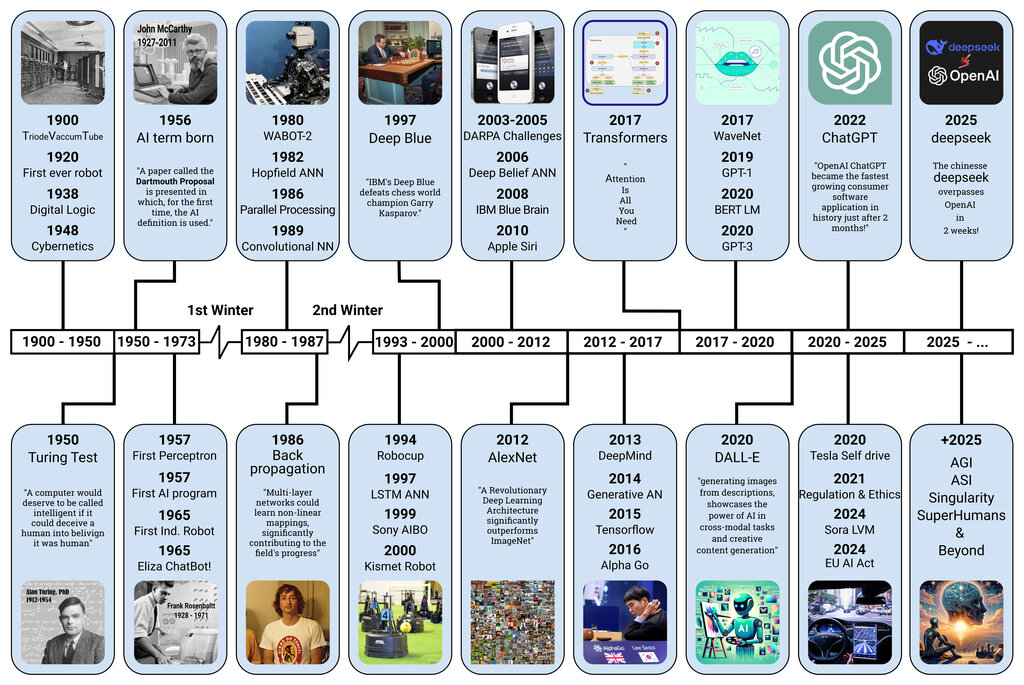
The last two decades have seen an explosion in AI capabilities, largely driven by three factors: the availability of vast amounts of data (big data), the development of powerful computing hardware (like GPUs), and breakthroughs in deep learning algorithms.
The Building Blocks
To understand modern AI, you need to grasp a few core concepts. As we saw in the diagram, Machine Learning and Deep Learning are central to how AI works today.
Machine Learning (ML) is the process of teaching a computer to make predictions or decisions by feeding it data. Instead of programming it with rules, you show it thousands of examples. For instance, to build a spam filter, you'd show it millions of emails labeled as "spam" or "not spam," and it would learn to identify the patterns on its own.
Deep Learning is a specialized type of machine learning that uses structures called neural networks. These networks are inspired by the human brain, with many layers of interconnected "neurons" that process information. Deep learning is particularly good at finding complex patterns in large datasets, which is why it excels at tasks like image recognition and natural language processing.
The fuel for both ML and Deep Learning is training data. This is the collection of examples—images, text, numbers—that the AI system learns from. The quality and quantity of this data are crucial for building an effective AI model.
Now, let's check your understanding of these fundamental concepts.
Which statement best describes the relationship between Artificial Intelligence (AI), Machine Learning (ML), and Deep Learning (DL)?
What were the periods of reduced funding and interest in artificial intelligence research known as?
Understanding these basics provides a solid foundation. You now know what AI is, where it came from, and the key ideas that power it.